Direction Test
Questions on directions are standard ones that are asked in most aptitude exams, hence are a common component in the study of reasoning. As the name itself suggests, questions about directions would involve reasoning based on the eight directions on a map - viz: north, northeast, east, southeast, south, southwest, west and northwest.
This question type requires a student to visualise these directions and the movement of an individual/relative positioning of places on a map.The key skills involved in solving questions based on directions are the following:
(i) The ability to understand and interpret the clues written in plain language in terms of what it means direction wise
(ii) The ability to order the clues in the correct order of usage (as explained in the theory of logical reasoning)
(iii) The ability to understand basic mapping concepts like what are the basic directions, what direction one would start facing if one turns right while going north or for that matter even what direction one would be facing if one turns 45o right while moving southwards, etc.
(iv) The ability to create a picture to represent the flow as mentioned in the problem Illustrated below are the solutions to a few typical questions on directions. We would urge you to first have a look at the questions and try to solve the same on your own before looking at the solutions provided.
Example 1
Direction for Questions 1 to 3: Answer the questions based on the following information.
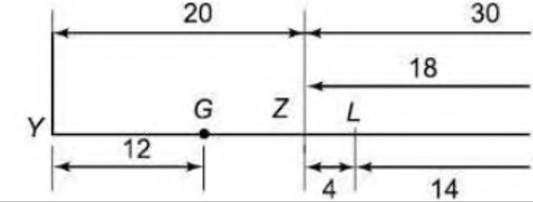
The city K is 30 km to the southeast of Z while Y is 50 km to the northwest of K. Also, H is 38 km to the southeast of Y. L lies in the direct route between Y and K and its distance from H is 14 km. G also lies on this route and is exactly midway between L and Y.
1. A car starting from K at 9 am and running at a constant speed towards Y reaches H at 9.24 am and then reaches G at
(a) 9.18 am (b) 10.16 am
(c) 10.36 am (d) 10.42 am
2.
If M is 1 km to the southeast of L, then it is exactly midway between(a) H and L (b) Y and K
(c) H and Z (d) None of these
3. The distance from G to H is
(a) 26 km (b) 24 km
(c) 12 km (d) 16 km
Solutions to Example 1
The figure below shows the respective positioning of the cities K, H, L, Z, G and Y.
From the figure we can deduce the answers using the following thinking:
(1) The car covers K to H—a distance of 12 kms in 24 minutes according to the figure (starting at 9 am and reaching at 9:24 am). From H to G, the distance is 26 kms. (18HtoZ + 8Zto G). Since the car has covered 12 kms in 24 minutes, it is obvious that it is taking 2 minutes to cover 1 km. We also know that the speed of the car is constant throughout. Hence, the car would take another 52 minutes to cover the 26 km distance between H to G. This means that the car would reach G at 10:16 am (52 minutes after 9:24 am). Hence, Option (b) is correct.
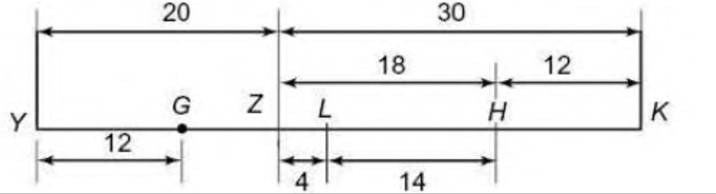
(2) The total distance between Y and K is 50 km (20 km from Y to Z and 30 km from Z to K). If M is 1 km southeast of L, it means that M is 4+1 =5 km from Z. This would also mean that M is 25 km from Y Hence, M would be exactly midway between Y and K. Option (b) is correct.
(3) G to Z, the distance is 8 km (20 km from Y to Z - 12 km from Y to G). Further, from Z to H the distance is 18 km (from the figure based on the logic that if H is 38 km southeast of Y and Z is 20 km southeast of Y, the distance from Z to H would be 38-20).
Total distance would be 8 + 18 = 26 km. Option (a) is correct.
Example 2
Direction for Questions 4 to 6: Refer to the table given below.
There are six cities viz., Amsterdam, Bhubaneshwar, Calgary, Denver, El Dorado and Frankfurt. Their positions with respect to one another on a map are described through the five clues given below.
Calgary is to the south OfFrankfurt, but to the west of Denver.
Frankfurt is to the south of El Dorado which is east of Denver.
Amsterdam is south OfBhubaneshwar which is west OfFrankfurt.
El Dorado is south of Amsterdam which is west of Calgary.
Denver is south OfFrankfurt which is west of Amsterdam
4. Which of the following are situated to the northeast of at least one other city?
(a) Bhubaneshwar, Amsterdam and El Dorado
(b) Amsterdam and El Dorado
(c) Bhubaneshwar, Amsterdam
(d) Amsterdam, Frankfurt and Denver
5. Which of the following are to the northeast OfFrankfurt?
(A) Amsterdam (B) El Dorado (C) Calgary
(a) A only (b) B only
(c) A and C (d) A and B
6. Which of the following statements cannot be derived from the given information?
(a) Bhubaneshwar is to the west of Amsterdam.
(b) Denver is to the south of Amsterdam.
(c) Denver is to the south of Calgary.
(d) Amsterdamis to the west of El Dorado.
Solutions to Example 2
It can be concluded that the northsouth distribution of the cities would be one of the following:
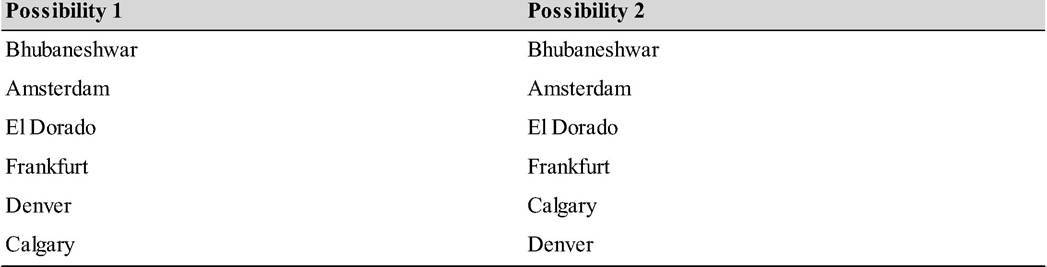
The eastwest placement would be as follows:
| Bhubaneshwar | Frankfurt | Amsterdam | Calgary | Denver | El Dorado |
The grid possibilities based on these two arrangements would be as follows:
Possibility 1:
| Bhubaneshwar | |||||
| Amsterdam | |||||
| El Dorado | |||||
| Frankfurt | |||||
| Denver | |||||
| Calgary |
Possibility 2:
| Bhubaneshwar | |||||
| Amsterdam | |||||
| El Dorado | |||||
| Frankfurt | |||||
| Calgary | |||||
| Denver |
Based on these we can answer the questions as follows:
4.
Looking at the above tabular picture of the placement of the cities as northsouth or eastwest, we can see that El Dorado and Amsterdam are the only cities that satisfy this condition. Denver and Calgary could be northeast to each other depending on which possibility we consider—in Possibility 1 Calgary is not northeast of any city and hence we can eliminate the possibility of Calgary being northeast of at least one other city. Similarly on the basis of Bhubaneshwar being west most cannot be to the northeast of any city (as Denver would. Option (2) is correct.5. Both A and B. Hence, Option (d) is correct.
6. Option (c) cannot be concluded from the information as we cannot decide on the northsouth placement between Calgary and Denver.
Example 3
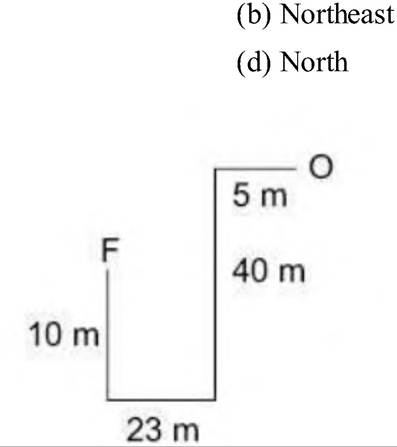
1. Jack runs IOm south from his flat, turns left and walks 23 m, again turns left and walks 40 m, then turns right and walks 5 m to reach his office. In which direction is the office from his house?
(a) East
(c) Southwest
Solution to Example 3
When we will look from F (Flat) to O (office) in the figure it can be observed that the direction is northeast. Option (b) is correct.
Example 4
2. I am facing north. I turn 90o in the clockwise direction and then 135o in the same direction and then 270o anti-clockwise. Which direction am I facing now?
(a) southwest (b) south
(c) west (d) northwest
Solution to Example 4
After turning 90o I am looking in the east direction, then after turning 135o in the same direction I would be facing the southwest direction. At last after turning 270o anticlockwise I would be facing the northwest direction. Option (d) is correct.
Example 5
Two cars start from the opposite points of straight part of the National Higway 8, 100 km apart. The first car runs for 20 km. It then takes a detour—takes a right turn goes straight for 15 km.
It then turns left, runs for another 25 km and then takes the straight connecting road to reach back on the main road. In the meantime, due to a minor breakdown, the other car has run only 35 km along the main road. What would be the distance between the two cars at this point?(a) 20 km (b) 30 km
(c) 45 km (d) 10 km
Solution to Example 5
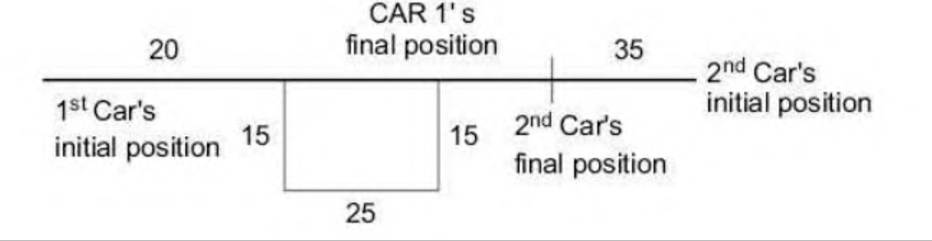
From the above figure it is clear that Car 1 would move 45 kms along the highway while Car 2 would run 35 kms along the same highway. Naturally, the distance between the two cars at this time would be 20 km. Option (a) is correct.
Example 6
A messenger was returning to his base station which was in front of him to the north. When his base station was 100 m away from him, he turned to the left and moved 50 m to deliver the last message to the Peshwa’s troops. He then moved in the same direction for 40 m, turned to his right and moved 100 m. How many meters away he was now from his base station?
(a) 0
(b) 150
(d) 100
(c) 90
Solution to Example 6
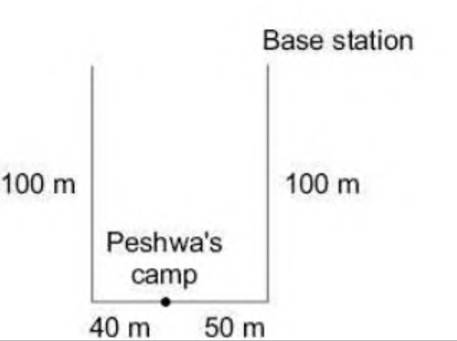
Option (c) is correct.
EXERCISE
Direction for Questions 1 to 4: Answer the questions independent of each other.
1. A watch in Huckleberry Finn’s house reads 4∙30. If the minute hand points towards the West, in which direction does the hour hand point?
(a) Northeast (b) Southwest
(c) Northwest (d) North
2. Hanuman, while looking for the Sanjeevani booty travels 3 km to the west, turns left and goes 3 km, turns right and goes 1 km, again turns right and goes 3 km How far is he from the starting point?
(a) 7 km (b) 6 km
(c) 5 km (d) 4 km
3. Raveena walks 10 km south from her house, turns left and walks 25 km, again turns left and walks 40 km, then turns right and walks 5 km to reach her office. In which direction was the office from her house?
(a) Southwest (b) Northeast
(c) East (d) North
For the above question, what is the distance of her office Ifomher home?
(a) 30 (b)30¥21/2
(c) 45 ¥ 21/2 (d) None of these
Directions for Questions 5 to 9: These questions are based on the diagram given below showing four persons Amar, Bhushan, Chandu and Dilip stationed at the four corners of a square piece of plot as shown.
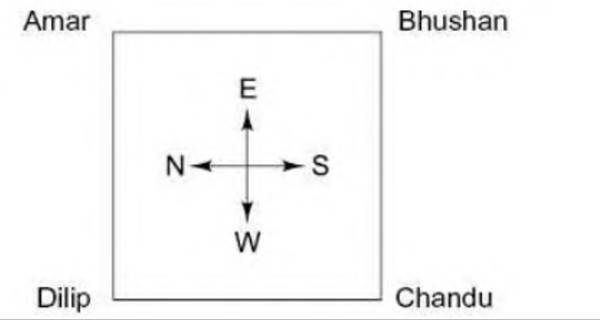
5.
Amar starts crossing the plot diagonally. After walking half the distance, he turns right (900), walks some distance and turns left. Which direction is A facing now?(a) Northeast (b) North
(c) Northwest (d) Southeast
6. From the original position given in the above figure, Amar and Chandu move one side length clockwise and then cross over to the corner diagonally opposite; Bhushan and Dilip move one side length anticlockwise and cross over to the corner diagonally opposite. The original configurations Amar-Bhushan-Chandu- Dilip (ABCD) has now changed to
(a) CBDA (b) DCBA
(c) BDAC (d) ACBD
7. From the original position, Bhushan and Dilip move one and a half length of sides clockwise and anti-clockwise respectively. Which one of the following statements is now true?
(a) Bhushan and Dilip are both at the midpoints between Amar and Chandu.
(b) Bhushan is at the midpoint between Amar and Chandu, and Dilip is at the corner originally occupied by Amar.
(c) Dilip is closer to Amar than he is to Chandu and Bhushan is closer to Chandu than he is to Amar.
(d) Dilip is closer to Chandu than he is to Amar and Bhushan is closer to Amar than he is to Chandu.
8. From the positions in the original figure, Bhushan and Amar move diagonally to opposite corners and then one side each clockwise and anticlockwise
respectively. Chandu and Dilip move three sides each anticlockwise and clockwise respectively. Where is Amar now?
(a) At the northwest corner
(b) At the southeast corner
(c) At the northeast corner
(d) At the southwest corner
9. After the movements given in the above questions, who is at the northwest comer?
(a) Amar (b) Chandu
(c) Bhushan (d) Dilip
10. A road network has parallel and perpendicular roads running northsouth or eastwest only. JunctionsZIntersections on this road network are marked as A, B, C, D... All roads are at exactly half a kilometer distance from each other. The following is known about junctions A, B, C, H and X.
‘A’ is east of ‘B’ and west of ‘C’, Ή’ is southwest of ‘C’ and southeast of B. ‘B’ is southeast of ‘X’. Whichjunctions are the farthest south and the farthest east?
(a) H, B (b) H, C
(c) C, H (d) B, H
11. The Suvarna Rekha river flows from west to east and on the way turns left and goes in a quarter circle around a Shiv temple, and then turns left in right-angles. In which direction is the river finally flowing?
(a) North (b) South
(c) East (d) West
Directions for Questions 12 to 14: Read the situation given below to answer these questions.
j, k, 1, m, n, o, p, q and r are nine huts. 1 is 2 km east of k. j is 1 km north of к and q is 2 km southofj. p is 1 km west of q while mis 3 km east of p and о is 2 km north of p. r is situated just in middle of k and 1 while n is just in middle of q and m.
12. Distance between k and 1 is:
(a) 2 km
(c) 5 km
(b) 1 km
(d) 1.5 km
13. Distance between к and r is:
(a) 1.41 km
(b) 3 km
(d) 1 km
(c) 2 km
14. Distance between p and q is:
(a) 4 km
(c) 1 km
(b) 2 km
(d) 3 km
Directions for Questions 15 to 19: Study the following information carefully to answer these questions.
All the streets of a city are either perpendicular or parallel to one another. The streets are all straight. Streets N, O, P, Q and R are parallel to one another. Streets S, T, U, Y W, X and Y are parallel to one another.
(i) Street Nisl km east of Street O.
(ii) Street O is 1/2 km west of Street P.
(iii) StreetQis 1 IcmwestofStreetR.
(iv) Street S is 1/2 km south of Street T.
(v) Street Uisl km north of Street V.
(vi) Street W is 1/2 km north of Street X.
(vii) Street Wisl km south of Street Y.
15. If W is parallel to U and W is 1/2 km south of V and 1 km north of T, then which two streets would be 1&1/2 km apart?
(a) U and W
(с) V and T
(b) VandS
(d) WandV
16. Which of the following possibilities would make two streets coincide?
(a) X is 1/2 km north of U
(b) P is 1 km west of Q
(c) Q is 1/2 km east of N
(d) R is 1/2 km east of O
17. If street R is between O and P, then distance between N and Q is:
(a) 1/2 km (b) 1 km
(c) 1.5 km (d) 1.5-2 km
18.
IfR is between O and P, then which of the following is false?
a) Q is 1.75 km west of N
(b) P is less than 1 km from Q
(c) R is less than 1 km from N
(d) Q is less than 1 km from O
19. Which of the following is necessarily true (given the basic clues)?
(a) R and O intersect
(b) Q is 2 km west of O
(c) Q is at least 2 km west of N
(d) Y is 1.5 kmnorthofX
20. Usain runs 100 m south from his house, turns left and runs 250 m, again turns left and runs 400 m, then turns right and runs 50 m to reach to the stadium. In which direction is the stadium from his house?
(a) Southwest (b) Northeast
(c) East (d) North
21. The front door of Kiran’s house is towards the south. Fromthe backside of her house she walks 50 metres straight then turns towards the left and walks 100 metres and after that turns right and stops after walking 100 metres. Now Kiran is facing which direction?
(a) East (b) South
(c) West (d) North
22. A boy starts walking straight towards the north and walks 10 feet, then he turns to his left and walks 5 feet, then he turns to his left and walks another 5 feet, then again he turns to his left and walks 10 feet and then he turns to his right and walks 2 feet. How far is he now from his starting point?

23. A policeman goes 20 km east and then turning to the south he goes 30 km and then again turns to his left and goes 10 km. How far is he from his starting point?
(a) 30 km
(c) 10 km
(b) 20 km
(d) 40 km
24. I walk 1 km to my east then I turn to the south and walk for 5 km Next, I turn east
and walk 2 km. After this I turn to the north and walk for 9 km How far am I Hij1SKfti starting point? (b)4km
(c) 6 km (d) Can’t be determined
25. A man walks 5 metres straight and then 10 meters to the right. After this he continuously turns left and every time walks 10, 5 and 10 meters respectively. How far is he now from his starting point?

26. Karan’s house is south facing. From the front door of his house Karan started walking and after walking 20 metres straight he turned to his left and walked 50 metres. After this he turned to his right and walked 80 metres. Find the distance between the point from where he finished his walk and the door of his house.

27. A man started walking towards north, he walks 10 metres and then turns to his right, walks 5 metres and turns to his right again and walks 10 metres and turns to his left, walks 7 metres and then turns to his right. At this point in which direction is he facing?
(a) East (b) South
(c) Southeast (d) Southwest
28. If Southeast becomes east and Northwest becomes west and all the other directions are changed in the same direction. Then what will be the direction for north?
(a) Northwest (b) Southeast
(c) Southwest (d) Northeast
29. If Northwest becomes south and southwest becomes east and all the other directions change in the similar manner, then what will be the direction for north?
(a) Southeast
(c) North
(b) Northeast
(d) None of these
30. At a crossing there was a direction pole, which was showing all the four directions in correct manner. But due to wind it turns in such a manner that now west pointer is showing South. A man went to the wrong direction thinking that he was traveling East. In what direction he was actually traveling?
(a) South (b) West
(c) North (d) Can’t say
31. A direction pole at a crossing, due to an accident turns in such a manner that now east pointer is showing southwest. A traveler went to wrong direction thinking that he was travelling south. In what direction was he actually traveling?
(a) Southwest (b) Westnorth
(c) Northeast (d) Eastsouth
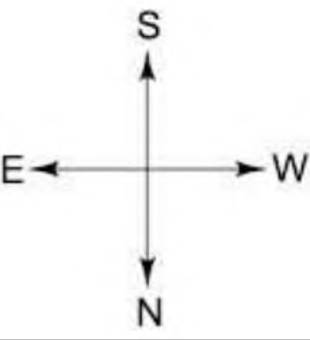
32. Aman, Raman, Saman and Chaman are standing on the four corners of a square carpet as shown in the figure here.
Aman starts walking towards Saman diagonally. After walking half the diagonal he turns to his left. What direction is Aman facing now?
(a) Northwest (b) East
(c) South (d) Southeast
33. If Ram is in the West of Shyam and Kareem is in the North of Shyam, in what direction is Kareem with respect to Ram?
(a) Northeast (b) Southwest
(c) Northwest (d) Southeast
Directions for Questions 34 to 34: Alok starts walking from his school toward his house as shown in the figure here. He starts from the front gate of his school, walks 5 km, turns left, walks 2 km, then turns left again and walks 4 kms, then he turns to his right and walks 3 km and then turns left, walks 1 km and then turns to his left again to walk 4 km and then to his right and walks 10 km and finally turns right, walks 3 km and thus reaches the front gate of his house.
34. If Alok’s house is southfacing, in which direction did he start walking?
(a) West
(b) North
(c) South
(d) None of these
35. Alok’s house is in what direction with respect to his school?
(a) Northwest
(b) Southwest
(c) South
(d) Cannot be determined
Answer Key
| l.(a) | 2. (d) | 3. (b) | 4. (b) |
| 5. (d) | 6∙(b) | 7. (c) | 8. (b) |
| 9. (b) | 10. (b) | H. (a) | 12. (a) |
| B. (c) | 14. (c) | 15. (a) | 16. (d) |
| 17. (d) | 18. (b) | 19. (b) | 20. (b) |
| 21. (d) | 22. (c) | 23. (c) | 24. (a) |
| 25. (c) | 26. (a) | 27. (b) | 28. (a) |
| 29. (d) | 30. (c) | 31. (c) | 32. (d) |
| 33. (a) | 34. (d) | 35. (d) |
More on the topic Direction Test:
- Direction Test
- Index
- ILLUSTRATION 2
- References
- B Scientific Versus Statistical Hypotheses
- Level of Difficulty (LOD)—III
- Control of BTB in Ethiopia
- STRABISMUS (SQUINT)
- Maintaining Effective and Professional Relationships with Witnesses
- Preface