Fitting Models
Now assume the language is not modal, but involves justification terms as in Section 2.2. Fitting models have a special piece of machinery, syntactic in nature and tracing back to Mkrtychev (1997): an evidence function.
This function, 6, maps justification terms and formulas to sets of possible worlds. Think of Γ є 6(t, X) as saying that at possible world Γ, t is relevant evidence for the truth of X. Informally, relevant evidence need not be conclusive. For example evidence that might be admitted in court, whose truth can then be discussed during the court proceedings, is relevant evidence. As another example, consider the findings of an expert who is knowledgeable and whose opinion must be taken into account, but who is fallible. The informal idea Fitting models embody is that to say t:X is so is to say that X is a necessary truth and t is relevant evidence for it.Definition 4.1 (Fitting Model) A Fitting model for a justification logic is a  tion 4.1, and E is an evidence function. Conditions for truth functional connectives are the same as for Kripke models—Boolean at each possible world. The possibility operator condition, (7), is dropped. The necessity condition, (3), is replaced with the following.

With modal models various frame conditions are imposed: transitivity, symmetry, convergence, etc. This is done with Fitting models in exactly the same way. But in addition one also puts conditions on Fitting model evidence functions. Particular justification logics can have operations on justification terms that are not shared by other logics, but we have assumed + and ■ are always present axiomatically, and correspondingly we always require the following semantically:
Definition 4.2 (Minimum Evidence Conditions) In all Fitting models the evidence function must meet the following conditions.

The ■ condition can be read informally as follows. Any world at which s counts as relevant evidence for an implication and t counts as relevant evidence for the antecedent is a world where s ■ t is relevant evidence for the consequent. Likewise the + condition says that s + t is relevant evidence for something provided one of s or t is. These general conditions are quite reasonable, but as logics get more and more esoteric, informal readings of evidence conditions are harder to come by. Ultimately they are simply mathematical requirements, of course.
Constant specifications (Definitions 10.32, 2.6, and 2.6) will be required to hold universally, whenever imposed by the constant specification.
Definition 4.3 (Constant Specification Condition) We say a Fitting model wise a formula is valid in a class of Fitting models if it is valid in every member of the class. If JL is a justification logic and CS is a constant specification for it, we say a Fitting model M is a model for JL(CS) if all axioms of JL are valid in M and M meets CS. An induction on axiomatic proof length gives an easy verification that if M is a model for JL(CS) then all theorems of JL(CS) are valid in M.
Fitting models historically preceded modular models and have a structure similar to modular models, with similar closure conditions, but they differ in  ting model encodes a modular model with JYB over the same frame and with the same truth evaluation of formulas at each node (Artemov, 2012; Kuznets and Goetschi, 2012).
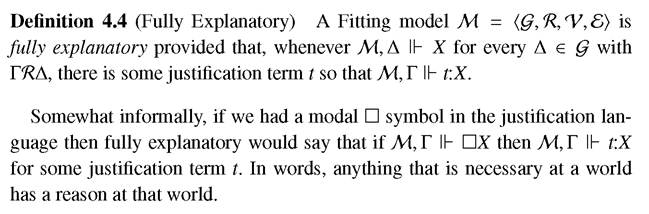
Two special conditions are often imposed on Fitting models: being fully explanatory, originating in Fitting (2003, 2005) and having a strong evidence function, originating in Rubtsova (2006a).
Definition 4.5 (Strong Evidence Function) Definition 4.1 for Fitting Models imposes two conditions: a Modal condition and an Evidence condition. 
If we have a Strong Evidence function, condition (30) from Definition 4.1 simplifies: Speaking informally, strong
evidence amounts to assuming that we are not dealing with mere relevant evidence, but with conclusive evidence.
Fully explanatory and strong evidence have quite different natures, and some general remarks are appropriate.
Being fully explanatory is attractive conceptually. Informally it says that necessary truths always have reasons. Still, despite its attractiveness no formal consequences of interest have yet been found. It is not a requirement on Fitting models and does not hold universally. Our completeness proofs use a justification logic analog of the familiar modal canonical model construction. These canonical justification models will always be fully explanatory provided we assume we have an axiomatically appropriate constant specification. In such cases we generally have soundness with respect to a set of Fitting models whether or not they are fully explanatory, but if X is not provable it will be falsifiable in a Fitting model that does have this feature.
Strong Evidence functions are quite another thing, however. Canonicaljus- tification models always have Strong Evidence functions, though for logics such as LP, Strong Evidence is not part of the characterization of LP model. But there are many examples of justification logics for which the natural class of Fitting models for them requires a Strong Evidence condition in order to establish soundness. A justification counterpart of S5 is such a case (Rubtsova, 2006a). This is the first such example known, but there are now many others for which strong evidence is needed to establish soundness. It can be quite difficult to actually exhibit particular models with strong evidence functions, though if such a condition is not needed, exhibiting a model is much less of a problem.
4.3
More on the topic Fitting Models:
- B The Big Data Mindset
- The Semantic View
- Wassily Leontief
- Abel A.B., Bernanke B., Croushore D.. Macroeconomics. 10th Edition, Global Edition. — Pearson,2021. — 690 pp., 2021
- THE THEORY AND PRACTICE OF EMPIRE-BUILDING
- The Keynesian System
- CHAPTER FOUR Town and Country Urban devotions and rural rituals
- Modern Economics
- REVIEW OF FORENSIC ASSESSMENT INSTRUMENTS