PREMISES—VARIOUS PATTERNS
A premise is defined as a proposition antecedently supposed or proved as a basis of argument or inference. In other words: something assumed or taken for granted.
Type 1: All A’s are B’s (Or No A is not B):
There are two possible Venn diagrams for this situation.
These are: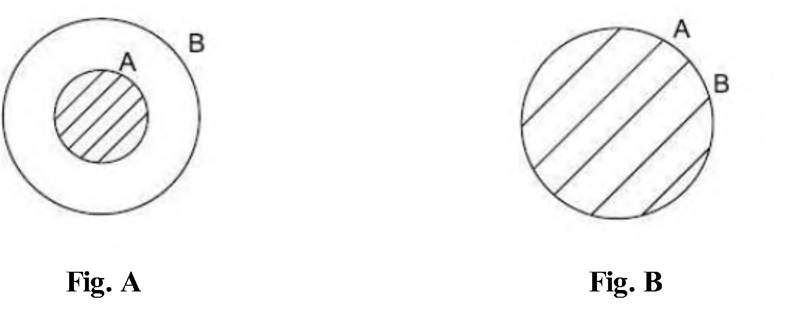
The following reactions to the premise All A ,s are B ,s are valid:
(a) Some B’s are A ,s. This is a definite conclusion.
This is true in both Figures A and B.
(b) Some B’s are not A’s. This is a probable conclusion and will occur only if the conclusion All B ,s are A ,s is not true.
Hence, it can be stated that iiAll A’s are B’s, then either All B’s are As (No B is Not A) or Some B’s are not A’s. As can be seen in the figures above, either Some B’s are not A’s (Figure A) or All B’s are A’s (as seen in Figure B).
Type 2: Some A’s are B’s
This premise is represented by the following figure:
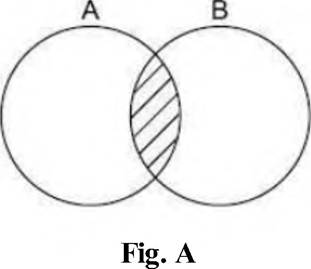
The valid reaction to this premise is:
Some B ,s are A ,s
This is a definite conclusion (as can be seen clearly in figure A above.)
Although the above figure also supports the conclusion —some B’s are not A’s, this cannot be taken as a definite conclusion. This is because, when we say that Some A s are B ,s, it does not mean that there have to be some B’s that are not A’s.
Type 3: No A is B
This premise is represented by the following figure:
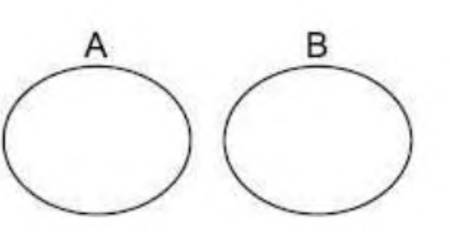
Fig. А
The conclusion M> B is ∠4 is a valid conclusion.
Type 4: Some A’s are not B’s (Or All A’s is not B’s)
There could be three possible VennDiagrams in this case, as shown below:
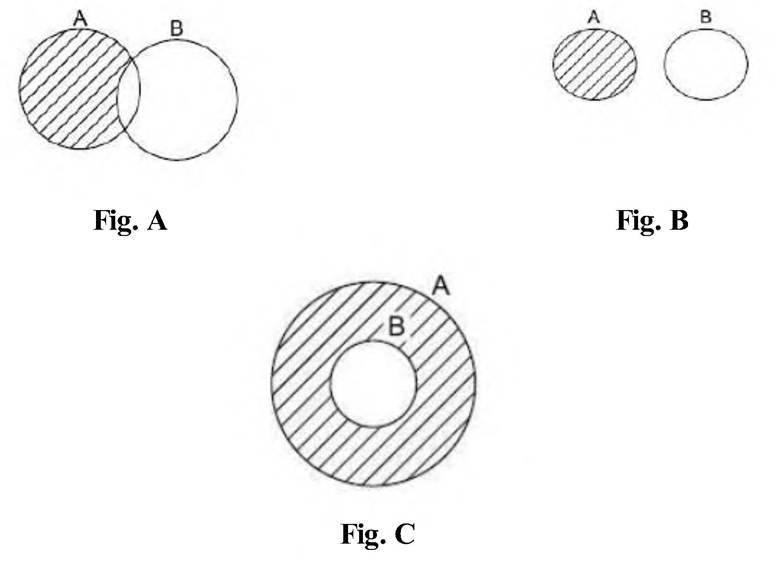
Q STANDARD PROCESS FOR SOLVING SYLLOGISM QUESTIONS
The most logical process of solving Syllogism questions is through Venn diagrams.
The following examples will make the process clear:SOLVED EXAMPLES
1. (A) All tigers lay eggs.
(B) All cats lay eggs.
(C) Some cats can fly.
(D) All tigers cannot fly.
(E) All tigers are cats.
(F) All tigers cannot swim.
(a) BEA (b) ABE
(c) DEC (d) ECB
In the above question, it can be clearly seen that the sequence BEA is the most appropriate since if all cats lay eggs is true and it is also true that all tigers are cats, then it will also be true that all tigers lay eggs.
2. (A) Some curtains are cloth.
(B) All cloth is wood.
(C) All that is wood is cloth.
(D) All cloth are curtains.
(E) All curtains are wood.
(F) Some curtains are wood.
(a) BED (b) BDF
(c) FAB (d) FBA.
BDF is the most logical sequence here since if we take B and D as the premises, then the curtains which are cloth, will also be wood.
The Venn Diagram for BD will look like this—
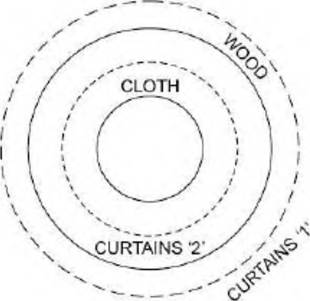
Hence, F is the correct conclusion.
3. (A) All balls are tails.
(B) Some tails are dolls.
(C) Some dolls are balls.
(D) Some tails are not balls.
(E) All tails are dolls.
(F) No tails are dolls.
(a) EAC (b) BCD
(c) ABC (d) EDC
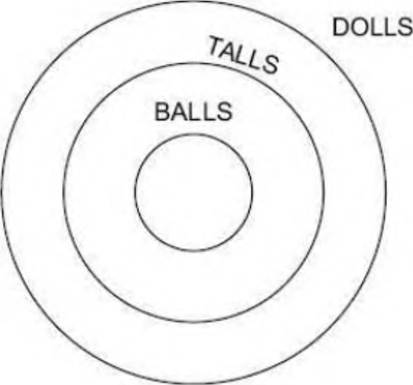
EA will give the following figure which will give C as the conclusion. Hence, the answer is (a).
4. (A) Some stone is bone.
(B) All slipper is bone.
(C) All bone is stone.
(D) No stone is slipper.
(E) No bone is stone.
(F) Some bone is slipper.
(a) BCA (b) AFE
(c) DEC (d) CEA
(CAT 1996)
(A) is the obvious answer here, since if all bone is stone(C), then obviously, some stone is bone(A).
5. (A) No rice is a pest.
(B) All pest is lice.
(G) Spine ric.e is lice.
(D) All rice is pest.
(E) All rice is lice.
(F) No rice is lice.
(a) BEF (b) FCB
(c) ABF (d) BDE
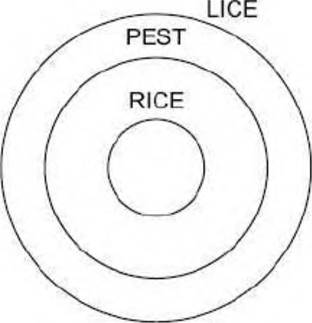
BDE will give the following Venn Diagram which makes E the correct conclusion for the premises BD.
6. For this question, you have to base your conclusion on the three
premises (viz: a, b and c). Identify the correct answer from amongst the options given to you:
Statements a.Some cakes are bikes
b. Some bikes are hills
c. All laptops are bikes
Conclusions I. All laptops are hills
II. Some laptops are cakes
III. Some cakes are hills
IV. Some laptops are not cakes
(a) Only I follows
(b) Only either II or IV follows
(c) Only I or III follow
(d) Only I and IV follows
(e) None of these
For the question above, the following Venn Diagram can be drawn:
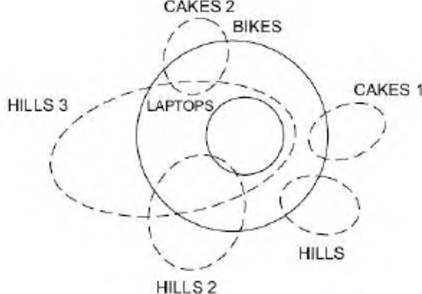
It is clear Ifomthe figure that the conclusion ‘All Laptops are Hills’ does not hold. Similarly, some Cakes are hills is also not necessarily true. If we take a look at II & Iλζ we can conclude that one of them has to be true. Hence, the answer is (b).
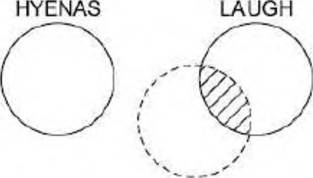
7. (A) No hyenas laugh. Some who laugh are lions. Some lions are not hyenas.
(B) All ghosts are red. Some ghosts do not dance. Some dancers are not red.
(C) Australians indulge in swearing. Those who swear are fined. Some who are fined are not Australians.
(D) Some Europeans are Spanish. All Europeans are British. Some British are Spanish.
(a) A and B (b) C only
(c) A and D (d) D only
The following Venn Diagram can made for the sequence A:
LIONS
Obviously, the lions who laugh are not hyenas. Hence, the conclusion is justified.
The following Venn Diagram will be made for the sequence D:
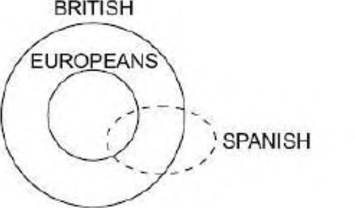
It is obvious that whatever circle we draw for Spanish (apart from the one shown) it will have to intersect the circle for Europeans.
This in effect, means that, it has also to intersect with the British circle. Hence, the conclusion that ‘Some British are Spanish’ is justified.8. (A) All Pakistanis are brave. All baskets are Pakistanis: All brave are baskets.
(B) No golfers are Asian. All golfers are athletic. Some Asians are pros.
(C) All burgers are chips. Some refreshments are burgers. Some refreshments are chips.
(D) Some bowlers are fast. All bowlers are spinners. Some spinners are fast.
(a) C and D (b) B and C
(c) A only (d) C only
The following Venn Diagram can be made for the sequence C:
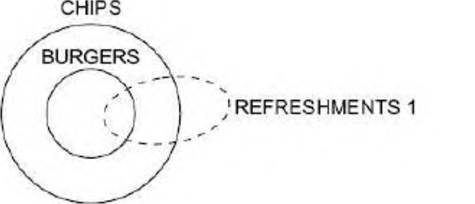
The conclusion for C is justified in exactly the same way as the one for the sequence D ofSolved Example 7.
The following Venn Diagram can be made for sequence D:
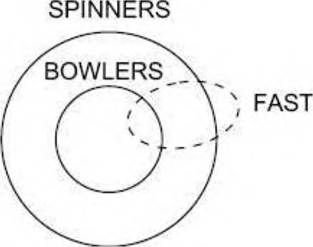
As is clear from the diagram above, the conclusion is justified on the basis of the same logic as for the last two diagrams.
More on the topic PREMISES—VARIOUS PATTERNS:
- PREMISES—VARIOUS PATTERNS
- LOGICAL DEDUCTIONS PREMISES— VARIOUS PATTERNS
- Conclusion
- Conclusion
- ARISTOTLE’S LOGIC
- SYMBOLS, FORMULAS, AND WFFS
- What is Culture's Relationship to Global Workplace Conflict?
- Relations between Disciplines
- SYMBOLS, FORMULAS, AND WFFS
- Culture-Based and Individually Flexible Identity as a Source of Intercultural Conflict