NUMERICAL PROBLEMS
1. Here are some balance of payments data:
Exports of goods, 100
Imports of goods, 125
Exports of services, 90
Imports of services, 80
Income receipts from abroad, 110
Income payments to foreigners, 150
Increase in home country's ownership of assets abroad, 160
Increase in foreign ownership of assets in home country, 200
Increase in home reserve assets, 30
Increase in foreign reserve assets, 35
Assuming that unilateral transfers equal zero, find net exports, the current account balance, the financial account balance, the balance of payments, and the statistical discrepancy.
(Note: The increase in home reserve assets of 30 is included in the increase in the home country's ownership of assets abroad of 160, and the increase in foreign reserve assets of 35 is included in the increase in foreign ownership of assets in the home country of 200.)2. In a small open economy, output (gross domestic product) is $25 billion, government purchases are $6 billion, and net factor payments from abroad are zero. Desired consumption and desired investment are related to the world real interest rate in the following manner:
| World Real | Desired | Desired |
| Interest Rate | Consumption | Investment |
| 5% | $12 billion | $3 billion |
| 4% | $13 billion | $4 billion |
| 3% | $14 billion | $5 billion |
| 2% | $15 billion | $6 billion |
For each value of the world real interest rate, find national saving, foreign lending, and absorption.
Calculate net exports as the difference between output and absorption. What is the relationship between net exports and foreign lending?much does it change? What is the connection between the government budget deficit and the current account balance?
10. In what periods has the United States had twin deficits? In what periods did the deficits move in opposite directions?
3. In a small open economy,
desired national saving, Sd = $10 billion
+ ($100 billion)rw;
desired investment, Id = $15 billion
— ($100 billion )rw; output, Y = $50 billion;
government purchases, G = $10 billion;
world real interest rate, rw = 0.03.
a. Find the economy's national saving, investment, current account surplus, net exports, desired consumption, and absorption.
b. Owing to a technological innovation that increases future productivity, the country's desired investment rises by $2 billion at each level of the world real interest rate. Repeat Part (a) with this new information.
4. Consider two large open economies, the home economy and the foreign economy. In the home country the following relationships hold:
desired consumption, Cd = 320 + 0.4(Y — T)
—200rw;
desired investment, Id = 150 — 200rw;
output, Y = 1000;
taxes, T = 200;
government purchases, G = 275.
In the foreign country the following relationships hold:
desired consumption, Cdor = 480 + 0.4(YFor — TFor)
-300rw;
desired investment, Idor = 225 — 300rw;
output, YFor = 1500;
taxes, TFor = 300;
government purchases, GFor = 300.
a. What is the equilibrium interest rate in the international capital market? What are the equilibrium values of consumption, national saving, investment, and the current account balance in each country?
b. Suppose that in the home country government purchases increase by 50 to 325.
Taxes also increase by 50 to keep the deficit from increasing. What is the new equilibrium interest rate in the international capital market? What are the new equilibrium values of consumption, national saving, investment, and the current account balance in each country?5. Consider a world with only two countries, which are designated the home country (H) and the foreign country (F). Output equals its full-employment level in each country. You are given the following information about each country:
Home Country
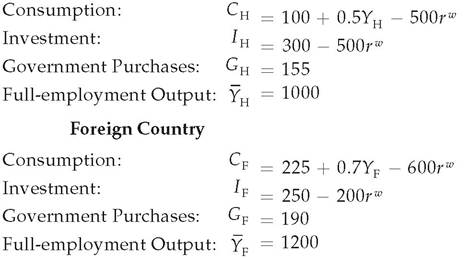
a. Write national saving in the home country and in the foreign country as functions of the world real interest rate rw.
b. What is the equilibrium value of the world real interest rate?
c. What are the equilibrium values of consumption, national saving, investment, the current account balance, and absorption in each country?
6. A small island nation is endowed with indestructible coconut trees. These trees live forever and no new trees can be planted. Every year $1 million worth of coconuts fall off the trees and can be eaten locally or exported to other countries. In past years the island nation ran current account surpluses and financial account deficits, acquiring foreign bonds. It now owns $500,000 of foreign bonds. The interest rate on these bonds is 5% per year. The residents of the island nation consume $1,025,000 per year. What are the values of investment, national saving, the current account balance, the financial account balance, net exports, GDP, and GNP in this country?
►
More on the topic NUMERICAL PROBLEMS:
- NUMERICAL PROBLEMS
- NUMERICAL PROBLEMS
- NUMERICAL PROBLEMS
- NUMERICAL PROBLEMS
- NUMERICAL PROBLEMS
- NUMERICAL PROBLEMS
- NUMERICAL PROBLEMS
- SALIENT FEATURES
- 8 The Keynesian Model of Income Determination in a Four Sector Economy: Introduction of the Foreign Sector
- INTRODUCTION TO REASONING IN THE XAT