Bond equivalent yield
To compare interest rates, yields are generally converted to annual rates, even for those instruments which mature in only a few days. Money market security yields are converted to an annualised rate called the bond equivalent yield.
If you receive £37.92 in interest on a three-month bank deposit (91 days) of £50,000 and want to know what annual rate (the bond equivalent yield, bey) this equates to:
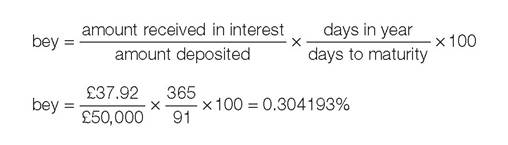
The bond equivalent yield we have calculated, 0.304193%, is simple annualised rate of return. It is not compounded, it is just (roughly) four lots of interest added up (one for each quarter of the year).
An alternative outcome might be that every three months you take your money (principal plus interest) and reinvest in the same deal at the same rate. Thus you can get interest on the accumulated interest as well as on the principal. If you reinvested the principal and accumulated interest every three months at this quarterly rate of return for a year you would receive:

This compound annualised rate of return is calculated by imagining that after the first 91 days the initial investment and the accrued interest, £50,037.92 are invested for a further 91 days, and so on each quarter.
The compound rate of return is slightly more than the simple annualised rate of return of 0.304193%:

Note that this is not entirely accurate because there are more than 4 ? 91 days in a year, so if you want to be really precise, a further small adjustment is necessary:
In a 365-day year the number of compounding periods is 365 ÷ 91 = 4.010989, thus to be really accurate the compound annualised rate of return is:

Thus, to my mind, there are two bond equivalent yields:
1 Simple annualised bey. This is the one most practitioners and books refer to and it is fine for comparing the rate offered on one money market security with another of the same time to maturity.
2 (What I'll call) compound annualised bey, but many people only use (1).
More on the topic Bond equivalent yield:
- Bond equivalent yield (bey) and discount (d) yield compared
- High-yield (junk) bonds
- INDEX
- Article 6.4 Loan terms eased in search for yield
- Sovereign bond risk and return
- Bond Market Development