STRUCTURAL FACTORS
Finally, structural factors support both technological and social factors that have helped the popularity of online lending in recent years. Strict banking regulation, mergers that lead to the disappearance of smaller banks, which decreased access to credit for consumers and SMEs, and a low interest rate environment are structural factors that have helped online lending gain ground.
3.3.1 Stricter banking regulation
The financial crisis of 2007/8 was a wake-up call for governments and regulators. It became clear that they had underestimated and ignored serious weaknesses in the financial sector. The outcry about banks that were too big to fail prompted regulators to tighten the screws. As a result, banks needed to comply with higher capital requirements and higher loan-to-deposit (LTD) ratios. However, results of stricter regulation are mixed: rising compliance costs strain even large banks. For example, according to its CEO Stuart Gulliver, HSBC spent about US$800 million in 2014 on its compliance and risk program, an increase of roughly US$200 million from the previous year. The bank's chairman, Douglas Flint, sees unprecedented demands from regulators, and notes that the compliance workload diminishes resources that would otherwise benefit consumers.12 Wells Fargo Bank added about 600 new employees to its risk management team to comply with increased regulation. Yet it is the smaller banks that suffer especially under the increased demands. Many of them claim that the current compliance reforms are unfairly applied, with the result that some of the smaller banks have had to double their compliance teams to keep up with regulations.13
Because most online lending platforms are non-banks, many regulations are of little concern to them, at least for the time being. While banks struggle to keep up with regulatory demands, non-banks can dedicate most of their resources to their core business: improving the simplicity of the loan application process, increasing the speed of delivery of capital, and improving the focus on customer service.
3.3.2 Disappearance of smaller banks has decreased access to credit for consumers and SMEs
As a result of regulatory overhead, smaller banks often see no other way out than to merge with larger ones to streamline their compliance departments. However, traditionally, it was often the small banks that underwrote smaller loans below $1 million to small and medium enterprises (SMEs). This has become less profitable for banks, as the cost for underwriting large loans is exactly the same as that for small loans. To cover their higher operating costs, banks focus on those transactions with higher profits. They have also become more risk averse, as loans to SMEs often involve higher risk and uncertainty than those to larger firms. The increased difficulty of accessing capital has driven up search costs and transaction costs for SMEs in need of credit. While most banks say they are lending without prejudice to company size, SMEs themselves have trouble getting loans. Figure 3.5 confirms this trend; it shows that loans below $1 million to small businesses and farms are about 15 percent down in the U.S. since the financial crisis of 2007/8.14
As authors Karen Gordon Mills and Brayden McCarthy point out, several banks have curtailed lending to firms with annual revenues below $2 million. This essentially cuts down on loans between $100,000 and $250,000 and opens up a lending gap, since over 50 percent of SMEs are seeking loans under $100,000. At the same time, however, high-growth segments like venture capital are at an all time high. Mills and McCarthy list a number of problems that exacerbate credit access of SMEs, many of them cyclical and structural. Since the financial
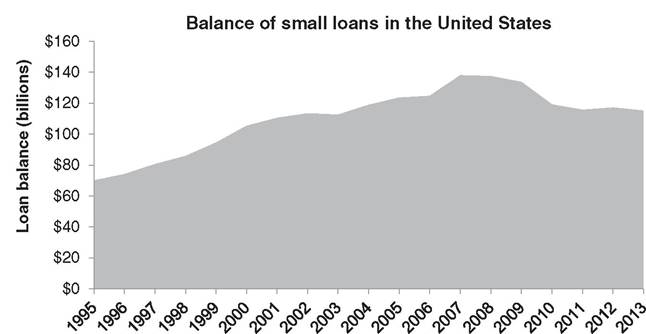
FIGURE 3.5 Loan balance in the U.S. of loans below $1 million to small businesses and farms. Shaded areas designate recessions.
Data source: FDIC
crisis of 2007/8, SME sales have largely been flat.
This in turn has hurt their collateral, which often exists in the form of infrastructure and real estate of the founders.15Another reason for banks to abandon small loans is that the market for securitized small business loans is relatively weak. When banks can easily package their loan portfolios and sell them to other banks or non-bank entities, they have a strong motivation to underwrite loans. However, several factors stand in the way of small business loan securitization; for instance, the lack of standardized lending terms and uniform underwriting guidelines, and the limited historical data on credit performance of small business loans. This further raises the costs of small business lending.16
3.3.3 Low interest rate environment
Finally, the low interest rates that banks offer on deposits are another enabler for online lenders. If depositors can get acceptable rates from their trusted bank, they might as well deposit their savings where they already have an existing relationship. Because interest rates hover around zero percent, savers and investors have started looking for alternatives. Online lenders promise comparatively high interest on deposits, which helps them attract capital. Traditional bank loans may yield a return of 5 to 7 percent while alternative lending platforms charge yields between 30 to 120 percent of the loan value, depending on the size, term and risk of the loan.17
3.4
More on the topic STRUCTURAL FACTORS:
- Mediation Competency Models
- Contents
- Defining "Orphans"
- The Street as a Place of Violence
- There is a reason why financial technology startups are taking off now instead of 20 years ago.
- Walter Salant and Forecasting Employment
- REVIEW QUESTIONS
- ASSESSING CONFLICT MANAGEMENT OUTCOMES
- 35 Infertility and Assisted Reproductive Technologies
- Primary Orientation Factors