FEDERAL CONSTITUTION, DAKWAH MOVEMENTS, AND HUDUD
In 1956, the Reid Constitutional Commission, consisting of members from the United Kingdom, Australia, India, and Pakistan, drafted a constitution modeled on the American and Indian constitutions and submitted it to a review party appointed by the British government, the Conference of Rulers, and the Government of the Federation (Ahmad Ibrahim 1992, 508, 510).
The Alliance Party (later named Barisan Nasional; BN), with a mandate from its overwhelming victory in the federal elections of 1955, influenced the recommendations made to the Reid Commission. However, it is important to note that the Alliance was dominated by the race-based parties—UMNO (United Malays National Organization), MCA (Malaysian Chinese Association), and MIC (Malaysian Indian Congress)—which negotiated and reached a compromise on a number of contentious issues (Andaya and Andaya [1982] 2001; Daniels 2005, 34–44; Ahmad Fauzi 1999, 31–32).15 The Federation of Malaya (named Malaysia in 1963) adopted and promulgated the Federal Constitution when it attained independence on August 31, 1957. This constitution embodies the bargain reached by these allied but skirmishing parties over matters such as the priority of Islam, freedom of religion, Malay special rights, political preeminence of Malays, equality before the law, and common citizenship.The Federal Constitution simultaneously embraces the priority of Islam and the freedom of religion. Article 3(1) declares that “Islam is the religion of the Federation; but other religions may be practiced in peace and harmony in any part of the Federation.” It goes on to state in Article 3(2):
In every State other than States not having a Ruler the position of the Ruler as the Head of the religion of Islam in his State in the manner and to extent acknowledged and declared by the Constitution of that State; and, subject to that Constitution, all rights, privileges and powers enjoyed by him as Head of that religion, are unaffected and unimpaired; but in any acts, observances or ceremonies with respect to which the Conference of Rulers has agreed that they should extend to the Federation as a whole each of the other Rulers shall in his capacity of Head of religion of Islam authorize the Yang di-Pertuan Agong to represent him.
Thus, this key article establishes “Islam as the religion of the Federation” and the Rulers or Yang di-Pertuan Agong (King) to be the “Head of the religion of Islam” in each state and for the federation overall, together with religious freedom for “other religions.” What does this mean? Is it calling for a theocratic state and for sharia to be the general law of society? In contemporary Malaysia, divergent interpretations of this article have ignited firestorms of controversy. Nevertheless, according to the Reid Commission Report and the White Paper, the framers of the constitution expressed concerns about the potential impact of this article on the religious freedom of non-Muslims. However, the Alliance submitted a memorandum stating that “the religion of Malaysia shall be Islam. The observance of this principle shall not... imply that the State is not a secular State” (Abdul Aziz and Farid 2009, 5). Mr. Justice Abdul Hamid, a Pakistani member of the Commission, added a note of dissent arguing that many countries have such a provision in their constitutions that has not caused harm to anyone. Moreover, the White Paper in the report recommended that this declaration “will not in no [sic] way affect the present position of the Federation as a secular state” and the freedom of non-Muslims to practice and propagate their religions, except for restrictions imposed by state law on the propagation of their religions to Muslims (6). Furthermore, the constitution enshrines the notion of a secular state in the way it locates the highest political authority in each state and the nation in the hands of the state constitutions (Article 71) and the Cabinet or its authorized ministers (Article 39) rather than the “heads of religion”; and, as we will see below, in the way it continues the pre-independence format of limiting the scope of sharia laws and excluding them from the Federal List. Nevertheless, many contemporary Malaysians interpret Article 3 in ways contrary to the expressed intentions of those who drafted the constitution.
It is also important to note that the idea of religious freedom was further inscribed in Article 11(1), which states, “Every person has the right to profess and practice his religion and, subject to Clause (4), to propagate it.” This article does not appear to have been intended to apply to Malays, who are Muslims by definition elsewhere in the constitution, or Muslims in general, although some contemporary proponents of liberal rights would extend it to Muslims who want to convert to other religions. Article 11(4), the caveat to this provision the Commission White Paper pointed to, clarifies that “State law and in respect to the Federal Territories of Kuala Lumpur, Labuan and Putrajaya, the federal law may control or restrict the propagation of any religious doctrine or belief among persons professing the religion of Islam.” Most Malaysian states have issued such enactments specifying restrictions on the propagation of non-Islamic religions to Muslims.
The compromise over the primacy of Islam and religious freedom for non-Muslims was part of a broader bargain. In Article 153, Malays were bestowed recognition as natives or Bumiputera, together with the indigenous groups of Sabah and Sarawak, and accorded a “special position” and “legitimate interests” to be safeguarded by the king of Malaysia. Article 152(1) recognizes the Malay language as the national language. On the other hand, Article 8(1) declares that “all persons are equal before the law and entitled to the equal protection of the law.” In addition, non-Malays attained a broad and inclusive form of legal citizenship as specified in Article 14(1). Representations of these sorts of compromises, inscribed in the Federal Constitution, were widely distributed throughout society and came to be known by many as “the social contract”: “Representations of diverse social groups and their horizontal inter-relations as equal citizen-members and representations of Malay privilege and special status on top of vertical rearrangements of diverse social groups are closely related to dominant and alternative senses of cultural citizenship” (Daniels 2005, 263).
These representations of Malaysian society and the notions of ethnicity, citizenship, and the nation-state they entail have become intertwined in various ways with conceptions of sharia.The marginalization of sharia laws is perpetuated in the Malaysian court system as structured according to the Federal Constitution. Sharia laws are omitted from the Federal List, List 1 of the Ninth Schedule, which includes civil and criminal law and procedure and the administration of justice. Sharia laws appear as Item 1 on List II, the State Legislative List, which reads as follows:
Except with respect to the Federal Territories of Kuala Lumpur, Labuan and Putrajaya, Islamic law and personal and family law of persons professing the religion of Islam, including the Islamic law relating to succession, testate, intestate, betrothal, marriage, divorce, dower, maintenance, adoption, legitimacy, guardianship, gifts, partitions and non-charitable trusts; Wakafs and the definition and regulation of charitable and religious trusts, the appointment of trustees and the incorporation of persons in respect of Islamic religious and charitable endowments, institutions, trusts, charities and charitable institutions operating wholly within the State; Malay customs; Zakat, Fitrah and Baitulmal or similar Islamic religious revenue; mosques or any Islamic public places of worship, creation and punishment of offences by persons professing the religion of Islam against precepts of that religion, except in regard to matters included in the Federal List; the constitution, organization and procedure of Syariah courts, which shall have jurisdiction only over persons professing the religion of Islam and in respect only of any of the matters included in this paragraph, but shall not have jurisdiction in respect of offences except in so far as conferred by federal law, the control of propagating doctrines and beliefs among persons professing the religion of Islam; the determination of matters of Islamic law and doctrine and Malay custom.
Civil laws based on English law are generally applied across postcolonial Malaysia. The various levels of civil courts—High Courts, Court of Appeal, and Federal Court—are part of the federal system and hear a wide range of cases for Muslims and non-Muslims, including all criminal cases except for those committed by Muslims against the “precepts of Islam.” Moreover, several of the kinds of cases on the state-level sharia list overlap with those on the federal-level civil court list, and many of these are in fact heard in local civil courts rather than sharia courts. The Federal Constitution and the Acts of Parliament determine the jurisdiction of sharia courts. Even in the case of gross violations of the “precepts of Islam” that transgress the limits of religious norms (hudud), offenses with fixed punishments in the Qur’an and Prophetic Traditions (hadith), the sharia courts are restricted from imposing penalties beyond those set by federal law. From 1965 to 1984, federal law limited penalties meted out by the sharia courts to RM 1,000 and six months of imprisonment. The Syariah Courts (Criminal Jurisdiction) Act of 1965 as amended in 1984 provides that sharia criminal jurisdiction should not be exercised for any punishment exceeding three years or with a fine exceeding RM 5,000 or whipping exceeding six strokes, or any combination of these penalties (Abdul Samat 2003, 104). This restriction has come be known as the three-five-six limits in the Malaysian judicial community, and is under consideration for another increase in the level of ta’zir (discretionary punishment) a Muslim judge can award. In the 1950s and 1960s these punishments existed only in the form of imprisonment and fines but were heightened in the 1980s and 1990s under the influence of the ongoing Islamic resurgence, in some cases including caning penalties.
Islamic resurgence, including a variety of dakwah movements, has spread across Malaysian society since the 1970s. Initially, student activists, several Islamic nongovernmental organizations, and the Islamic Party of Malaysia (PAS) actively struggled for a more public presence and observance of Islam in society.
However, by the 1980s, the UMNO-led federal government under the leadership of prime minister Mahathir Mohamad initiated its own dakwah movement and tried to get out in front of the growing Islamic turn of the Muslim community. UMNO, PAS, and a variety of Islamic missionary, Sufi, and activist organizations mobilized and motivated the Muslim grass roots to participate in Islamic education, study groups, and religious revival meetings, and to implement more sharia in their personal and family lives. Campaigns were waged promoting Islamic attire and covering the female body according to Islamic norms, and for expressing Muslim identity and values in media. The federal government set up the International Islamic University and several Islamic think tanks. Expanding corps of ulama (Ar. ‘ulama’) were developed and established in increasingly public roles in society. The National Council for Islamic Affairs Fatwa Committee (Jawatankuasa Fatwa Majlis Kebangsaan Bagi Hal Ehwal Ugama Islam Malaysia), which was first organized in 1970 to issue fatwas or legal opinions on a national level, shifted the label for its meetings from persidangan (M. conference) to muzakarah (Ar. mudhākara; consultation, deliberation) in 1981. This council comprises all the state-level and Federal Territories’ muftis, nine ulama, a Muslim legal professional selected and appointed by the Council of Rulers, and a director appointed by the National Council for Islamic Affairs (Majlis Kebangsaan Bagi Hal Ehwal Ugama Islam Malaysia; MKI). The state and national fatwa councils issue rulings covering all categories of Islamic law, including akidah (Ar. ’aqidah; religious belief), ibadah (worship), munakahat (marriage and family), jenayah (criminal), and muamalat (economics). Looked at from a broad perspective, the affiliations of these increasingly public and influential Muslim scholars and jurists are varied, with some more or less attached to UMNO or the UMNO-led government and others with PAS or PAS-affiliated NGOs, while other ulama are more independent. These dakwah movements also explored making the economy more sharia-compliant, including halal certification and expansion of companies producing halal products and the development of Islamic banking, insurance, and investment vehicles. The Islamic Banking Act was passed in 1983 and the Islamic Insurance (Takaful) Act in 1984. Malaysia developed one of the most regulated Islamic finance sectors in the world and eventually shifted the jurisdiction of these institutions and products from civil courts to Bank Negara Malaysia (Malaysian Central Bank) in 2009 (Kamali 2000, 328–30; Fischer 2008; Sloane-White 2011).In this historical context of resurgent Islam and the growing emphasis on Muslim identity for Malay “natives,” several states passed laws on non-Islamic religion and made amendments to family and criminal law enactments, and the federal government pushed through an amendment of the Federal Constitution raising the status of sharia courts. In the 1980s, the peninsular states of Kelantan, Terengganu, Kedah, Melaka, Pahang, Perak, and Selangor passed enactments restricting non-Muslim usage of several words and phrases deemed to be uniquely Islamic. The Selangor Non-Islamic Religions (Control of Propagation Among Muslims) Enactment of 1988 bans non-Muslims from using twenty-five words, including Allah, ulama, ibadah, syariah, dakwah, wali, and nabi, and ten phrases, such as Subhanallah, Alhamdulillah, Lailahaillallah, and Allahu Akbar, in reference to non-Islamic religion. All the peninsular states, except for Penang, passed similar enactments. Malay leaders considered these laws consistent with Article 11(4) of the Federal Constitution. However, the Christian Federation of Malaysia argues that these enactments are too broad and infringe on their rights of religious freedom, which is upheld in “the supreme law of the land,” the Federal Constitution (see chapter 3). The federal government passed amendments to the Islamic Family Law (Federal Territories) Act of 1984 in 1992 and 1994 that altered some of the reforms concerning polygamy and divorce. Sisters in Islam and many of their supporters consider these amendments a step backward for gender equality. In 1982, in Kelantan, and after 1993 in other states and jurisdictions, revised Administration of Muslim Law enactments were passed providing for a three-tiered system of courts—Sharia Subordinate Court, Sharia High Court, and Sharia Appeal Court—independent of the state religious councils and with enhanced status for sharia judges (Roff 1998, 224). Subsequently, many peninsular states also passed new enactments or amendments to family laws: Kelantan in 2002 (under a PAS-led administration), Melaka in 2003, Negeri Sembilan and Selangor in 2003, and Kedah in 2008. Similarly, Malay leaders passed new sharia criminal enactments in the direction of strengthening the punishment of crimes that violate Islamic precepts. Kelantan passed the Syariah Criminal Code in 1985, Kedah the Kanun Jenayah Syariah in 1988, Melaka the Enakmen Kesalahan Syariah in 1991, Negeri Sembilan the Enakmen Jenayah Syariah in 1992, Selangor the Syariah Criminal Enactment in 1995, and the federal government the Syariah Criminal Offences (Federal Territories) Act in 1997. In several cases, these enactments repealed more lenient laws from the 1960s.
Meanwhile, with a more than two-thirds majority in Parliament in 1988, the Mahathir-led BN government was able to make an important amendment to the Federal Constitution for raising the status and jurisdiction of the state-level sharia courts. This new provision was intended to address the overlapping and conflicting jurisdictions of the civil and sharia courts that saw many cases falling within the purview of sharia courts being heard and decided on by civil courts. This condition was carried over from the colonial period. Article 121(1A) states, “The courts referred to in Clause (1) [two High Courts] shall have no jurisdiction in respect of any matter within the jurisdiction of the Syariah courts.” Although this provision was supposed to establish an exclusive jurisdiction for the sharia courts, it appears that the power of the civil courts to hear cases in the fields of succession, testate, intestate, legitimacy of a child, interpretation of wills, guardianship and conversion, Islamic religious endowments (wakaf), and divisions of joint marital assets (harta sepencarian) upon divorce has not been eliminated (Abdul Samat 2003, 105–6).16 This provision raises the authority of the sharia courts to handle matters that fall under its jurisdiction and is a powerful symbolic gesture for reducing the perceived marginalization of many in the Muslim community. Although it is only a slight tweaking of the secular format established prior to political independence and not a transformation of the subordinate position of sharia courts, this provision has become a principal target of liberal rights organizations protesting the unwelcome authority of sharia courts in conversion and child custody cases involving Muslims and non-Muslims (see Martinez 2008; Moustafa 2013).
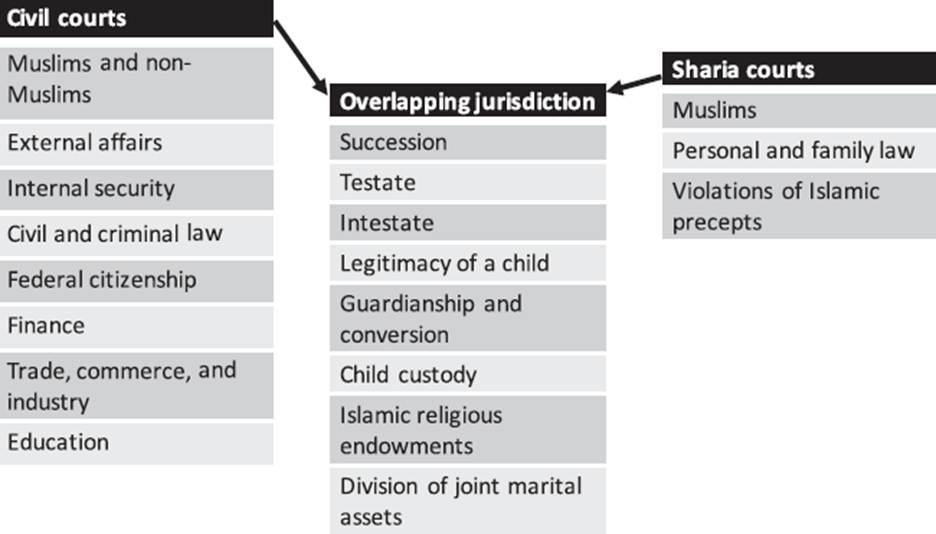
Civil courts and sharia courts jurisdiction
On the other hand, PAS, reorganized under the leadership of ulama in the 1980s, waged a strong campaign for a more thoroughgoing transformation of Malaysian society and the establishment of an Islamic system. After its electoral victory in 1990, it regained control of the state of Kelantan and began trying to manifest its notion of an Islamic state. In 1991, the Kelantan state government banned performances of mak yong and wayang, traditional dance and shadow puppet arts, which they interpreted as entailing elements of “superstition” and “un-Islamic beliefs” as well as inappropriate attire and the mixing of genders. The official Enactment Controlling Entertainment and Places of Entertainment of 1998 (Enakmen Kawalan Hiburan dan Tempat-tempat Hiburan) codified restrictions on traditional arts and entertainment venues deemed to be flouting Islamic values and norms.17 PAS also tried to deliver on its criticism of the secularism of UMNO and their own arguments for a full implementation of sharia laws by having the state governments of Kelantan and Terengganu pass sharia criminal laws that included hudud. The Kelantan state government issued the Syariah Criminal Code (II) in 1993 (Hukum Hudud) and the Terengganu state government the Syariah Criminal Offences Bill in 2002. These enactments, though of powerful discursive value, were unable to be implemented in practice due to federal-level legal and structural constraints. Nevertheless, PAS leaders have maintained a commitment to replacing the reduced ta’zir punishments with the hudud code. Tuan Guru Nik Abdul Aziz, the spiritual leader of PAS and chief minister of Kelantan, in the Kelantan House in Kuala Lumpur, told me emphatically:
In Malaysia, there are two courts. There is the civil court and the sharia court. Who said it is supposed to be this way? In the time of Prophet Muhammad, in the time of the caliphs, there was only one court. Why is there two? In Malaysia, there is a mufti and a chief justice. Why is there two? The chief justice is different from the Mufti. In terms of knowledge, they are the same. If I speak about it, if I had the power, I would make the chief justice a mufti and the mufti a chief justice; there must be only one. The knowledge of both of them is the same; they all study in universities. Why is there two of them? They divide and rule.18
In Nik Aziz’s vision of an Islamic state, there would be only one court system: the sharia system. Many Malaysian Muslims have been swayed by PAS leaders’ arguments for Islamic sovereignty. Nevertheless, there are also many committed to the more moderate, secular format of UMNO. For instance, Halim, a middle-aged Malayali Muslim from Kerala, remarked:
Malays are becoming more fanatic. They have to realize that Malaysia is a cosmopolitan society. You can’t force non-Muslims to follow Islamic law. If a person steals, then you cut off a finger and if they steal again, you cut off a hand. What if a Chinese person steals, what will you do, cut off his finger or hand, too? No, you cannot do that; they are not Muslims. Islamic law does not apply to them.... But this is not Allah’s law. Allah is merciful and forgiving. How can you just punish people like this? People should be forgiven if they ask for it and [be] given a chance to change and be good people. This is what Allah wants because Allah has all the power, and if he wanted to punish us for all the wrong things we do each day he could do it right away.19
Most non-Muslims I spoke with also expressed similar anti-hudud sentiments and fears about the rising tide of Islamic resurgence.
Indeed, many non-Muslim interlocutors described their experiences with the changes that took place in their everyday relations with Malay Muslims after the Islamic resurgence. Ching, a middle-aged Chinese Buddhist woman, explained that things were different when she grew up on the east coast of peninsular Malaysia:
I grew up in Terengganu and I used to have lots of Malay friends, and we used to mix with each other, and they came over to eat with us. But it has all changed after the Islamic movement. Now we do not mix because they are restricted from mixing with us. They cannot come into a temple or church.... It was the Muslim extremists that started all this.... They say they cannot marry a Christian or Jew, but this is not what Islam teaches.... But they do not allow it here.20 A Muslim man or woman must marry a Muslim, so a non-Muslim has to convert. They are following Malay customs and call everything they do Islam, but they don’t realize that there are many Muslims in the world. Malays are not the only Muslims.21
Ching now lives in the more ethnically diverse west coast city of Melaka, but she found that social relations had changed there, too. She laments the distance she felt grow between non-Muslims and Malay Muslims. In addition, the separation she experienced appears to be hardened by the way race and religion were intertwined. Malay custom and identity took on more of an Islamic aura, while Islam, the prestigious religion of the federation, was claimed as an essential Malay attribute.
More on the topic FEDERAL CONSTITUTION, DAKWAH MOVEMENTS, AND HUDUD:
- RAISING TA’ZIR PUNISHMENTS, HUDUD, AND QISAS
- The Federal Reserve and the FOMC
- PROPERTY LAW UNDER THE IRANIAN CONSTITUTION
- Governing Money Democratically: Rechartering the Federal Reserve
- The Physiocratic constitution is what we refer to as The General Agreement.
- THE “BENDER CONSTITUTION”
- 2. The Constitution of the Empire
- The Constitution of Cities
- Part V: The Constitution — The General Agreement
- Article 10.2 New York Federal Reserve takes on key role in repo market
- WHY DID THE FEDERAL RESERVE MISS THE FINANCIAL CRISIS OF 2008?
- Chapter 9 Appendix I: Location and Responsibilities of Veterinarians in the Federal Government
- Religious Norms Affecting the Constitution of an Arbitral Tribunal
- The Size and Distribution of the Movements
- Chapter 3 The Federal Government Lacks a Comprehensive Understanding of the Sufficiency of Its Veterinarian Workforce
- What are the Causes of these Movements?
- Resistance Movements and Social Justice
- Islamic Movements and Organisations
- A Brief History of Cattle Movements in Africa