The Concept of Comprehensive Justice
Al-Mawardi’s concept begins with a basic premise, namely, that in order for the world to be a good[92] world, six criteria must be met: a religion that is followed (din muttaba,), a firm ruler (sultan qahir), comprehensive justice (‘adl shamil), public security (amn ‘amm), lasting fecundity (khisb da ’im) of the land, and the broad hope (amal fasih) of the people.46
In the following I shall explain these points in more detail:
Religion: although al-Mawardi considers religion essential to his conception of a good world, his understanding of religion is rationalistic.
Adherence to religious guidance is not important simply because it is commanded, or for fear of punishment from God, but rather, because it impedes the overstepping of moral boundaries and contributes to a well-adjusted life.47 He differentiates between the terms shar‘ (in this case, synonymous with religion) and ‘aql (reason), and he explains that in his opinion, religion follows on from reason, i. e., religion appears to the human who is already equipped with reason. According to him, reason leads humans to recognise the necessity of religious guidance.48 Interestingly, he differentiates between the spheres of religion and politics. Both are connected to justice, however, and both ensure healthy rule and the prospering of countries.He reinforces the separation of religion and politics in the next part of his argument, in which he states that it is important to follow religious as well as political guidelines. He reasons that if one does not follow religious obligations, one harms oneself; but if one brings ruin to other countries, one is inflicting harm on others?9 Thus, for him, the religious sphere concerns individual, personal space, while political prescriptions affect society as a whole.
Firm ruler: the second condition for a good world, according to al-Mawardi, is to have a strong ruler. This is not an end in itself, however, but a means of guaranteeing justice.
As an experienced judge and effective emissary, al-Mawardi had no illusions about the difficulty inherent in achieving the type of comprehensive justice that
has generally been ascribed to the pre-modern age, when the good was conceived as existing independently of the individual and the world. On the historical-philosophical development of the term, see Robert Spaemann, ‘Gut, hochstes’, in Historisches Worterbuch der Philosophie, vol. 3, ed. Joachim Ritter et al., 13 vols. (Basel: Schwabe, 1971-2007), 3. In al-Mawardi’s thought, however, the connection of the good world with humans and their actions is very clear.
46 Abu al-Hasan al-Mawardi, Adab al-dunya wa al-din, ed. Mustafa al-Saqqa (Cairo: Maktabat al-Wahba, 1973), 135 -136.
47 Ibid., 136.
48 Ibid.
49 Ibid.
is so central to his conception of a good world. He endorsed the need for a strong ruler in order to fight potential abuses of power, rivalries, to contain outbreaks of violence, and to combat injustice.50 And although he concedes that it is possible to confront injustice through one’s own reason and spiritual conviction, both reason and religion are still susceptible to weakness and liable to be abused; they may be put to personal use by being interpreted in favour of self-serving interests. Only strong rule then, can reliably stave off injustice?1 His thoughts on this theme are very far-reaching. Translated into modern terminology, he is basically making the case that rational or religious arguments, compelling as they might be, are insufficient to guarantee justice; to this end, one needs strong institutions that are able to act in a decisive manner. He does not, however, discuss the question of what to do when the institutions or political leadership no longer act in a just manner.
As will become clear, he hopes that he can trust in the ruler’s common sense and ego, as he considers that unjust action will not serve a ruler’s interests either.It is not essential for al-Mawardi whether the necessity of a strong ruler is justified in religious or in rational terms. He is more concerned with a different argument, namely that systems of parallel rule are not permissible on religious or on rational grounds?2 This is also borne out by his stance vis-a-vis the Buyid power struggle against the caliphate in Baghdad; he was at pains to convince the Buyids to submit to the caliph?3
He lists the duties of a ruler as follows: a) the safeguarding of religion against falsification and the fostering of compliance with religious prescriptions; b) the defence of central authority, the protection of society in the face of enemies of religion and dangers to the lives and property of the citizens; c) the construction of cities and streets; d) the sound management of finances; e) the fight against injustice and the provision of just conditions; f) the execution of the law in an even-handed manner, without dilution or exaggeration; and g) the consideration of competence and reliability when it comes to official authorities?4
Al-Mawardi concludes that if a ruler manages to accomplish all of these, then he has acted justly towards God and deserves the loyalty and sympathy of his subjects.55
50 Ibid., 136 -137.
51 Ibid., 137.
52 Ibid., 138.
53 Brockelmann, ‘al-Mawardi’, 869.
54 Al-Mawardi, Adab al-dunyd wa al-dm, 139.
55 Ibid.
Comprehensive justice: the third condition for a good world that al-Mawardi lists is that of comprehensive justice (al-‘adl al-shamil). If this criterion is fulfilled, it will foster mutual trust, encourage citizens to be law-abiding, promote the flourishing of communities, the increase of wealth and of the children, and overall heightened security.56 He warns, however:
nothing destroys the earth and the hearts of humans more swiftly than injustice; for injustice knows no limits and obeys no boundaries.
Every one of its manifestations (kull juz’ minhu) shares in the ruin, until it is omnipresent?7Al-Mawardi clearly believes that legislation is insufficient to guarantee justice. He emphasises, in a somewhat didactic manner, that it is equally important for an individual to be convinced of justice and its general advantages. To demonstrate this point more clearly, he makes recourse to an anecdote, as is the case in many of his works. During the conquest of India, Alexander the Great is said to have encountered some local scholars; in mild bewilderment, he asked them why there were so few laws governing societies in the region. They are said to have answered, because everyone respects the rights of others and the rulers act justly.58 While it is impossible to ascertain the veracity of the encounter, the point here is rather to consider the function of anecdotes and proverbs in al-Mawardi’s work. In this case, he makes use of the anecdote to suggest that the execution of existing laws is more effective than constantly passing new ones.
Early on in his thoughts on justice, al-Mawardi established a differentiation between the individual and the social sides of justice. He discusses on the one hand what it means to act in a just manner towards oneself (‘adl al-insanfi naf- sihi), and on the other, what justice means in relation to others (‘adluhufi ghayr- ihi).59 He does not have much to say about the individual side of it, save that to be just towards oneself is to turn to what is good and to distance oneself from vice. This also means to know oneself, one’s habits and weaknesses, in order to remain centred along the continuum of excess and neglect. For there is injustice in both, excess and neglect; if you are unjust toward yourself, you are more likely to be unjust unto others, and if you do yourself an injustice, then you are committing a larger injustice towards others.6°
| 56 | Ibid. |
| 57 | Ibid. |
| 58 | Ibid. |
| 59 | Ibid. |
| 60 | Ibid. |
Al-MawardFs exposition on the social aspects of justice is both more elaborate and more remarkable.
He establishes different relational spheres within society, illustrates the ways in which they are connected, and gives each of them equal importance in the conceptualization of comprehensive justice. His is a remarkable thought process and very much ahead of his time. This becomes clearer, however, when his ideas are translated into modern terminology, as will be shown below.Al-Mawardi distinguishes three spheres of relationships within society: there is the top-down relationship (‘adl al-insan fι man dunahu), there is the bottom- up relational sphere, (‘adl al-insan ma ‘a man fawqahu), and then there is the realm of ‘horizontal relations’ (‘adl al-insan ma‘a akfa’ihi).[93] Al-Mawardi makes conscious use of vague expressions of top and bottom, above, below, high, and low, by which he indicates social hierarchies. The top rungs include the individuals who occupy higher positions within the social structure, such as the ruler, a judge, an employer, or simply anyone in a superior position.[94] [95] These are distinguished from the subjects, the citizens, who are at a lower level within the social hierarchic structure/3 The horizontal sphere is the mutual relationship of the subjects/citizens. The three dimensions are illustrated below.
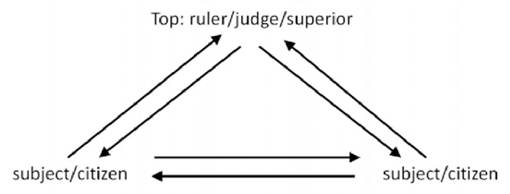
Al-Mawardi considers the hierarchic structure of society to be rational. He warns, however, that the sustainability of contentedness within society is only achieved if and when those at the top rule over their subjects in a just manner. According to him, this means: a) asking of their subjects only what is within reason (maysur); b) omitting that which is not within reason (ma‘sur); c) not attempting to solidify their rule through acts of violence; and d) striving to be just in all their actions.[96] [97] [98] [99] [100] [101] [102] Al-Mawardi backs these claims up by saying that following what is reasonable to ask of people is sustainable in the long-run, avoiding demanding what is not feasible provides for safety, refraining from violence builds up sympathy, and just behaviour secures a strong support base/5
Conversely, when considering the behaviour of those below towards those above, justice is served when citizens can wholeheartedly follow the commands of those above them, fully support them, and be honest in their loyalty towards them.
For a loyal following leads to solidarity; devotion and support are the best defences against weakness, and honest loyalty does away with distrust.66 Al- Mawardi is very much aware of the consequences of a distrustful relationship between the state and its citizens. He warns against betrayal, stating that the subjects will, in the end, have to be fearful of the very entity of which they seek pro- tection.67He then discusses the third sphere, the relationship of citizens with one another. Their relations are just if every citizen treats the other as an equal, is not arrogant, and inflicts no harm. Treating each other as equals fosters harmony, avoiding arrogance promotes mutual understanding, and avoiding harm supports justice/8 If citizens neglect these points, al-Mawardi continues, there will be constant enmity between them that will eventually lead everyone into destruction/9
In his explications, al-Mawardi consistently reasons on deontological and more so on teleological grounds. This reasoning occurs already in his discussion of how top-down relations in society can be considered just. By always referring back to the Quran or hadιth, he simultaneously reinforces the notion that just behaviour is a religious and moral imperative. He is more concerned, however, with explaining how acting in a just manner is advantageous to all parties involved. Throughout the work he formulates his arguments with reference to relevant aphorisms or verses of poetry. He refers to sayings such as: rule can be maintained by deceit, but not by injustice; or, the unjust will never have a neighbor I friend, nor a home; or, if a sovereign turns his back on justice, his subjects will turn their backs on him; or, lastly, injustice destroys wealth and engenders rage.7° He further maintains his teleological form of argumentation in a paragraph concerning the relationships of subjects amongst each other. At the end of it, he concludes: in this respect, there is nothing more beneficial than justice and nothing more detrimental than injustice.[103] [104] [105] [106] [107] [108] [109] [110]
Public security: without public security, there is no comprehensive justice and the good world al-Mawardi imagines remains unattainable. There can be just conditions only in a society in which one does not need to fear for one’s life, one’s family, or one’s wealth. Where there is fear, there is no possibility of caring for oneself, or of pursuing one’s rights, let alone of tending to the needs of others/2 At the same time, however, he warns that one should not become too accustomed to general safety or take it for granted. For the real value of security is realised only when it is not there and one must fear everything. In the same vein, a healthy individual will only appreciate the value of health when he is afflicted by illness.73 To reinforce his point, al-Mawardi makes use of another proverb: the value of a comfort is only recognised when one is forced to struggle with its opposite. 74
Lasting fecundity: the fifth condition for a good world listed by al-Mawardi is the lasting fecundity (khisb da’im) of the land for this guarantees the wellbeing of the individual. He emphasises that all members of society, rich and poor, must be equal participants in maintaining the fertility of the land/5 This way, he believes, there will be hardly any room for jealousy or hate. The fertility of the land makes more offspring possible, leads to mutual support, and general social cohesion/6 This will strengthen efforts towards well-being and order in the world; for a fertile land will lead to prosperity, and prosperity in turn to security and munificence.77 Here also al-Mawardi considered both sides of the coin: the general availability of sufficient goods has a positive effect on the public, just as a scarcity of resources affects all as well. Hence, the fertility of the land is to be seen as one of the conditions of a good world/8 Al-Mawardi does not deny that agricultural yields also depend on factors outside human control (precipitation, sunshine, etc.), but emphasises that their effectiveness is strongly connected to justice.[111] [112]
Broad hope: in order for the well-being of the good world and all its other advantages to extend into the next generation, humans should consider and plan for the long-term sustainability of their actions and think about their consequences beyond their own lifetimes. This way of life that is oriented toward the future is expressed in al-Mawardi’s writing as far-reaching, broad hope (amal fasιh)∙.so
Concerning the sixth precondition, it consists of an expansive hope, that drives the acquisition [production] of things, for whose attainment and ascertainment this life is too short.[113] [114]
It would be anachronistic to project onto al-Mawardi’s broad hope the modern conception of generational justice. His formulation does, nonetheless, call for gainful occupation, be it agricultural or artisanal, for as long and as well as possible, so that the next generations may also gain something from it:
Were it not that the descendant benefits from the work of his predecessor, then the people of each generation would have to begin anew which would involve a great deal of hardship. Hence, may humans be blessed with expansive hope. If people cultivate only short-term hopes, then the individual will not overcome/surpass the needs of each day, and will tend only to his immediate needs. But then the world would but be passed in a wholly decayed state from one generation to the next?2
In this manner, al-Mawardi devises a good world, that requires adherence to religion, but in the centre of which stands the concept of justice that cannot be guaranteed without state force, that is not realizable without security and a sufficient amount of material well-being, and that, in the absence of expansive hope, will not bear fruit for future generations.
At the end of his explications, al-Mawardi anticipates the question that logically arises after this conceptualization, namely: what to do when the conditions of this good world/society have been met? Is this not then the end of social processes? Will the good world not fall into stagnation from this point onwards? How can the members of this good world motivate themselves further?
Without actually formulating these questions, al-Mawardi points out, in an almost deconstructivist manner, that there can be no moment of perfection or completion in a world that is constantly in flux. And thus, the striving for a good/just world will never cease. In his words:
These six conditions provide for the well-being and fidelity of the world. If they are all met, the world will be perfect. It is unlikely, however, for man to have a completely perfect world. The world is created as something that is alterable and ephemeral. As one man once lamented that God was always transforming the world, a sage responded, then the world is in order, insofar as it is ever-changing.[115]
More on the topic The Concept of Comprehensive Justice:
- The Concept of Comprehensive Justice by AbQ al-Hasan al-Maward! (972 -1058)
- Comprehensive Care Programs
- PROPOSING A COMPREHENSIVE INVESTMENT ANALYSIS METHOD
- Restorative Justice: social service, paradigm shift, or social justice movement?3
- Restorative justice in Islamic law: application in Malaysian legal history and the criminal justice system
- A MORE COMPREHENSIVE CASH FLOW MEASURE
- Chapter 3 The Federal Government Lacks a Comprehensive Understanding of the Sufficiency of Its Veterinarian Workforce
- Justice, utility and the ‘Justice of Nature'
- Understanding the Term “Environmental Justice”
- Defining restorative justice
- Justice as Performance
- Justice and Iconography
- Restorative Justice
- Reflections on Justice as Fairness