COLD CHAIN SYSTEM
Vaccines, being the biological agents, are likely to lose their potency when exposed to higher (or lower) than the recommended environmental temperature. This exposure can occur at the level of manufacture, transport, storage or administration.
Loss of vaccine potency depends not only on the degree of temperature but also on the duration of exposure and type of vaccine. Live vaccines, e.g. OPV and measles are most heat-sensitive and lose their potency rapidly on heat exposure. Inactivated vaccines, specially those containing aluminium adjuvants, e.g. DTwP/DTaP/ HBV, HAV, HPV and PCV are usually more heat stable but should never be frozen, as they deteriorate on thawing. Cold chain is an operational term to define a system of transporting and storing the vaccines at recommended temperatures from the manufacturers' level till the point of administration. Desired temperature zones for storage and transport of most vaccines is:
For short-term (1-2 months) storage: 2-8°C
For long-term storage: -20°C
In addition, lyophilized vaccines, e.g. BCG, MR/ MMR, varicella and rotavirus vaccines are also sensitive to light exposure.
Components: Essential components of cold chain include:
• Supply of appropriate pieces of equipment to maintain the desired temperature during transport, storage and immunization sessions,
• Provision of quick transport facilities to decrease the risk of exposure to high temperatures,
• Training of the people, who organize and manage vaccine distribution,
• Continuous as well as periodic surveillance for efficacy of cold-chain maintenance.
Tools (equipment) to maintain adequate cold chain system include (Table 9.7):
• Walk-in coolers to store large amounts of vaccines at the state and/or regional centers.
• Deep freezers for long-term storage of OPV and MR/ MMR vaccine at -20°C.
• Ice-lined refrigerators (ILR) are top-open refrigerators, acting as a buffer in case of power failure.
• Purpose-built or dedicated refrigerator is essential equipment for the routine storage of vaccines at clinics and small hospitals. In refrigerators, OPV vaccine should be kept in freezer compartment, BCG, MR/MMR and varicella vaccines on the top-shelf, other vaccines in middle-shelf/s, and diluents in the lower-most shelf (Fig. 9.3). A dial thermometer should be kept in the upper-shelf to monitor the temperature.
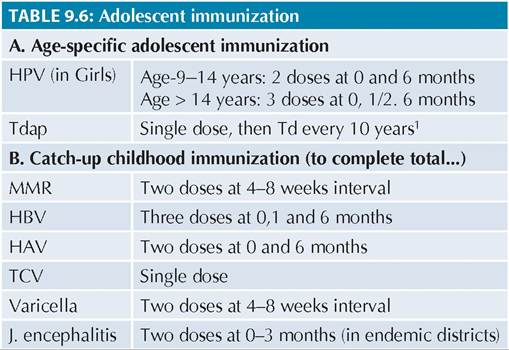
Fig. 9.3: Correct method of vaccine storage in refrigerator.
TABLE 9.7: Common cold-chain equipment used under UIP at different storage centers

Hold-over time (at 43°C): Deep freezer 2.5 hours, ILR 20 hours, cold box 48-96 hour, vaccine carrier 36 hours
* Avoid domestic refrigerators
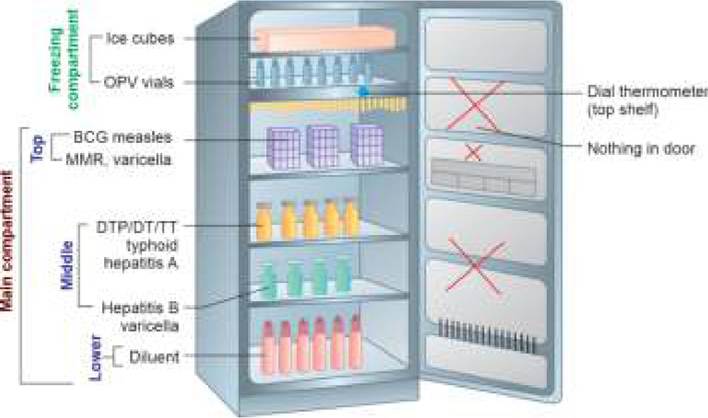
Fig. 9.4: Vaccine carrier.
Enough ice cubes and vaccine carrier packs should be kept in the freezer compartment to keep the vaccines cool in case of power failure. Nothing should be kept in the door of the refrigerator.
Refrigerators used for vaccine storage, should not be used for any other purpose, e.g. water/drug storage, to avoid unnecessary opening of doors.
Domestic refrigerators should not be used for storage of vaccines due to wild temperature fluctuations during frosting-defrosting cycles and frequent door opening. However if used in absence of alternatives, it should be: (a) frost-free with no heating cycles, (b) have separate door for freezer, (c) accessible only to vaccination staff and not used to store other things, e.g. water, and (d) temperature is maintained at 2-8°C with freezer temperature below -5°F (-15°C). • Vaccine carriers or isothermic boxes are used to carry small amounts of vaccines from refrigerator to the site of immunization session.
In these carriers, safe temperature can be maintained for 6-8 hours. Frozen ice packs are used to line the side of the box and a dial thermometer should be kept inside to record the temperature. The vials of DTwP/Td should first be wrapped in plastic sheets before keeping inside, to avoid freezing (Fig. 9.4).Vaccine van is an insulated van used for bulk transport of vaccines from central or regional depots to district centers. Vaccines should be transported only in cold boxes, which should be loaded in the vaccine van immediately after packing. At destination, these boxes must be unloaded as early as possible and vaccines should be transferred to the ILR immediately.
Monitoring of cold chain is done by: (a) regular check with dial thermometers, (b) vaccine-vial monitors, and (c)
Fig. 9.5: Vaccine vial monitor.
random collection of vaccine samples from distribution and field sites for laboratory potency testing. Some other monitoring tools include freeze-indicators, data-loggers and other types of thermometers.
Vaccine Vial Monitor (VVM) is a sticker fixed over many of the heat-sensitive vaccine vials to identify whether the vaccine has been damaged by exposure to heat and should not be used. It includes a lighter square made of a heat-sensitive material inside a darker circle. On exposure to higher ambient temperatures, the color of the square darkens irreversibly. If the color of square is darker or matching the outer circle, vaccine is probably not potent and should be discarded (Fig. 9.5).
VVMs are unique to each vaccine and are of four types: VVM 30, VVM 14, VVM 7 and VVM 2, with the number corresponding to the number of days the vaccine remains potent on exposure at +37°C. In combination vaccines, the VVM corresponds to the most heat-sensitive component of the vaccines, e.g. VVM on DPT vial corresponds to the pertussis component of the vaccine.
VVM is not a substitute of expiry date and vaccine may also degrade due to other factors, e.g. light exposure, which is not indicated by VVM.
9.6
More on the topic COLD CHAIN SYSTEM:
- Design of decision support system “reverse supply chain management” based on Android
- An android supply chain application system for automation order processing
- Service-performance chain: A triangle conceptual model
- Open Account, Prepayment, and Supply Chain Finance
- A chain saw cut through a thin layer of aluminum alloy with much whining but little difficulty—the monument’s neck was hollow.
- The Rise of Open Account, Prepayment, and Supply Chain Finance
- Cold-Induced Illness
- Decolonisation and the Cold War
- Neutrality in Cold War Europe
- Has the Ukrainian crisis sparked a new Cold War?
- Cold War Divisions
- Cold War Legacies
- Imperial Overstretch after the Cold War
- China, Japan and the Cold War in Asia
- Widening and deepening in the shadow of the Cold War
- The Cold War occupies a rather unusual place in the history of organised mass violence.
- The Cold War in Africa
- The Violence of the Cold War
- Insurgency and Military Rule in the Cold War, c. 1945 to c. 1990