COMPETING INTERESTS
For the remainder of this chapter, and in chapter 7, I rely upon the classification of conflict types which emerged from my interviews with solicitors. In each of these categories of conflict the respective parties have different interests.
The views of the client, the position of the firm, and the opinions of individual partners will all contribute to the decision which is taken. The factors which have to be considered by the person making the decision may differ with each type of conflict. These considerations can be summarised as follows:1. legal rules—the law as laid down by the courts;
2. rules of the profession;
3. client interests—ensuring that clients’ interests are adequately protected;
4. client wishes;
5. commercial considerations.
The last of these, commercial considerations, may be further sub-divided as follows:
i) firm as a whole—the best course of action for the firm in the immediate future;
ii) firm as a whole—in the longer term;
iii) individual fee-earners—immediate interests of the fee-earner;
iv) individual fee-earners—longer-term interests.
Before we examine how firms manage these competing interests, it will be useful to consider how firms should conduct themselves in each of the above hypothetical situations[361] in order to comply with the Law Society’s current rules. It is also helpful to bear in mind the client perspective on what constitutes a conflict.
LAW SOCIETY GUIDANCE
1. Direct Conflicts
In relation to direct conflicts involving two existing clients of the same firm, Rule 15.03 states that the firm must not continue to act.[362] In the commentary to this rule, the Guide states that the firm must cease to act for both clients and may continue to represent one only if it is not in possession of relevant confidential
Glover1
Finn2
Law Society
Solicitor
Informants
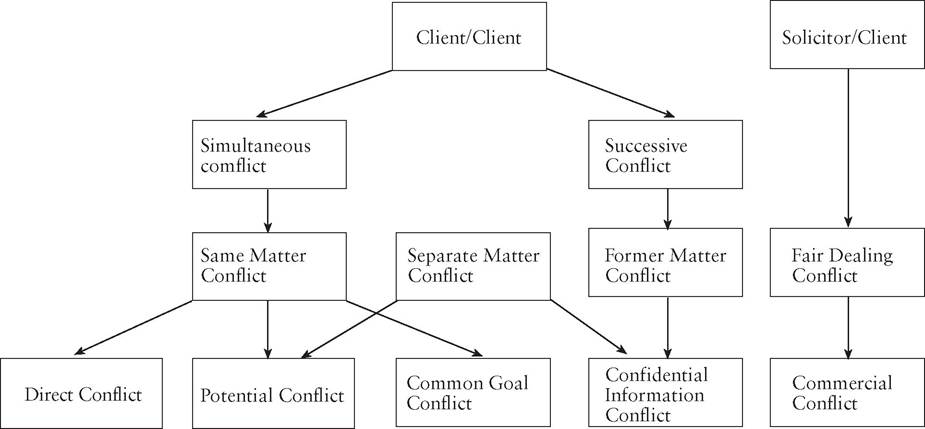
Figure 1.
Classification of Conflicts1 Temporal classification
2 Subject matter classification
The Decision Whether to Act: Procedures and Interests 117
information. Thus, with Tom and Jerry, Partner A should send both Tom and Jerry to other firms of solicitors. He could, however, continue to act for one of them if he had no relevant confidential information about the other. In the case of the rival bidders for Monarchs Forever Ltd, although they are not directly opposing each other, their interests will conflict as both are determined to win the bidding. As with Tom and Jerry, the firm cannot act for both clients because, according to rule 15.01, where the clients’ interests conflict, the firm should not act. This is the case even if the firm informs both clients of the conflict and both consent to the firm’s acting.[363] In this instance, however, the bidder who first approached the firm will still be allowed to retain its services as there is not the complication of their both being established clients.
2. Common-goal Conflicts
Similarly, where the firm is faced with a common-goal conflict, rule 15.01 will apply. The Guide is clear that a firm should not act for two or more clients where there is a conflict, or a significant risk of conflict, between those clients. Thus, in the case of the parties wishing to construct a motorway, not only may their interests be said to conflict at the start of the project, but there is also a significant risk of conflict developing later. Therefore the firm in this instance could act for the bank, or the bondholders, or the constructor, but not for all three.
3. Confidential-information Conflicts
With a confidential-information conflict, the rules are slightly different. According to rule 15.02, the firm is prohibited from acting only if it is in possession of information which is or may be relevant to the new client. Thus, if BSE Ltd has imparted information to the firm which is relevant to the matter in hand, the firm should decline instructions from Heifer & Sons.
Likewise with Wallis Williams, if Robert Gibbs is in possession of information relevant to John Brown’s dispute with Wood Enterprises, the firm should not continue to act.[364] With Bright Books there is an unresolvable conflict between the duty to keep ABC’s affairs confidential (rule 16.01) and the duty to disclose all relevant information to the client regardless of the source of that information (rule 16.06). Bright Books should, therefore, be turned away, or perhaps both clients should be turned away if Bright Books is an established client of the firm.4. Commercial Conflicts and Potential Conflicts
For the remaining scenarios, namely commercial conflicts and potential conflicts, the Law Society gives no guidance as to what a firm should do. These types of conflicts are not seen as ‘legal’ conflicts but rather as commercial decisions, and as such are matters for each firm to decide. Moreover, potential commercial conflicts (in the sense given above) cannot be judged until the firm is in full possession of the facts.
It can be seen therefore that the Law Society Guidelines are reasonably clear with regard to each type of conflict. This assumes that the only relevant considerations are those laid down in the Guide to Professional Conduct. But solicitors may find themselves under pressure from their clients to act in ways which reflect those clients’ perception of their own broader interests. The clients’ view concerning what constitutes a conflict, and how that conflict should be handled, may have considerable bearing upon the way firms respond to these dilemmas.
More on the topic COMPETING INTERESTS:
- A Very Brief Philosophy of Measurement
- The Basis of Moral Difference
- Conflict Processes
- Learning Objectives
- The British in the Coral Sea: Fiji
- Political Institutions and Growth-Enhancing Policies
- CONCLUSION
- §36. The Method of Mechanics
- Reviewers
- Price Stickiness