B. Usucapio
a. Reversio in potestatem (interpretation of the lex Atinia)
CASE 72
D 41.3.4.6 (Paulus libro quinquagensimo quarto ad edictum)
Quod autem dicit lex Atinia, ut res furtiva non usucapiatur, nisi in potestatem eius, cui subrepta est, revertatur, sic acceptum est, ut in domini potestatem debeat reverti, non in eius utique, cui subreptum est.
igitur creditori subrepta et ei, cui commodata est, in potestatem domini redire debet.Translation: (Paul in the 54th book of his Commentary on the Praetor’s Edict)[159]
But what the lex Atinia [“Atilian Statute”] says, that stolen property cannot be usu- capted unless it is returned to him from whom it was stolen, is understood as follows: that it must be returned to the control of the owner, not merely to the control of him from whom it was stolen. Therefore, property that has been stolen from a creditor or someone to whom it has been lent must return to the control of the owner.
Notes on the Text:
The Roman author, Aulus Gellius, states in his work, Noctes Atticae 17.7.1: Legis veteris Atiniae verba sunt “Quod subruptum erit, accipiendum) est (“is understood as”) the jurists communicate an interpretation of language. Since they equate the understood content with the language of a law or legal rule, one refers to such a statement as an “expository” interpretation.
This extremely common practice also takes the form of expressions like intellegi, esse, videri, (appellatione) contineri [“is understood, is, is seen as, is included (within the term)”]. The jurists also use these formulations in their interpretation of legal concepts, of the meaning of expressions of intent, and of the factual conduct of persons.Discussion Questions:
1) [Referring to the “Notes” on Case 68] what sort of “construction” of the lex [“statute”] is set forth in this case?
2) Try to provide a rationale for this “construction.”
3) Could it also be argued that with the return of the property to the depositary or the borrower a reversio ad dominum [“return to the owner”] has taken place?
4) Is there a reversio ad dominum if the property reaches the owner's slave?
Literature:
Thomas,J. A. C. “The Theftuous Pledger and the Lex Atinia,” in Studi in Onore Di Gaetano Scherillo 1. Milano: Cisalpino - La Goliardica, 1972, 395-404, at 396 ff.
D 41.3.41 (Neratius libro septimo membranarum)
Si rem subreptam mihi procurator meus adprehendit, quamvis per procuratorem possessionem apisci nos iam fere conveniat, nihilo magis eam in potestatem meam redisse usuque capi posse existimandum est, quia contra statui captiosum erit.
Translation: (Neratius in the seventh book of his Legal Notes)[160]
If my procurator recovers a piece of property that was stolen from me, although it is now generally recognized that we can acquire possession through a procurator, it is not to be thought that the property has returned to my control and can be usucapted, because it would be harmful to decide otherwise.
Discussion Questions:
1) How might Neratius and Paul at D 41.3.4.6 (Case 72) have distinguished between possessio [“legal possession”] and potestas [“legal power/control”]?
2) In what might Neratius have detected the harmfulness of a contrary decision?
3) What would you expect the jurists' decision to be if the stolen property is returned without the knowledge of the dominus to his slave (with or without peculium)?
name=bookmark1351>Literature:
Watson (Case 32) 22 ff.
(reprinted in Studies 64 f.).Honore, A. M. “A Study of Neratius and a Reflection on Method,” RHD 63 (1975) 223-240, at 231 ff.
Claus (Case 35) 125 ff.
Krenz (Case 33) 346 ff.
D 41.3.4.21 (Paulus libro quinquagensimo quarto ad edictum)
Si rem pignori datam debitor subripuerit et vendiderit, usucapi eam posse Cassius scribit, quia in potestatem domini videtur pervenisse, qui pignori dederit, quamvis cum eo furti agi potest: quod puto rectius dici.
Translation: (Paul in the 54th book of his Commentary on the Praetor’s Edict)[161]
If the debtor turns over property on pledge [i.e., as security] and then steals it back and sells it, Cassius writes that it can be usucapted, since it counts as having returned to the control of the owner who pledged it—although he can be sued for theft. I consider this decision to be better.
Note on the Text:
On videtur (“counts as”), see under Case 72.
Discussion Questions:
1) On what grounds could Cassius and Paul have based their decision?
2) “Quod puto rectius dici" (“I consider this decision to be better”) alludes to a juristic controversy (cf. verius in Case 8). How might the contrary view be argued?
Literature:
Thomas (Case 72) 397.
Kaser (Case 159) 272.
D 41.3.49 (Labeo libro quinto pithanon a Paulo epitomatorum)
Si quid est subreptum, id usucapi non potest, antequam in domini potestatem pervenerit.
Paulus: immo forsitan et contra: nam si id, quod mihi pignori dederis, subripueris, erit ea res furtiva facta: sed simul atque in meam potestatem venerit, usucapi poterit.Translation: (Labeo in the fifth book of Paul's Epitome of his Pithana)[162]
If something is stolen, it cannot be usucapted, as long as it has not returned to the potestas of the owner. Paul: perhaps also the opposite, since, if you have pledged something to me and then you steal it, it has become res furtiva [“stolen property”], yet as soon as it comes back into my control, it can be usucapted.
Discussion Questions:
Discuss the relationship of this text to Paul at D 41.3.4.6 (Case 72) and D 41.3.4.21 (Case 74).
Literature:
Thomas (Case 72) 396 ff.
D 41.3.4.10 (Paulus libro quinquagensimo quarto ad edictum)
Si rem, quam apud te deposueram, lucri faciendi causa vendideris, deinde ex paenitentia redemeris et eodem statu habeas: sive ignorante me sive sciente ea gesta sint, videri in potestatem meam redisse secundum Proculi sententiam, quae et vera est.
Translation: (Paul in the 54th book of his Commentary on the Praetor’s Edict)[163]
If, with the intention of making a profit, you sell property that I have deposited with you, and then from regret you buy it back and keep it in the same condition as before, it counts as having returned to my control, whether I had knowledge of these events or not.
That is the view of Proculus, which is also the correct view.Note on the Text:
On videri (“counts as”), see under Case 72.
Discussion Questions:
1) The depositary sells the deposited property and later buys it back from regret. After his death his heir sells it to a good-faith acquirer. Can it be usucapted?
2) Compare the decision of Proculus and Paul with Paul at D 41.3.4.6 (Case 72). Can one resolve the contradiction by reference to the different subject matter, or only by assuming an interpolation?
D 41.3.4.12 (Paulus libro quinquagensimo quarto ad edictum)
Tunc in potestatem domini redisse dicendum est, cum possessionem eius nactus sit iuste, ut avelli non possit, sed et tamquam suae rei: nam si ignorans rem mihi subreptam emam, non videri in potestatem meam reversam.
Translation: (Paul in the 54th book of his Commentary on the Praetor’s Edict)[164]
It is to be said that property returns to the control of its owner if he obtains the defect-free possession in such a manner that he cannot be separated from it. However, he must have obtained it also with the knowledge that it involves his own property. So, if I unwittingly buy property that has been stolen from me, it does not count as returned to my control.
Note on the Text:
On videri (“counts as”), see under Case 72.
Discussion Questions:
1) What kind of interpretation does Paul prefer here? [See “Note on the Text” under Case 68].
size=1 color=black face="Book Antiqua">2) Compare the requirement here of a defect-free reversio [“return”] with Cassius/Paul at D 41.3.4.25 (Case 78) and D 41.3.4.21 (Case 74), and with Paul at D 41.3.49 (Case 75).
D 41.3.4.25 (Paulus libro quinquagensimo quarto ad edictum)
Si dominus fundi possessorem vi deiecerit, Cassius ait non videri in potestatem eius redisse, quando interdicto unde vi restituturus sit possessionem.
Translation: (Paul in the 54th book of his Commentary on the Praetor’s Edict)[165]
If the owner of a plot of land ousts the possessor with force, Cassius says the land does not count as returned to his control, since he must restore the possession under the interdictum unde vi.[166]
Note on the Text:
On videri (“counts as”), see under Case 72.
Discussion Questions:
1) Does this fact-situation fall within the application of the lex Atinia?
2) Consider and explain the relationship of this decision to Cassius/Paulus at D 41.3.4.21 (Case 74).
3) The owner, Smith, has lost the possession of his land to the intruder, Jones.
After some time the current possessor, Jones, is forcibly driven off by Smith. Thereafter a bad-faith third party, Brown, enters the property and sells and delivers it to a good-faith acquirer, Green. Can Green usucapt?4) The owner, Smith, is driven off his land by Jones. Jones gives the possession to Brown. Smith then ousts Brown. Has there been a reversio ad dominum [“return to the owner”]?
Literature:
Thomas (Case 72) 397 ff.
Manthe (Case 19) 94 ff.
D 41.2.3.13 and 14 (Paulus libro quinquagensimo quarto ad edictum)
13) Sed et si vindicavero rem mihi subreptam et litis aestimationem accepero, licet corporaliter eius non sim nactus possessionem, usucapietur.
14) Idem dicendum est etiam, si voluntate mea alii tradita sit.
Translation: (Paul in the 54th book of his Commentary on the Praetor’s Edict)color=black face="Book Antiqua">[167]
13) But if I vindicate property stolen from me and accept the judicial valuation in money,[168] the property can be usucapted, although I have not physically recovered its possession.
14) The same can be said if the property is transferred to another with my consent.
Discussion Questions:
1) Who is understood to acquire by usucapion in the first case?
2) Create a concrete example to clarify the second case.
3) How does Paul interpret the concept of reversio [“return”] in both cases?
b. Bona fides
CASE 80
D 50.16.109 (Modestinus libro quinto pandectarum)
‘Bonaefidei emptor’ esse videtur, qui ignoravit eam rem alienam esse, aut putavit eum qui vendidit ius vendendi habere, puta procuratorem aut tutorem esse.
Translation: (Modestinus in the fifth book of his Pandects)[169]
Someone is deemed a “good-faith buyer” if he did not know that someone else's property was involved in the transaction, or he believed the seller had the right to sell it—e.g., he was a procurator or a guardian.
Note on the Text:
On videtur (“is deemed”), see under Case 72.
Discussion Questions:
1) Gaius Inst. 2.43 understands bona fides as belief that the transferor is the owner. How far beyond this “normal case” does the definition of Modestinus go?
2) According to Modestinus, is a buyer bona fide if he doubts the ownership of the seller?
Compare with this Case:
lang=EN-US style='font-size:8.5pt; line-height:115%'>§ 1460 Austrian Civil Code:
For acquisition by prescription, in addition to the capacity of the person and the object, it is necessary that someone actually possesses the property or the right that is supposed to be acquired in this manner; that his possession is legally valid, reasonable, and true, and is continuous through the entire time specified by law (§§ 309, 316, 326, and 345).[170]
§ 326 Austrian Civil Code:
He who on plausible grounds considers as his own the property that he possesses is a reasonable possessor. An unreasonable possessor is that person who knows, or from the circumstances must suspect, that the property in his possession belongs to another. From an error of fact or ignorance of the legal provisions someone can be a legally invalid (§ 316) but still reasonable possessor.[171]
§ 937 German Civil Code:
I He who holds movable property for 10 years in proprietary possession acquires the ownership (prescription).[172]
II Prescription is excluded if the acquirer at the time of acquiring his possession is not in good faith or if he later learns that the ownership does not belong to him.
§ 932 II German Civil Code:
The acquirer is not in good faith, if it is known by him, or unknown as a result of gross negligence, that the property does not belong to the transferor.[173]
D 41.3.24 pr. (Pomponius libro vicensimo quarto ad Quintum Mucium)
Ubi lex inhibet usucapionem, bona fides possidenti nihil prodest.
Translation: (Pomponius in the 24th book of his Commentary on the Ius Civile of Quintus Mucius)[174]
Where a statute prohibits usucapion, the bona fides of the possessor is of no advantage.
Discussion Questions:
1) What statute could be meant here?
2) The thief, Smith, sells to a good-faith Jones, and Jones sells to the goodfaith Brown. Can Brown usucapt?
Literature:
Mayer-Maly, Theo. Das Putativtitelproblem bei der Usucapio, Graz; Köln: Böhlaus, 1962, 143.
D 41.3.12 (Paulus libro vicensimo primo ad edictum)
Si ab eo emas, quem praetor vetuit alienare, idque tu scias, usucapere non potes.
Translation: (Paul in the 21st book of his Commentary on the Praetor’s Edict)[175]
If you buy from someone on whom the Praetor has imposed a ban against alienating property, and you know it, you cannot usucapt.
Discussion Questions:
1) The Praetor has imposed a ban on alienating property against a spendthrift or a contingent heir in order to protect the dependents or creditors. Someone who is unaware of the ban buys property from this person. What are the legal consequences?
2) Titius without knowledge of the lex Atinia buys a stolen thing that he regards as the seller's property. Legal consequences?
3) What considerations could you offer to justify the decisions under “1” and “2”?
Literature:
Hausmaninger, H. Die bona fides des Ersitzungsbesitzers im klassischen römischen Recht, Wien: Herold, 1964, 38 ff.
D 22.6.9.4 (Paulus libro singulari de iuris et facti ignorantia)
Qui ignoravit dominum esse rei venditorem, plus in re est, quam in existimatione mentis: et ideo, tametsi existimet se non a domino emere, tamen, si a domino ei tradatur, dominus efficitur.
Translation: (Paul in his monograph on Errors of Fact and of Law)[176]
If someone does not know that the seller of a thing is the owner, the objective condition of the thing matters more than the subjective opinion. Therefore, even if he believes he is not buying from the owner, he nevertheless becomes the owner, if the property is in fact transferred by the owner.
Note on the Text:
Si emptor [“if a buyer”] would fit the context better than qui [“if someone”].
Discussion Questions:
Create a plausible fact situation and illustrate the decision.
Literature:
Hausmaninger (Case 82) 79 ff.
Wacke, Andreas. “Plus est in re quam in existimatione,” RHD 64 (1996) 309-357, at 315 ff.
lang=EN-US style='font-size:8.5pt; line-height:115%;font-weight:bold'>D 41.3.32.1 (Pomponius libro trigensimo secundo ad Sabinum)
Si quis id, quod possidet, non putat sibi per leges licere usucapere, dicendum est, etiamsi erret, non procedere tamen eius usucapionem, vel quia non bona fide videatur possidere vel quia in iure erranti non procedat usucapio.
Translation: (Pomponius in the 32nd book of his Commentary on the Ius Civile of Sabinus)[177]
If someone believes that under the statutes he may not usucapt the property he possesses, then it must be said that he cannot usucapt, even if he is wrong in his belief—either because he does not count as a good-faith possessor, or because there is no usucapion where there is an error of law.
Note on the Text:
While an error of fact (error facti) can sometimes be forgivable and work in favor of the person in error, a defective knowledge of law (error of law) is fundamentally no basis for excuse: error iuris nocet (“an error of law causes harm [to the party in error]”): cf. Paul D 22.6.9 pr. regula est iuris quidem ignorantiam cuique nocere, facti vero ignorantiam non nocere... (“the rule exists that ignorance of law causes harm, but error of fact does not cause harm”). In post-classical law the strict rule was relaxed in favor of certain groups of persons, of whom a complete knowledge of the law was not presumed (e.g., juveniles, women, peasants, soldiers).
Discussion Questions:
1) Could Pomponius be thinking of the case in which the possessor erroneously considers the property stolen?
2) How does Pomponius stand in relation to the statement plus est in re quam in existimatione [“the objective condition of the thing matters more than the subjective opinion ”] at D 22.6.9.4 (Case 83). Describe his understanding of bona fi des.
Literature:
Hausmaninger (Case 82) 72 ff.
Bauer, Karen. Ersitzung und Bereicherung im klassischen römischen Recht: und die Ersitzung im BGB, n.F., Bd. 11. Berlin: Duncker & Humblot, 1988, 58 ff.
Wacke (Case 83) 334 ff.
D 41.4.8 (lulianus libro secundo ex Minicio)
Si quis, cum sciret venditorem pecuniam statim consumpturum, servos ab eo emisset, plerique responderunt eum nihilo minus bona fide emptorem esse, idque verius est: quomodo enim mala fide emisse videtur, qui a domino emit? Nisi forte et is, qui a luxurioso et protinus scorto daturo pecuniam servos emit, non usucapiet.
Translation: (Julian in the second book on Minicius)[178]
If someone, although he knows that the seller will immediately spend the money, buys slaves from this person, most jurists have decided that he is nevertheless a good-faith buyer, and that is the better opinion. For why should someone who has bought from the owner be seen as a bad-faith buyer? Unless it is the case that someone who buys slaves from a dissolute person, who is going to give the money to a prostitute, will not acquire by usucapion.
Discussion Questions [with model answers]:
1) Julian's presentation of the fact-situation is incomplete. Do you think that the buyer wrongly takes the seller for a prodigus (“spendthrift”), or that the seller is in fact a spendthrift under interdict but the buyer is not aware of this condition? [cf. Case 82]
2) Plerique [“most jurists”] and verius est [“better opinion”] (see Case 8 ) signal a controversy. Concerning what might the jurists be in disagreement?
3) Provide an interpretation of the question: “quomodo enim mala fide emisse videtur, qui a domino emit?” [“For why should someone who has bought from the owner be seen as a bad-faith buyer?”]
4) How should one understand Julian's argumentum ad absurdum (see Case 34): “nisi forte et is...” [“Unless it is the case...”]?
5) Compare Julian's conception of bona fides with that of the other jurists.
Answers:
1) The first. An interdicted spendthrift lacks capacity to alienate his property. Julian would not have referred to him simply as dominus.
2) Whether the subjective understanding of the acquirer (v. Pomponius at D 41.3.32.1 [Case 84]) or the objective circumstances (plus in re quam in existimatione: see Paul at D 22.6.9.4 [Case 83]) should be determinative.
3) The question of bona fi des becomes irrelevant if the latter is not required in order to cure certain defects of acquisition.
4) Clearly no one will deny the usucapion if the buyer knows that the seller will apply the sales price to immoral purposes. Therefore in the present case also a moralizing treatment of bona fides would be irrelevant.
5) It is a functional concept of bona fides, like that of Paul (Case 83) but different from Pomponius (Case 84).
D 41.4.2.15 (Paulus libro quinquagensimo quarto ad edictum)
Si a pupillo emero sine tutoris auctoritate, quem puberem esse putem, dicimus usucapionem sequi, ut hic plus sit in re quam in existimatione: quod si scias pupillum esse, putes tamen pupillis licere res suas sine tutoris auctoritate administrare, non capies usu, quia iuris error nulli prodest.
Translation: (Paul in the 54th book of his Commentary on the Praetor’s Edict)[179]
If I buy from a ward, whom I take for an adult, without the auctoritas tutoris, we say that there can be usucapion, on the grounds that here the (objective) fact is more at issue than the (subjective) opinion. But if you know that he is a ward and nevertheless believe that a ward can manage his own affairs without the auctoritas tutoris, you cannot usucapt, since an error of law benefits no one.
Notes on the Text:
On error iuris [“mistake of law”] see on Case 84.
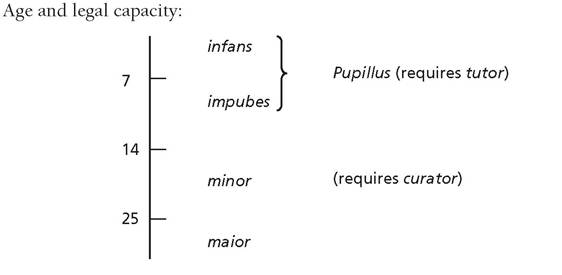
Discussion Questions:
1) The formulation plus in re est, quam in existimatione [“the (objective) fact is more at issue than the (subjective) opinion”] does not apply to Paul's decision. Probably some text has fallen out between sequi and ut [i.e., just prior to the English clause beginning “on the grounds that...”]. Do you think it possible that the compilers omitted a case (item si a minore emero, quem pupillum esse putem [i.e., “likewise if I buy from a minor whom I take to be a ward”])?
2) Someone buys a thing from a 13-year-old pupillus [“ward”]. He thinks at the time: “The seller seems somewhat young to me: certainly I shall not ask about his age.” Can the buyer usucapt?
3) What arguments speak in favor of and against allowing usucapio by a goodfaith purchaser from someone who lacks legal capacity (esp. pupillus and furiosus [“insane person”])?
Literature:
Hausmaninger (Case 82) 29 ff.
Bauer (Case 84) 136 ff.
Mayer-Maly (Case 81) 103 ff.
Wacke (Case 83) 333 ff.
c.
More on the topic B. Usucapio:
- B. Usucapio
- Introduction
- Contents
- Hausmaninger H., Gamauf R.. A Casebook on Roman Property Law. Oxford University Press,2013. — 371 p., 2013
- Rex imperator in regno suo est
- CASE 215: The Tutor as Owner
- I OWNERSHIP
- Commerce in Early Legislation
- Means of Acquisition: corpore et animo
- B. The actio publiciana and Defenses