Collective Responsibility When Harm is a Foreseen Side-EffectofCollective Action
Many harmful effects of aggregate human activity are not intended. If these results bear on responsibility for climate change, ocean plastic pollution, and so on, they must extend to foreseen as well as intended harm.
I look first at a group doing one thing intentionally while recognizing it has a harmful side effect. Then I consider cases in which a group is not acting together intentionally but its members foresee that what they do together unintentionally will have a harmful side effect. I do not consider overdetermination, because the reasoning of the previous section can be repeated once we reach the conclusion that, in cases in which there is no overdetermination, there is undiluted distribution of responsibility to members of a group collectively responsible for something.Intentional collective action with a foreseen harmful side effect is illustrated in FILLING THE TANK.
FILLING THE TANK: Ten men are hired to fill a tank at the aquarium by dipping buckets in a salt water pool and then pouring the water into the tank. They get a bonus if they fill the tank by noon. They notice that a toddler has fallen into the tank. They do not intend to harm him, but they foresee that when they fill the tank he will drown. The boy drowns.
In FILLING THE TANK, the 10 men are collectively responsible for a toddler’s death. What are their individual responsibilities? From the moral standpoint there is no relevant difference between this case and cases in which the group intends to bring about the harm. Why is there no relevant difference?
First, we can apply the NO RELEVANT DIFFERENCE principle by way of analogy. Consider a single person first who intends to drown the toddler by filling the tank. He is fully morally responsible for the death. Now suppose that he merely intends to fill the tank and foresees that the toddler will drown.
He is equally morally responsible. There is no morally relevant difference. This is an act evaluation rather than an agent evaluation. Intending harm may reveal a more vicious character than indifference. However, our concern is the relation of the agent to an outcome for which he can be held morally responsible. It is with respect to the latter that there is no morally relevant difference. By parity of reasoning, if members of a group who jointly intend to bring about a harm and do so are each fully responsible, so are members of a group who each foresee a harm as a side effect of something they do together intentionally and then do it.11Second, we can explain why there is no morally relevant difference. One has a duty not to harm others (extenuating circumstances aside). This is why it is wrong to aim intentionally at harming someone and why you are to blame if you do. The duty not to harm others is not a duty merely not to harm others intentionally, but a duty not to harm others period, whether intentionally or not. We derive from the duty not to cause harm that it is wrong to intentionally do so—not the other way around. So there can be no relevant moral difference between the case of intended and foreseen harm.
Next, what if we foresee harm as a result of our doing something together that is not intentional under any description, like causing global warming? First, we consider harms brought about by unintentional group action in which the total harm is not simply the aggregate of individual harms foreseen but brought about unintentionally by members of the group. Second, we consider harms that are aggregative in the sense that the total harm is simply the sum of the individual harms.
The case of non-aggregative harms is illustrated by UNINTENDED TANK FILLING.
UNINTENDED TANK FILLING: The aquarium pays $1 for every bucket of water someone puts in the tank until it is full. Ten men independently carry buckets of water to the tank noticing the others doing the same thing.
They are not working together but realize that they will together fill the tank. Each sees a toddler has fallen into the tank. None of them intends the toddler harm, but each realizes that when they have filled the tank through their independent actions, the toddler will drown. They fill the tank. The toddler drowns.Is this relevantly morally different from FILLING THE TANK? No. In this case, they are jointly morally responsible for drowning the toddler, and the distribution of blame is exactly the same as in the previous case. UNINTENDED FILLING THE TANK differs from FILLING THE TANK in there not being an intentional joint action that the men are undertaking. But it does not differ in their epistemic position with respect to what they are doing together (filling the tank) or with respect to their individual knowledge of what side effects they bring about by what they do jointly. The moral principle is not to do anything to harm another. It is immaterial that the background conditions for one’s making a contribution to a sufficient condition for the harm is a state of nature or of society, and it is immaterial when background conditions involve the actions of others whether those contributions are jointly intended or not. Other aspects of this case can be brought out by the contrast with aggregative harms.
The case of aggregative harms is illustrated by ARMORED CAR.
ARMORED CAR: An armored car turns over on the road, the back doors pop open, a sack of money spills out. Twenty bystanders each take $1000 in a stack of twenties. The total loss is $20,000. Each sees the others taking a single stack and that the total loss will be $20,000.
Is each responsible for the full amount? No. Why not? The main difference is the relation of the harm to what each does individually. In UNINTENDED TANK FILLING, the harm was not the sum of the harm that each of them does. While there may be harms that each contributes as a sole agent, the death is not the sum of individual harms but a harm brought about only by all of them together.
There is no separable portion of the death as such to be assigned to each. There may be differences in their causal contributions, but this doesn’t isolate a portion of the death to assign to each. None do anything sufficient and what each does is not an incremental contribution to the death (as if it were the sum of a lot of smallish harms) as opposed to a partial cause of it. There is then no way to assign to each independently just a bit of the harm. ARMORED CAR differs in this respect: there is for each a harm for which he or she is solelyresponsible. When these have been taken into account, the total harm has been accounted for. In this case, the group is not in the first instance the locus of responsibility but instead the individual members of the group. Thus, the case of foreseen but unintended aggregative harms does not engage the mechanism by which I argued that each member of a group is equally and fully responsible for what the group did. This contrast is illustrated in Figure 6.1.
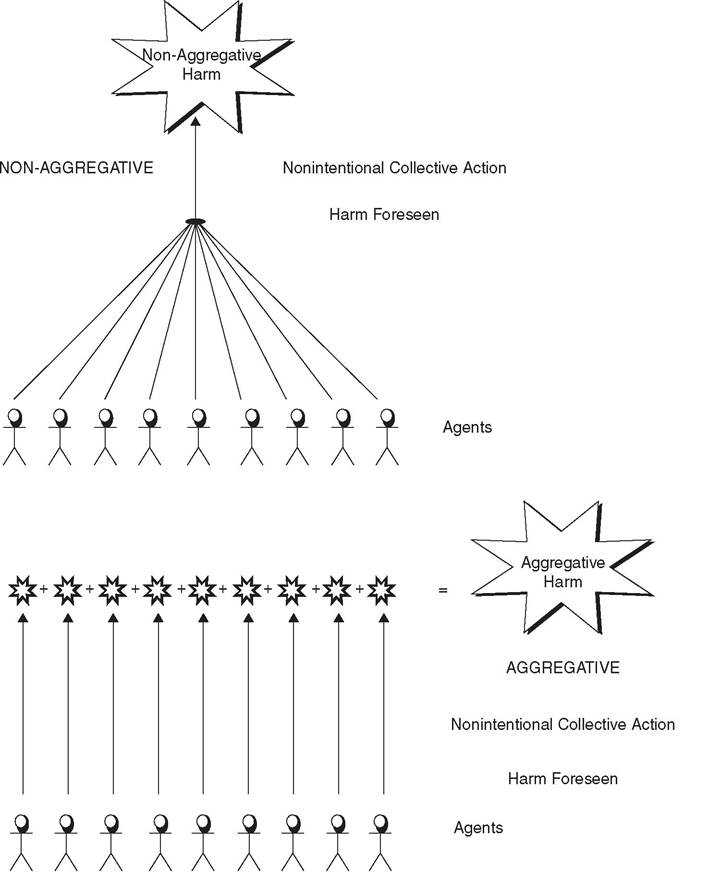
Figure 6.1 Non-Aggregative vs Aggregative Harms. In the top image, the contributions of the individual agents combine to produce a harm that is not just the sum of their causing individual harms. In the bottom image, the contributions of each leads to a discrete harm and the total harm is the sum of the individual harms.
Why is it different with aggregative harms that are intended or foreseen side effects of intended action? For intended harm the individual members conceptualize what they are doing as contributing to bringing about the total harm. When successful they do it. They take on the responsibility for doing what they intended. In the case of foreseen harm that results from something one intends to do with a group, the foreseen harm is also seen as a consequence of something intended. Thus, members conceptualize it as a consequence of something they are doing. They take on the responsibility for foreseen harms that are the result of what they bring about intentionally.
6.6
More on the topic Collective Responsibility When Harm is a Foreseen Side-EffectofCollective Action:
- Collective Responsibility When Harm is a Foreseen Side-EffectofCollective Action
- Expelling and Avoiding Harmful Spirits
- Violence converges from the bottom-up, top-down, and side-ways. Individuals most apt to find themselves in this convergence will do so at home and/or as children.
- Retrospective Responsibility and Prospective Reason for Action
- Collective Responsibility When Harm is Intended
- Article 3.4 Kuroda always looks on the bright side, but reality is dark
- Collective Action, Complicity, and Criminal Law8
- Track One Laws Concerning Messages That Cause Harm in Two Steps
- Other Dimensions of Collective Action and Liability
- What Made Humans Really Human? Cooperation and “Collective” Action at the Dawn of Humanity