The content of the social reality
The next step in the epistemological analysis of the social world after the determination of its essence is the determination of its content which is indifferent to the form and “the external form is indifferent to it; the content is something different than the form” [48, 86].
In this research, not the substrate of the social is understood under the content of the social world, but its internal state, the complex of the processes that characterize the interaction of the elements creating the social world between each other and the environment and cause their existence, development and change; in this sense the content of the social appears to be the process.At this, in the form of axiom, such a view on the world appears when everything opened to rational thinking and irrational observation occurs to be the social in the field form. At the same time it is necessary to pay attention to the fact, that the social world, based on the material stated above, is composed as if from two parts: subjective and objective, which arise on the micro level, are placed on the macro level and move to mega level.
Now we have all the reason to think that the subjective part of this contradictive unity is located in the structure of man’s personal identity and exists in the potential form. Its content is partially analyzed in the material above, where the social content is presented as the personality or as the sum of the social roles that human personalities have to play in the social life. However, we analyze not just bare social roles because they are, most likely, only the external signs of the social quality, but the social roles in the combination with their spiritual component, which comes out to the surface in the form of ether.
Another part of the content of the social is objectivized in the environment. It represents the well known objectivized reality.
It is usually called the social medium (socium). Unfortunately, this term is unknown to the philosophical thought in our country. It is just overlooked in its problem scope. For a very long time it was considered to be the “discovery” of the western philosophical thought. It was enough for us to use the category “society”, which was the productive means of the materialistic analysis of the social reality. It is reassuring that today, finally, this notion comes into attention of both Russian and Ukrainian social philosophy [See: 29; 101; 146; 157; 163].Therefore, it is better to analyze the content of the social on the level of the objectivized social world. It is connected with the fact that on this level the notion of social medium appears to be the external subject for the researcher. In this case, it appears to be the social thing, which the researcher can recreate as the neutral thing. In order to show its components, it is necessary to see the social world as the “real process of formation in its various phases” [132, 526].
Here it is necessary to make another methodological digression. Such a necessity is connected with the fact that even though separate fragments of categorical schemes of formation can be easily projected to the theoretical models of synergetic and cosmology, it is impossible to conduct further research omitting the problems of determination. Indeed, the categories of internal and external, which we have to research according to the algorithm of the procedure of formation, cannot be analyzed beyond the category of determination. Besides, the fact of causality is determined to be the genetic connection of potential and actual social worlds.
Therefore, the objective social world or the social medium is the product of double determination: basis and conditions. At this, the basis creates the content of the social world in the process of self - organization of the substrate of the “social” and the conditions quantize its specific knots - nodules of social content - of the intelligible matter.
That is why we will consider the process of self-creation of the content of the “social” under the influence of the basis or the internal forces and factors, and after that we will analyze the way of its dosage under the influence of the external conditions.First, let us make several general comments as for the problem of expression of the content of the social world. The everlasting ability of universum to self-organization lies in the forming forces typical for the universum per se, because without them the formation of different in configuration or coherence matter either sensible or intelligible is impossible. However, due to the fact that the force that forms the universum dominates both in the first and in the second nature, the beginning that brings it above the first nature should attach to it.
Here the question appears: how does the common force that forms the universum that was characteristic of the sensible matter, namely perceived by our common senses, transforms into the desire to form the intelligible matter, perceived by the spiritual senses?
Such a qualitative leap is possible only by means of the collective thinking, which, as opposed to the thinking of a separate person, already loses the signs of negentropy. The collective thinking, as it comes out from the material stated above, is directly connected with the producing of the intellectual energy by the collective person. This is connected with the fact that the collective subject is capable of producing the scientific knowledge in the process of thinking, giving that information the homogenous phenotypical character.
As earlier we have justified the fact of existence of the exchange of knowledge between the participants of the social process, here it is necessary to come out of this fact as if from the regular circumstance, which causes the intelligent interaction between people. It should be noticed that the knowledge itself, as the logical constructions, cause the internal potential in a certain space, where the actualized social world is located.
This is accomplished due to the fact that the knowledge is the senses quantized and packed into ideas. The energy fields appear between them. However, the critical mass of intellectual material should be composed for this. Then, the generic life of ethnos gets the single stream of development, with which every member has the long-term direct and return connection. Acting as the stimulating cause, the conceptual field becomes the center of crystallization of human thoughts that direct their actions to the achievement of certain goals.Thus, from the thoughts of people, the peculiar conceptual core is formed, which becomes the attractor of the process of creation of the local social world. As a result of this, the local fields (the core) of sociality spontaneously appear, which as a rule take up those parts of the space where the elite of the given ethnos is concentrated.
Therefore, the initial point of the process of objectivism is the alienation (rejection) by the human personality, or exactly by all people living on the planet, of the potential content of the social world into the environment. Here, the product of individual production that is being alienated (rejected) takes the form of the specific product that got the name of the state of mind of the people.
There is no doubt in the fact that the self-creation of the socium starts with the state of mind of the people. G.Hegel (Encyclopedia of the Philosophical Sciences) wrote that in the state, the spirit of the people, the customs and the laws were the dominating origin [57, 243]. Thus, in the famous his work Philosophy of Law the pilosopher convincingly showed that the state of mind of the people should be viewed as something that can serve as the origin and can come out of the subjective ideas and thoughts of a single nation, ethnos or finally superethnos [52, 292]. And as it is known, he connected the underdevelopment of Russian nationhood to the lack of the middle class mass producer of the spiritual material for the construction of the social life.
He writes that the state of mind of the people is something that the state got used to know as the substantial grounds and the goal [54, 292].In the theoretic research of the process of self-creation of the content of the social it is necessary to abstract from the existing social world. For this, let us analyze the formation of the intellectual products created by the individuals in the conditions of free game of cosmic forces. K. Marx and F. Engels point out to the possibility of the synergetic way of creation of life, by means of its random, spontaneous autogenesis (aseity) [See: 129, 611-612; 134, 125].
The first stage of autogenesis of the social world, if to use the common logic of forming, is composed of three secondary forming processes and three specific products, namely: societal psyche, the collective conscious and generic product of the mentality of the social unity.
We have mentioned above that the modern psychology views societal psyche as the relatively independent formation that develops beyond the mind of a separate person. What is meant under the notion of societal psyche? “In the widest sense, - O. Donchenko writes, - it is the substance of life of the socium that is passed from generation to generation in the form of the product of inheritance of history and culture of the society, which includes the geographic, climatic and landscape conditions of life of people who lived and who live on the given territory. So, using the Jung’s terminology, the societal psyche is the distinctive archetype” [70, 31-32].
Let us leave the development of more detailed characteristics of the societal psyche to the specialists, and here we will only underline its ability to save and to pass various information without the help of depictive features of the matter (for example, the brain of a person) from generation to generation. It will be wise to support the notions of the psychological science with the notions of the social science. It is important to mention the categories of objectification and disobjecti- fication discovered by K.
Marx. They have a fundamental meaning for the understanding of the content of the social as well [See: 134, 121].The nature of the societal psyche lies in the ability of both material and immaterial varieties of the matter (energetic and informational) to save the sum of the stages, characteristics, abilities, forms of behavior, samples of reactions and other processes of mental intravital realty even after the death of the organism of a person, which provides the generic memory and the succession of the in- tergenerational, specific to each particular ethnos, code of collective psychic life.
The main product of this stage is the collective conscious. The unity of consciousness, which is found in the history of development of the social theories, is the best proof of the fact that the unity and continuity exist both in collective and individual consciousness. Finally, the collective mind, or the collective conscious, which K. Marx called the “associative mind”, is formed from them. We will return to this moment.
The collective conscious went through several stages of self-organization. Otherwise we cannot explain the consequent change of form of the collective conscious. Here, as it is known, we can talk about mythology, early philosophy, theology, metaphysics, scientific philosophy and, finally, science. Even today the formation of its several forms, which are developed not enough for the full-scale - extraction of the planetary humanity, continues. Because of this reason various forms of group, collective, class, national, mythological, religious, scientific, legal, professional, political, ethical, esthetical and other forms of social consciousness appear.
Today science performs this function. It does it, basing on the attributive characteristics of the scientific knowledge. As V. Vernadsky wrote, the scientific thought covered the whole planet, all the nations on it. Numerous centers of scientific thought and scientific research were created everywhere. It was also stated that today the potency of the scientific knowledge is used not to the full extent, because very often the “social underdevelopment prevents the occurrence of breakthrough to develop in its real power” [36, 500-501].
This means that the scientific thought emerged to the first place as the important and profound basis of - reflecting event of the planetary social world. V.Vernadsky wrote, “The discovery of the idea of the social organism of formation was the ignition of the explosion of the systemic understanding of the reality. Understanding of the notion of the social organism is the demonstration of organization of noosphere” [36, 79].
After this, from the collective conscious, the super functional organs appear in noosociogenesis; they have the autonomic life in the second nature. The sociologists directly point out to the existence of such functional formations similar to the ones described by us in the structure of a person. They write, “without doubt, its substrate is not just a single organ. It, in its own way, is spread in the whole society. Nevertheless, the specific features that detach it as a separate reality are common to it. In reality it does not depend on special conditions in which the individuals find themselves; they go by and it stays. It is the same in the North and in the South, in big cities and in small ones, in representatives of different professions. Likewise, it does not change with each generation, but vice versa connects the consequent generations. Therefore, it is something different from separate consciousnesses even though it results only in individuals. It is the psychic type of the society, the type that has its own peculiarities, conditions of its existence, its means of development similar to those for individual types, but different” [6, 319]. Our task is to discover this “different”, to point out the kinds of functional organs, to show their place in the social body and to see their specific functions within the whole.
Therefore, the collective conscious of the social unity is the final product of the subjectivity of the first nature, because it appears on the basis of individual leptonic fields. Next, the objectified social develops in accordance to its algorithm. Based on the form of its existence, it is the force field. However, in itself it differs from the stages of the individual conscious; this is the notion of a different kind. The thinking of groups differs from the thinking of separate people; it has its own laws. Indeed, the collective ideas express the way based on which the group comprehends itself in its relations with the objects that influence it.
The generic product of this stage is the specific ontological basis of collective rational living substance that is called mentality. Under this notion the structure, the content of the soul of the collective person, of the ethnos, the correlation of its elements and the stages of the latter are understood [See: 89, 32]. Lately, more and more researchers are willing to view the mentality as the generic memory, which is based on the synthesis of natural and social programs of inheritance. Mentality as the morphological organ has in itself (in transformed or subjectified form) all the ontological treasure of the first and the second nature.
In the functional aspect - it is the system of collective norms of social reactions - of the group, ethnos, nation, people etc.
The category “mentality” was not always a part of the sociological vocabulary. At the beginning of the XXth century in the daily usage this term named the more common collective systems of world perception and behavior, the peculiar “forms of spirit”; today, this notion is presented in the scientific vocabulary as well. The mentality appears in the social environment due to such attributive characteristic of the latter as the mindset. The mindset means the contra- dictive wholeness of the picture of the world, the pre-reflective layer of consciousness, the socio-cultural automatisms of consciousnesses of individuals and groups, and “the global, all-encompassing “ether” of culture, in which all the members of the society are placed”.
According to the definition of L. Gumilyov, the mindset is the peculiarity of the psychic configuration and worldview of people who are the part of any given ethnic wholeness. Mindset appears in the form of hierarchy of ideas, beliefs, conceptions about the world, tastes, cultural canons, means of thought expression, and it is the most essential part of the ethnical tradition. The mindset is formed during the ethnogenesis from the natural and social material.
In order to understand thoroughly the mentality and the mindset, it is necessary to turn to the monographic work of R. Dodonov Ethnic mindset, where its descriptive, psychological, standard, structural, genetic and historic definitions are analyzed in detail. Here we will only quote the conclusion of the author about the fact that the “mindset expresses the out-of-individual side of personality” [69, 75].
The mindset is materialized in the form of life of people, traditions, values, norms of behavior, in the language (proverbs, sayings, common language culture). The mindset means something more than the style of thinking; it lies in the basis of conscious and unconscious, logical and emotional, it reflects the deep and therefore complex for theoretical fixation source of thinking and belief, senses and emotions. That is why the mindset should be viewed as something more than consciousness. In this sense it is possible to say that the mindset is the “sediment of history”. Factually, the mentality is the generic memory that is based on the synthesis of natural and social programs of inheritance, and the mindset is the process of their manifestation and usage of the kind.
Therefore, on the first stage of the process of formation of the social world the state of mind of the people is produced by three specific spiritual products, which first of all mediate the transition from the individual intellect to the collective one, and secondly open up the chain of the transformation of the intelligent component on its own collective basis. Thus the objectivized social world appears on the planetary arena. From this moment the objectivized social reality separates from its source - a separate person - and starts developing according to its own laws. The individual that created it loses his domination over it, and moreover it begins to dictate the condition of life to him. The person begins to resist (oppose) it as the hostile essence. The moment of complete spiritual alienation (rejection) begins. At this, it is important to underline that from the organizational point of view we deal with the social chaos.
The second stage of formation of the social world appears as a result of self-evolution of the collective consciousness of the social congenialities, ethnos, and people. It is the mediated moment in the creation of the objectivized social world. The original products of this stage are the civilization, division of social labor and culture.
The first product, or the result, meant only for the intrastage usage is the civilization, under which we understand the way, with the help of which people break the stream of natural development of natural processes, creating the human way of interaction of a person with the natural environment. In other words, the civilization is the means of arrangement of the collective life.
Let us pay attention to the fact that in the existing literature there is no univocal understanding of the meaning of the content of the notion of civilization. It is common knowledge that under the term of “civilization” people understand a) wide common philosophical notion, the synonym of the notion “social form of matter or the society on the whole” (F. Brodel, P.Ganchev, A.Molchanov, M. Mched- lov, A. Ursul and others); b) the stage of historical process, the social organization of civil life as the new form of sociality (classical philosophers, T. Hobbes, thinkers of the age of Enlightenement, F. Gizo, G. Bokl, M. Benediktov, V. Ilushechkin, V. Mishyn, L. Novikova, E. Sajko and others); c) concrete social community (N. Danylevsky, O. Spengler, A. Toynbee, P. Sorokin, M. Barg, B. Evrasov, T. Mylo- slavsky, F. Konechni and others).
In the research, we think that the civilization is the social organization, which appears in process of historical development of a person and serves as the means and the way of development of society and its wholeness in the process of production and recreation of the social life and the person himself. This conclusion is proved by the latest researches in the social philosophy, for example, in the works of foreign researchers (O.Spengler, A. Toynbee, F. Brodel, D. Bell, E. Toffler and others), Russian scientists (G. Gudozhnik, I. Meisel, V. Marahov, M Mchedlov, L. Novikova, V. Semenov and others), Ukrainian philosophers (V. Andrushchenko, B. Gavryl- ishyn, M. Kyrychenko, M. Mychalchenko, V. Pazenok and others) [See: 92, 6, 10].
There exists as it is known the infinite amount of definitions and classifications of civilizations. We think that throughout the human history three main types of civilization appeared: traditional, industrial and informational, which just began to show.
The civilizations appear due to the combination of two factors: the presence of creative minority and not very favorable environmental conditions. The mechanism of appearance, as well as the further dynamics of civilizations, is embodied in the idea of “challenge-response”. The surrounding (initial natural and then social) always tosses challenges to the society, which tries to overcome them with the help of creative minority. As soon as the response is found, the new challenge appears, and for it, in its turn, the new response is given. On the stage of development of civilization the responses are successful, because people use the unprecedented efforts in order to solve colossal problems and in such a way they undermine the “habitual foundations”.
The main product of the second stage of the formation of the so- cium is the division of social labor. It appears on the basis of selfevolution of civilization as the social organization of humanity itself. The moment of conscious regulation of exchange of activity within the community and the interaction of the latter with the natural and social environment appears. That is why only from the moment of creation of civilization the historical development of humanity begins in the sense that the organization, the arrangement of social life is realised in the process of the conscious activity of people, which does not cancel its objective laws, but gives the motivated and therefore the reflexive character to the social development.
The value of the division of the social labor, as E. Durkheim (The Division of Labor in Society) wrote, is in the concentration of the social connections between people. The latter is achieved thanks to the fact that the collective consciousness becomes weak and undetermined in the process of division enhancement. Due to this progressive indetermination the division of labor becomes the main source of solidarity.Indeed, the economic services that it can provide are nothing compared to the moral action created by it; its real function is to create the sense of solidarity between two or several people. Thus, M. Weber thought that the division of labor can exist 1) technically, in accordance with organization of labor and technique requirements;
2) economically, depending on the organization of the company (or depending on the budget and administrative principal, or according to the principal of private enterprise for the production of income);
3) socially, depending on the possession of the means of production.
The division of social labor as a notion is defined differently in various sciences. We use it in the widest or general philosophical sense as a social, professional division of labor or activities, which differentiates into the society in accordance with the set of various social functions, which are performed by certain groups of people and which lead to separation of diverse spheres of society (industry, agriculture, management, science, services, army etc). The manifestation of division of social labor is the exchange of activity in its qualitatively different and historically caused forms [See: 110, 454].
In human dimension, the division of social labor looks like human solidarity that the deepening of collectivism happens not only between the members of closed labor process, but among the subjects of the single life process that happens on Earth. The exchange of activity motivates a person to view himself as a part of organic unity: people depend on each other, because every person is imperfect on his own, due to the fact, that with division of labor the person was divided also. The division of labor in economic sphere provides the integration of individuals into the single social organism that stipulates their solidarity. As E. Durkheim mentions, it plays the role once performed by the common consciousness; it mainly keeps together the social aggregates of the higher types [See: 71, 5]. At this, the sociologists found out that the more energetic and determined the social consciousness would be the slower and more difficult the progress of division of labor would develop.
Division of labor, according to E. Durkheim, is the “law of nature”, and the division of social labor is its separate form. Enhancement of labor division creates the system of interconnected social functions and produces organic solidarity instead of mechanic solidarity of altruistic society. It is important to underline that the mor- phogenic function of division of labor lies in the fact that it substitutes the collective consciousness in its role of the source of social solidarity and of the basis of the moral order.
Thus, the economic aspect of labor division is connected with the increase of manufacturing. The social aspect, according to R. Aron, is connected with the possibility to live in new, created by us conditions [See: 7, 398]. In his turn, E. Durkheim saw the social aspect of this event. According to him, if the labor division produces solidarity, it is not only because it makes every individual the participant of the exchange, but because it creates the whole system of rights and obligations between people, which tie them to one another for a long time. Just like the social similarities originate the right and morality, which protect them, the labor division originates the rules that provide peaceful and regular collaboration of the divided functions [See: 71, 415].
K. Marx described this process and its role in the self-development of human life. The analysis of tendencies of labor division, mainly in large industry, allowed K. Marx and F. Engels to determine the patterns of the future society where the spontaneous character of labor division is overcome and the submission of a person to the labor division that enslaves him is destroyed [See: 128, 20]. So a person becomes whole again. We shall let the ideological bases of materialism by as yet.
The characteristic tendency of modern developed society is the embodiment of new spheres necessary for its functioning and development; the increase of number of departments in them and, accordingly, the profiling of labor division. At the same time, in every separate sphere the labor division has its peculiar and contradictive character [See: 110, 456]. In order to figure out the order of appearance of elements of the second nature we need to pay attention to the quote of E. Durkheim about the fact that the need for cooperation created the society. He underlines that it means that the latter appeared for the labor to divide, and not that the labor was divided due to social condition [See: 75, 218]. Therefore, the society genetically grows from the social division of labour. It is very important for the understanding of the process of formation of the social world. Enhancement of labor division happens, as E. Durkheim wrote, therefore, because the social segments lose their individuality, the partitions that separate them become more permeable, they grow together and this makes the social matter free for entrance into new combinations [See: 71, 239].
At the finishing stage the civilization and social labor division, being the functional organs of socium, in the process of their selfdevelopment, create a generic product-culture. Culture as a notion and as an element of the social world is absolutely multiplex. It is not an accident that in the world literature one can find hundreds of its definitions, each of which reflects this or that, often essential, aspects and characteristics of a given social phenomenon. Such situation concerning the definition of essence and content of the culture has developed because it is “a deep collective consciousness which gets to the roots of the remote past and creates a dim mosaic of stereotypes, which are given the function of distribution of probabilities” [144, 20].
The science has intensively started to search for the answer to a question on structure and elements of culture, and also to study cultural complexes which arise from elements. Studying of culture sruc- ture has begun since 1949 when American researcher E. Hoebel has suggested specifying the least unit of culture, which received the name of a cultural element. According to Hoebel‘s definition, a cultural element is an indivisible unit of the behavioral sample or a material product“ [215, 499]. So it is possible to offer a working hypothesis that under a cultural element it is necessary to understand a phenotype reaction norm of the human personality.
So, in this way the culture arises in integrity and interrelation of its spiritual, subject and functional life. In the spiritual form the culture is fixed at the whole diversity of stereotypes (impressions) of surrounding world and person, in ideas, ideals, scientific theories, ideology, and social psychology and so on. The subject form of culture is represented by the instruments of labor, the production technology, law, social institutes, works of literature and art, etc. So, in the functional form the culture is shown in images of activity of the person, social communities and institutes.
Within the framework of our present research we recognize that “culture, education, formation, development - specific means of external stimulation of the person to development and the organization of the highly effective activity, presented in products of material and spiritual work, in system of social norms and establishments, in cultural wealth, in aggregate of people’s relations to the nature, among themselves and to themselves” [187, 293]. It is its function along with interrelation with the subject of the historical action.
Here we also recognize that culture represents a continuity of natural-historical process, its internal potential, however the civilization determines the general and progressive character of its
realization by changing social structures. The culture considers the basic set of aspirations and values of civilization, which determine its humanistic orientation in general. In its turn, civilization provides socially-organizational and technological means of functioning and development of culture, but owing to this, it is capable to determin it, i.e., fixes the border of it, braking through which becomes a powerful impulse of social progress, as soon as the culture exhausts all reserve possibilities, granted to it by civilization.
Organizationally, the second stage is the social environment, understood as a total intellectual field, which is made of a number of individual fields inherent in separate personalities.
For the analysis of problems under consideration, certainly the third stage of formation of a society is the most significant, since it, contrary to the previous two stages, is the most materialized part of objectivized world. The process of objectivizing of content of the social world here seems to transcend from micro level towards macro level and becomes more appreciable and conceivable for us. Elements of the given stage concern: productive forces, labour and society.
Productive forces are the first element which arises on the basis of transformation of all previous self-evolvement of the social content; they consist of subjective (person) and objective (systems of means of production) elements. Owing to vocational training, the person is potentially capable of acting as unique means of transformation of world for the sake of personal interests and interests of others. Here the human body acts as a universal means of production. In addition to this, the system of means of production (the means of labor and objects of labor) intended to make human life more convenient. The very process of its qualitative enrichment is none other than scientific and technological advance, or when is viewed through the lences of acting characteristics, - scientific-technical revolution.
In the material culture we should distinguish the process of creation of instruments of labor. Besides, we should distinguish between two kinds of tools: those, which are designed to create, and those, which are designed to destroy. From here the bifurcation of the uniform and object-mediated process of interaction into two qualitatively opposite processes - creative, mediated by tools, and destructive, mediated by the weapon, starts. Bifurcation as history of further formation and development of a society prove, had far-reaching consequences. But on the eve of this bifurcation destructive processes were ousted from the interior life of the communities, taken out into the sphere of external interactions of these functional systems as in the form of hunting and struggle against predators, and in the form of armed conflicts with other (“alien”) communities [ 96, 114].
In addition, other sort of products of spiritual culture - sign systems, i.e. the tools of information influence, appeared. It is qualitatively different in form, and much more powerful in the force of influence on the person, product. We will notice that reference of language signs to the category of tools is not accidental. First of all, “ function, belonging to both and performing as mediator, undergirds analogy between sign and tool”, as L.Vygotsky marks [46, 123]. These both serve for the person as means of activity, “mechanism”, a conductor of his/her influence on certain systems of world around. “If in the process of labor”, B. Ananyev wrote, “the mechanism of interaction between the person and the object of labor is the instrument of labor, in the process of communication the sign, more truly, the sign system, performs the function of such mechanism” [6, 319].
Thus, a language sign - is much more than just the means of activity. Likewise the instrument of labor it is also its product. And in this very sense, as created by people, not by nature, signs and tools are social by the nature phenomena. The experience of generations is fixed in them, and to employ it every person masters not merely the tools but also appropriate sign systems.
Owing to their subjectivity, sign systems like tools receive relatively independent of their creators existence and function as components of their communities. L. Vygotsky wrote: “sign that is outside the organism, similar to the tool, is separated from an individual, and is, in its essence, a social organ” [46, 198].
Moreover, in certain fields of activity sign system is a productive social organ, special means of production, first of all, in the sense that sign systems are the most subtle tool of influence on mentality, being the major means of its production and reproduction as of human, societal mentality, as of systems of functional organs of human brain, which is being formed during a life period. O. Leontyev repeatedly specified this aspect of productivity of sign systems.
There are also essential differences between material instruments of labour and sign systems; as far as the instruments of labor; are the means of subjective-energetic influence; however signs are the means of energetic-informational influence. Thereof effectiveness of signs is appreciably independent of their substantial embodiment. Their “functional being, repeating K. Marx’s words, absorbs, so to say, their material being” [130,140].
The named above products interact between themselves owing to process in which its source, namely, a human being, finds him\herself involved in this new interaction as a means of mediation. He strives to be released from it and, thus, he strives to replace a mechanical part, i.e. the part, which provides functioning of both parts of products, upon an artificial intellect, preferring by himself instead to maintain a process of creation of new life.
Basic element of last stage of an objectivization of subjectivized first nature - labor; it is understood as the expedient live activity of the person directed towards modifications and the adaptation of objects of the nature for satisfaction of individual needs. In present research we precede from the fact that live labor, genetically growing from social labor division, represents certain type of interaction of people and means of production (substantivized person). It is that K. Marx in his work German Ideology named intercourse. Interaction of people as a product of formation of society becomes the factor of development of the second nature.
Besides, it is labor as the material form of communication that is meant; moreover, communication, taking place during interaction of people among themselves at an initial stage of socium formation, is also present here. They should not be confused. “They differ in the following”, as M.Kagan wrote: “in material intercourse spiritual activity of a subject has for an object only managements of his practical actions (italisized - V.B.), while spiritual intercourse aims towards spiritual unification of partners, attaining their togetherness, as for the practical actions, if they are used in support, serve only to the given purpose; as a rule, spiritual intercourse is carried out in a form of verbal, or by using other sign devices, dialogue” [84,131].
All the more so, in practice there are cases when productive form of intercourse restrains the development of spiritual intercourse and owing to this freely or involuntarily “slows down the sociality sails”. F. Engels wrote: “The existence of a dominative class becomes the daily increasing obstacle for development of productive force of industry as well as development of science, arts, and in particular, cultural forms of intercourse” [127, 216].
So, labor as the basic product of the third stage of formation of the social world, arises to give an individual the opportunity to realize his\her nature out, and all changes he\she has gone through have no other purpose than to make this realization easier and more complete. In this context labor should be considered as realization of a professional knowledge of the worker or man of liberal profession/ K. Marx wrote:. in such a way “under the conditions of actual (true) collectiveness individuals get freedom in their association and by means of it” [133,75].
Let’s turn our attention to the fact, that labor is a means of maintenance of normal vital functions of a person and his∖her collective formations at horizontal level. In a vertical plane its spiritual component, that is being developed. Therefore, immortality of a person is prepared at the highest levels of self-motion of universum while all industrial success of people is collecting dust on the shelves of planetary archive.
Society is a generic product at the third stage of formation of a social world. It is not necessary to expatiate on the fact, that a society is the product of human activity - of labor. It is a generally recognized fact. In addition, we will underline that presently there is no unambiguous definition of the concept of society. It to some degree complicates the explanation of its origin, place and role in a life of planetary mankind.
It is a thought, that a society is a product of vital function of people, that different authors agree with. Will remind only that G. Hegel defined a society as “system of his (the person. - V.B.) general relations” [57, 344]. According to K. Marx’ definition, as it is known, a society is “a product of interaction of people” [133, 402]. T. Parsons defines a society in a following way, “A social system... which meets all important functional requirements connected with long existence at the expense of own resources, will be called a society. For concept of a society it is important, that it should keep all structural functional bases, in order to be an independently existing system” [150, 35-58]. Unfortunately, this approach appears ineffective at society studying in development and in general in its dynamics. In this sense T. Parsons’ theory, despite its symmetry and even known refinement, nevertheless, remains one-sided.
In the native textbook on social philosophy in this connection the following is written:” According to Plato, the society is the association of people for satisfaction of their needs and is a means of realisation of people’s need of affiliation. For Aristotle it is an embodiment of a social natural instinct of the person inherent in him from birth. The religious philosophy considered it as manifestation of God’s creation. The representatives of Enlightenment (T.Hobbes, J.J. Rousseau, Voltaire) and the French materialists of the XVIIIth century interpreted a society as a form of the social agreement. G. Hegel interpreted it as a real process of vital activity of people, that is carried out owing to an embodiment of absolute idea into the life. I. Bentam recognizes a society as “a fictitious body which consists of separate persons who are considered as its functional constituent members”, G. Zimmel revives Plato’s idea about a society as a tool of realization of internal promptings, needs, and motives of individuals. M. Weber supplements it with his thesis about “some minimum interorientations”. E. Durkheim underlined the value of a division of labor. T.Parsons treats a society as a social system, which functions owing to interaction of people and social institutes. Within the framework of Marxist social philosophy a society is defined as a “set of historically conditioned forms of the general activity of people” [5, 148].
However, the common fault of the majority of definitions of a society, since it is a functional body of socium, is a static character of a picture, which researchers fix. It is a photo, instead of process. Its components, as a rule, are as follows: constant territory; self-reproduction, basically for the account of child-bearing; the developed national culture and political independence. Even such authoritative researcher as T. Parsons, who has turned so called invariant set of “functional problems” in a kernel of his concept of a society, has not avoided this shortcoming.
At the same time, the generic product of this stage as the most objectivized product has some historical modifications, which have received the specific name - a formation. We will remind that this term is used to name the society, which is, according to K. Marx’s known expression, at a certain step of historical development. For us it is a specific product of the generic process at this stage of selforganizing of the social content. Since the society as a generic product is an interaction of means of production and social labor, then, developing even under the influence of the same type of division of social labor, they can interact between themselves on the basis of different variants of connecting nexuses (the form of property or intercourse forms). K. Marx, with characteristic of him insight, noticed it and used as a base for distribution of local products of the third stage of self-evolvement of social content. Having thoroughly scrutinized the types of links between a person and society, he came to a following conclusion: there are five public formations: primitive, slaveholding, feudal, capitalistic and communistic. A formation, thus, as a product of historical development is a category of phylogenesis. Later we will consider it in more detail.
It is a paradox, but in the end of the XXth century we observe all of them de facto. Such attractive their vital capacity, to our mind, is accounted for by a problem of human qualities. Because of the deficiency of corresponding qualities of people in the modern world all public formations exist; none of them is exhausted, none of global problems of mankind is solved; in spite of the fact, that there are plenty of ideas concerning the ways of their solution.
But, as it has been shown above, two kinds of instruments of labor behave differently in the course of their functional application by a person. A person can master the language sign system, turn it into a tool of his activity, without appropriating it as a thing but only recreating it in the functional structures of the brain. The instruments of labor can be turned into the tools of the activity, only under condition of having incorporated with it spatially as with a thing.
Thereof the associacion (connection, coherence)of people with the certain instrument of labor is potentially competitive, while the same with sign systems is not. Therefore the person can turn a language sign system, in contrast to the instrument, into property of other person without losing it as means of his own activity; for the same reason the same sign system made up by one person can become means of activity of many people at the same time [See: 96, 118]. In this connection K. Marx, having noticed this difference, assumed as a basis a form of ownership of the basic means in sphere of material production, while explaining the differences between historical ways of self-organization of social life.
From the aspect of organization the given stage of formation of the social content is already the most structured and advantageously differs from two previous stages, therefore here we deal with severely structured socium which is called “sphere”. In this case, the notion “sphere” is used by us as methodological means for reflexion of the difference between the two previous stages.
At this stage the functions generated by the process of division of social labor, are already personalized and assigned to particular workers. The latter, owing to this, do not represent communities any more, but form collectives. The given stage is known to us from the scientific literature as noosphere.
Thus, we have finished the analysis of the content of socium, or objectivized social world, which is carried out at micro- and macrolevels under the influence of the basis - the potential social worlds of a particular subject of historical action.
The motion of the potential social worlds is caused by their immanent aspiration to come outward and manifest itself, i.e. to acquire finitness within the actual dimention of our planetary system. But this is only one causal part of the social world, its other part, as has been underlined above, is connected with the conditions of our planetary system. Thus, it is important to notice that if the basis has provided rational character of the second nature, than concrete conditions, within which the process of generating of the social content takes place, have the mission to determine parametres of social system. The latter have situational character, since they are connected with the stage of development of planetary mankind, for example, civilization type, the character of division of the social labor, dominating form of ownership or the appearance of society etc.
Now it is time to consider the place and the role of conditions as the second determinant of formation of the social world content. Conditions, as it is known, are that immediate with which the basis correlates as with its essential precondition; therefore the real basis inherently is conditioned by its nature. Determinacy it contains is its other form of existence.
Conditions occupy in relation to the determined by the basis social content as if an extraneous position. In this connection, they (conditions) possess also a specific function within the given process of formation. Its essence consists in quantification of social content. They as if dose it out according to known to them principle and promptly pack it in the various organizational packages. If the dimention is wrong, then abnormalities occur and we deal with a mutation of the social content. K. Marx writes convincingly about it [See: 121,70-78].
Conditions have for this purpose an original executive organ and mechanism. The nearest environment in which immediate interaction between people takes place is the operating element of conditions. As V. Afanasyev marks, that “owing to various influences of environment on the system, usually the environment is understood as both: in wide sense, as all reality, environmental system, and in narrow sense, as important, necessary environment for a system, i.e.that very system, in interaction with which the system reveals its properties, its integrity, determinacy, and not only determines, but also forms certain properties - the properties which will enable it not to merge into this environment but function and develop rather independently” [10, 151].
From above stated the understanding follows that conditions (environment) play in a process of self-organization of socium at the micro-level the same role which in the first nature is carried out by human (biological) organism, i.e. they become the competent subject of geological process, generating objectivized at macro-level social reality.
With the only difference that in the first case all parameters of social world are determined by a human body which changes all but external parameter of the social and in the second case vice versa, namely, the environment, which endows invariable social content with richness of external manifestation, determines everything. In addition, in this context it should especially be underlined that insignificant, even the least deviations in the conditions of the social world content initiation are capable of changing its appearance essentially.
The peculiar feature of the process of dosing of the social world is the following: it is carried out by the forces which exist in external to the social content environment. By origin these forces are generated, on the one hand, by attributive properties of the social content itself, on the other hand, by conditions in which it is realized. Therefore the nearest environment is a product of the content which is being based, and conditions, and as we have marked earlier in a methodological part of our work, it is a field of possible ways of self-evolve- ment of the social world. Thus, such environment merely induces the social content to development. Its basic function is to create conditions for an unlimited individualization of the social content.
There is a reason hereinafter specially to investigate as the forces of external compression such elements of environment, as the law, values, morals, after all, national idea as the system of certain stereotypes concerning accomodation of generic life. So, for example, it is logically to imagine that at the first stage of formation of socium collective feelings and experiences, archetypes and customs of the people operate, at the second - most likely such powerful social institutes as belief and knowledge, values and world outlook systems are revealed, and at the third - ideological systems and traditions as social technologies of forming the behavior of people, morality and morals as developed regulatory systems of proper and practical behavior of people. More than that, we do not deny probability that every separately taken process of formation of the social world arises as a result of operation of exclusively “own” set of forces of compression.
So, along with withdrawal of produced social content from its source, it will come across impact of various forces of external compression which have rather limited ranges for independent existence in an objective reality. In addition, the elements of compression are getting more and more “rigid” character. Rigidity in this context should be understood as necessity for generated content of the social to follow logic, contained within compulsion elements. Free causality is in action in this case.
Now we have to model the process of self-generation of content of the social world as some independent totality. Heuristic modeling allows us to cope with the task without special effort. (picture 2.3).
The “material”, which embodies integrity of the described system, is, first of all, its internal and external relations. The funda-
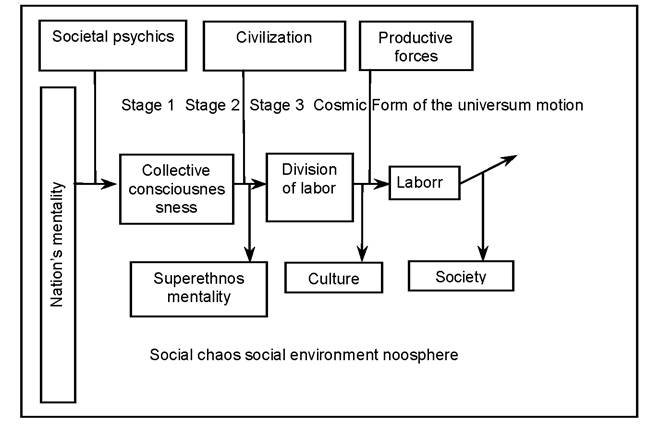
Fig. 2.3. Algorithm of socium self-development or of objectivized social world
mental organization of the social world and the order of its interaction with environment, with mechanisms of management and development of the object of research is built on the basis of these relations.
While considerating the algorithm of self-development of soci- um, we clearly distinguish three levels of organizational maturity of the content of social world: the social chaos, the social environment and noosphere. The given three structural elements of socium, since being generated in a course of the integrated morphological process, represent integrity and make a social body. It is an unusual form of rational living substance.
The ascertainment of the three elements as components of again arisen rational living formation, which does not possess morphologically accurately separated from environment structure and is as if diffused in space, is an important conclusion. Its essence consists in the fact, that, no matter what, here we deal with a morphological object. It, in particular, can be seen as rational (thinking) ether. In addition, at the same time socium as totality is supposed to sustain the processes generated within the chaos regime, go through the stage of self-organization in free social environment proceeding after that to faze of severe rationality. Our special interest is also provoked by the fact that as any living being society is capable of giving increase at the stage of functioning, as it has been with the person. In connection with stated above, we will characterize them briefly.
The social chaos. The first stage is a domain of unstructured accumulation and functioning of objectivized material, in which products of spiritual production, spontaneously rejected by a separate person, are being found in a state of chaos, in its antique sense of existing disorder, of disorder-logos, of “the big abyss filled with creative power and divine seed, as if integral chaotic mass, heavy and dark, a mix of earth, water, fire and air”. Such chaos is neither annihilation of the spiritual social content, nor its transformations into Nothing, but balancing at some border between life and a non-existence of objectivizing form of the universum. Phantoms of the past are mixed with phantoms of the future. Everything is as if in disperse state. Everythung is obscure, indistinct and not clear. A separate person is a carrier of an elementary particle of social chaos.
Coming of a social content of the given stage to the forefront of our everyday life earlier has already received the name of the Distempered times, and presently its splash is referred to as the New Distempered times. It is in the secular history, however, and in the Bible it is pictured as the Apocalypse. The current crisis of the social development has attracted attention of native scientists to social chaos as the relatively independent stage of social world formation. The stage of a social chaos, for example, was specially investigated by Y. Surmin [146].
At this stage the sources of the future blossoming and declines of empires are laid down. The border drawn between the elements here, further on materializes and parts the adherents asunder and reconciles unreconciling in the secular life. Split of ethnic fields also dates back to this sphere. Fluctuations of free energy, which take place here approximately 600 years later after the beginning of formation of a super-ethnos, cause fracture processes in its development. L. Gumilyov testifies the fact, that “the fracture phase in Arabian-Muslim super-ethnos was under a hard way when in 945 the power was seized by Ahmed Buid - the leader of deilamid’s ethnos - antisystems (kar- mats) appeared and Arabian caliphate collapsed. Moreover the the fraction became a crisis phase for other known super-ethnoses: in Rome it was the period of civil wars of 100-30 BC, and revolt of Spartak and Katilini; in Byzantium iconoclasm (a type example of uniform mentality break) and ante-system of paulicians (630-843 AD). In ancient China a break phase - an epoch of seven “Belligerent kingdoms” (IV BC), and in medieval China similar phase came after overthrow Tan’ empire (907 AD) with the beginning of the period known as times of “five dynasties and ten kingdoms”. In the West European super-ethnos the break is connected, first of all, with Reformation and Contrreformation which have split the Western world into parts - Protestant and Catholic. Increase of the number of sub-passionists (bearers of new values. - V.B.) allowed condottieres to create the whole armies, which led to huge number of victims among the population. Thus, in Germany thirty-year war took about three quarters of the population. The break had lasted till XVII cent., when the transition to an inertial phase begun. In Russia the break begun in the XIXth cent.; bloody cataclysms of the beginning of the XXth cent. (especially the civil war) are considered to be its brightest display” [65, 528-529].
At this stage of self-generation or renovating of the content the bearers of progressing values - elite - are attractors, i.e. initial points of self-organization of the social world. How painfully and how long the process of generation of new values and their approval as the centers of crystallization of new social structures is going off, can be clearly seen by visualizing the process of formation of early Christianity as social movement which involved the most part of the planet in later times.
The shifts in social chaos are always connected with the change of values which cause reorientation of the individual, and then collective and social consciousness. And only the latter, and only in the final analysis, lead to shocks of the social world. P. Sorokin investigated the question of change of values with all scientific diligence, grounding upon enormous statistical base. In his four volumes work Social and Cultural Dynamics he, equally with the others, has clearly demonstrated, that sensual system of values which finishes the present cycle of development, is being in a state of disintegration and self-destruction. There are all grounds to consider that it originated after Neolithic revolution 6-5 thousand years BC. From its depths, as the sprout from a rotten apple, the “ideation” culture of a new cycle was born, a major principle and main value of which is a pretersensual reality.
At present moment the process of renovation of the social content has been intensively taking place. It means that at the given stage the universal values become attractors and fussing germs of the future more materialized products of objectivization disorderly have already been gravitating toward them. This fact determines the depth of modern crisis of social development. The change of character of leading values has been taking place; it causes restructuring of the existing social world. The planetary mankind moves from aeon (eternity) of sensual values to aeon of prevailing of spiritual values. Thus, sensual values not only preserve their rich content, but even add\increase some functional variety. Transition from one aeon to another one will terminate at the very moment when essentially new system of morals will be developed by the planetary mankind. The leading role of human reason will constitute its main difference from presently existing one. It will be a kingdom of the intellectual. Ethnos in this context as unstructured social formation is the main operating subject.
The social environment. We have already specified, that social environment represents a set of individual intellectual fields. Such plurality has not been structuralized yet; therefore it possesses polyvariance of combinations of ways of intellectual energy potentials involvement by quantities of compound potential, and also forms of their realization. The second stage carrying out the function of mediation as if puts the social content in order, and we deal with rather stable and integral formation - the social environment. In this case by social environment we mean the same content that was determined by E. Ilyenkov. “ It is always a concrete set of interrelations between real individuals”, E. Ilyenkov wrote: “variously dismembered within itself, and not only into the basic class oppositions, but also into other infinitely various knots and links, into local “ensembles” inside of these basic oppositions, up to such nucleus as a family with its internal relations between individuals, always very alike in one, and completely different in the other, if compared with another similar family” [79,409].
It is at this point that the stable boundaries of division of the social content into objectivized processes and products appear. Owing to this stage the content of the social world acquires continuance and orderliness. The concept of structural continuance which plays an important role in self-organization theory, opens up a good deal of possibilities for consideration of dissipative structures, to which so- cium is included. The matter is that formation of the social world as a dissipative structure depends neither on the differences in initial conditions, nor on the value and frequencies of following fluctuations (if any) [See: 68, 64].
Having achieved a certain degree of maturation of the second nature formation process, which passes according to synergy laws, such environment acquires structure and turns into specific sphere in which interaction of people among themselves is reflected, and products, which had appeared in the course of this interaction, are accumulated. The concept of whole, as it is known, presupposes continuance, repeatability, reproduction of the process of establishment.
The subject of historical action, which by this time has been defined by the notion people, gets now characteristics of a nation. The definition of a nation as a historical community of people which is made in the course of formation of their common territory, economic relations, literature, language, ethnic features of culture and character, is as if a view of it from the outside. Now, if to take a look from the inside of formation process, it should be characterized, first of all, as social formation, which owns a certain degree of the social maturity with ability to pass from community to rational forms of living as the main property. In this case, the nation performs as a subject of morphogenetic process.
Noosphere. To characterize the third component of socium, it is necessary to state the difference between concepts “environment” and “sphere”. For us environment is all that surrounds, penetrates, and is involved in the orbit of activity of the subject, either as a subject, or as means, or as a condition; and sphere is referred to as some result of the environment arranged in a certain way. Therefore, noosphere, which we understand similarly to V.Vernadsky’s interpretation: is a summation of creativity of persons. Thus in noosphere products, of both, material and spiritual origin, the world evolutionary process acquires its special value owing to the fact, that it has created a new geological force - scientific thought of mankind. Here the objectivation process reaches a maximum of its objectivity.
Moreover, the mankind as the subject, endowed with activity, becomes more powerful and starts to play the role of a creator and reformer, distinct from all live substances. Laying emphasis on the special character of this metamorphosis, V. Vernadsky wrote that the mankind, taken as a whole, becomes powerful geological force. Thus, before him, before his mind and work, the question on biosphere reorganization in behalf of free-thinking mankind as a single whole is being raised. This new status of biosphere to which we, without noticing it, approach, is “noosphere”.
The noosphere arises as a universal means of creation of the basic product of the given stage. Therefore, the noosphere is a very complicated formation, which involves all attributive riches of terrestrial mankind. In this connection the definition of noosphere “as an artificial informational structure created by purposeful activity of the person”; is, in our opinion, a one-sided and inexact definition. By nature it is the universum subjectivized, and after that again objec- tuvized within our planetary system framework. Therefore, we rather agree with its following definition given by R. Abdeyev, who writes: “In noosphere besides all objects of life, instruments of labour, complex technical systems, also the information industry, integrated communication networks, global TV are created and, eventually, the processes of economic and cultural integration of the states, which strive for finding new forms of interaction, cooperation, self-improvement and the survival of a human society by the way of adaptation to changing conditions, are deepening. Because it becomes clear that only such global self-organization of life opens up the possibility to mankind of optimization of management of all ecosphere” [1, 201-202].
Example with noosphere proves that the basic substance of our world not only preserves its double beginning, but also each time it reveals it in the original form in all metamorphoses. Thus, for example, in noosphere all content of the material beginning is concentrated in productive forces of a society, and spiritual beginning is cin- centrated in scientific outlook.
At this stage the subject of historical action is transformed from a nation to collectives. The transformation of a nation to collectives is caused by the fact that at this stage people attached themselves to certain functions of workplaces; they became performers of certain roles. At this very point T. Parsons discovers correspondence between the objective process of formalization, codification and consolidation of social norms and the subjective process of their personal internalization as allochthonous (acquired) social samples of behavior. Standards of behavior of the performer he regards to as role expectations. Institualization of a number of role expectations and corresponding sanctions has a certain degree of its realization as, by the way, also has its opposition - “anomia”. Complete institualization is opposed to complete “anomia”, the break of any standard order. Anomia is manifestation of chaos at the stage of functioning of a social body.
So, we have consecutively presented the processes of socium formation having interpreted them as integrity. Young generation finds it, a reappeared integrity, already finished, and hence it is no less objective reality for them than the first nature. For the person who only begins his∖her life, socium is an external force, which will subordinate him∖her to itself and directs his∖her further development. In other words, a person as a rational living being is opposed by a society as by more powerful living integrity.
At this point it is necessary to tell more. The objectivized social world or socium should be referred to as a huge organism, which, functioning as integrity, acquires essentially new qualities, peculiar to a rational living being. Here we observe the same picture as in the case of formation of a human body. A human, as it is known, starting to act, acquired qualities of a person. We have all grounds to state that socium, having passed all three stages of formation, transforms into integrity which has the same effect. In other words, socium should be referred to as a subject - a nation, generating the effect of functioning. It is a collective person that represents functional body.
Thus the organism of socium is arranged according to the same principles as a human body is, but only the other way round. There is an objectivized spiritual part within it, the life of which runs in the form of chaos, in contrast to exact order within this element of the structure of human body. There is an objectivized material part, the life of which runs in an “exact order”, as far as it is a question of noosphere. There is also a middle part, mediator of their interaction - the social environment. The latter one is a deep aspect of life of socium.
The specific character of functioning of a social body of socium as integrity consists in the fact, that in the sphere of public consciousness chaos rules, however in the material component, on the contrary, all is efficiently and is strictly organized as would be natural in a noosphere. These features of the organic whole were fixed very accurately by F. Scheling (System of Transcendental Idealism). In the connection with this the philosopher says that change turned to itself, brought to rest, is what is meant by organization. Rest is the expression of organic formation (structure) though constant reproduction of such tranquility is possible only due to the change that continuously occurs inside [204, 209-210].
The analysis proves that at this point a functional increase should take place. And it idoes take place. Such gain of quality has a broad band of reflection in the scientific literature. However, the researchers refer to it in different ways. Most frequently the given functional quality is mentioned as “a collective person”, “a group person”, “a corporate person”, “a conditional person”, “a national person”, “a sobornal person”, “a heterogeneous person”, “a collective “I”, “a living All-Russia Person”, “a state person”, “a territorial person”, “allmankind” etc. [see: 33, 159-160, 209, 228-229, 235-236, 243, 249, 290, 463]. V. Behterev, for example, considered “a heterogeneous person” as a social body, as the integrity that consists of parts, the role of which the separate individuals, all social formations play. Even in the last degree conditional among them he consideres to be collectives. Any formations, which consist of individuals who have something in common - from a crowd to a state - fall into this category [See: 22, 87]. As it is known, K. Marx considered the mankind and the society to be a subject also [135; 21, 38]. From the analysis it follows, that the person opposes the society, which also might be rightfully referred to as a collective personality. It means that a separate person opposes a collective person. Here the interaction goes through “I” - “You” (sing.) or “You” (pl.) concepts correspondingly. It is necessary to point out, that it is still quite inappropriate to use the term “We”, in which any separate person and the collective person have something in common, that will allow them to be merged into some integrity.
At this very point the analysis of the formation of the social world objectivized content could be concluded. It is necessary to draw some general conclusions, which naturally follow the facts stated above. The first conclusion states, that in the course of our research we have approached to the definition of the social world, we have also specified its basic elements and have disintegrated the morphology. It has been revealed to us as the objectification process of the potential social world of a human personality, which had appeared as a result of another total process of the first nature subjectification. The potential social world, which used to be hidden inside the personality, has eventually realized itself as a result of its spontaneous self-organization. It has generated a society, which is morphologically composed of some social substance, which is knowledge. In other words, the self-development of any social substance is the form of interaction of the potential worlds, which function in the structure of a human personality. The macrocosm and microcosm are in constant interrelation with each other.
Thus, the human personality has emerged as the absolute basis of the social world in which the social essence (content) is given as a basis in general for the basis; or, to be more precise, the person defines himself as a social form and a social substance and imparts himself the social content. Besides, the person is a certain basis as the basis of the certain, i.e. social content; as far as the relation of the basis, in the course of its self-realization, becomes, in general, external to itself, it transfers into conditioned mediation.
At last, it became clear, that an individual admits a specific condition of life activity conceivable for the producting a social world - a free exchange with the environement, with substance, energy and information; but the condition of the life activity admits it to the same extent as the basis do; the unconditioned is their unity, the fact of the matter itself, which via mediation of the conditioned relation changes to the existence. Here you cannot help but take a great interest in the groundworks of the philosophers-existentialists, who persist on the concept of the transcedentness of the social world from the inside content of the individual. Therein we have not only examined the technological aspect of the process under consideration, but also connected it with the existential school in philosophy.
The second conclusion lies in the fact, that the genetic affinity of the first nature and the second one is demonstrated. The content of the social world as the exchange of the essential forces between people is the second derivative from the human individuality. The first derivative is the individuality itself as a product, in which the first nature is withdrawn. Thus the term “the second nature” is an exclusively apt name, when concerning the social phenomenon. Becides, in the course of the study of the social the technological connection between the two forms of the naturally-natural material is shown. They are the two different phases of self-motion of the same universum.
The third conclusion lies in the fact, that the mechanism of the self-generation of the second nature from the first one is determined. It is presented by us as the process of the human intellect products formation. Then the intellect, in its turn, passes through the three relatively independent phases in the planetary (local cosmic) envi- ronement. Here it is important to lay emphasis again on the unique character of the general function of the human individuality, lying in the self-generation of the macrocosm, the importance and the necessity of giving it the first-degree freedom for creative accumulation of the individual and collective intellectual capaαity (mental powers). The morphological processes obtain more freedom only due to the beginning of the chaos. Therein it is important to refer to the fact, that in the given case we deal with the chaos in morphogenesis and, besides, one should distinguish also the chaos in the phase of the morphological structures functioning (activity).
The fourth conclusion lies in the fact, that the objectivized social world is an independent live being, which has all basic characteristics of a rational being. Its basic difference from a person lies in the fact, that it is realised at the level of collective social formations. Thus, the society, as well as the human individual, has morphology and rich functional qualities, as it forms a collective personality. Then, we might conclude, that in the structure of a society one should search for a specific system of functional organs, similar to those, which we have revealed in a human body.
To bring the gnoseological analysis of the problem of the philosophical study of the social world to the end, we only need to consider the problem of the form, which the hereinabove content obtains. This is the very point we proceed to.
2.5.
More on the topic The content of the social reality:
- The functional aspect of the social organism
- Preface
- On Shared Mutual Beliefs
- THEORY
- Radical Political Economy
- INDEX
- Oetzel John, Ting-Toomey Stella. The SAGE Handbook of Conflict Communication: Integrating Theory, Research and Practice. SAGE Publications,2013. — 912 p., 2013
- XII USUL AL-FIQH: BEYOND TRADITION1
- REVIEW OF FORENSIC ASSESSMENT INSTRUMENTS
- The jurisprudence of interests: G e ny, Heck, Pound