Cytological Evaluation
Cytological examination of specimens from every infected ear should be a routine part of every ear examination (see Chapter 3). Information gained from studying the cellular components of ear exudates becomes an integral part of the decision-making process in treatment of ear disease.
Cytological specimens are obtained from the proximal horizontal canal to minimize contaminants and are prepared as follows:
1. A small cotton-tipped swab is inserted into the ear without touching the ear canal.
A plastic otoscope speculum to shroud the ear swab is helpful.
2. The sample is obtained by pressing the applicator tip against the ear canal as the swab is withdrawn. With this approach, packing of wax and exudates is minimal.
3. The swab is rolled onto a clean frosted-end microscope slide; the harvested material from the left ear is rolled onto the left side of the slide, and the material from the right ear onto the right side of the slide.
4. The slide is labeled with the patient’s name and the date of the sample (Figure 2-18).
5. The slide is heat fixed and stained with a blood stain (Diff-Quik or Wright-
Giemsa stain).
6. After the slide is dried, a drop of slide-mounting medium (Cytoseal60, Richard Allen Scientific, Kalamazoo, Michigan) is applied, and a coverslip is placed over the material.
In this manner, a permanent slide is made. A drop of mineral oil can be spread on the slide if permanent slides are not desired. This standardized approach to making slides allows uniform identification of organisms from each ear and allows comparison of cytological findings from visit to visit.
Evaluation of slides should begin with a low-power (100?) overview of the cell types. Look for clumps or clusters of cells. If there are large numbers of cornified
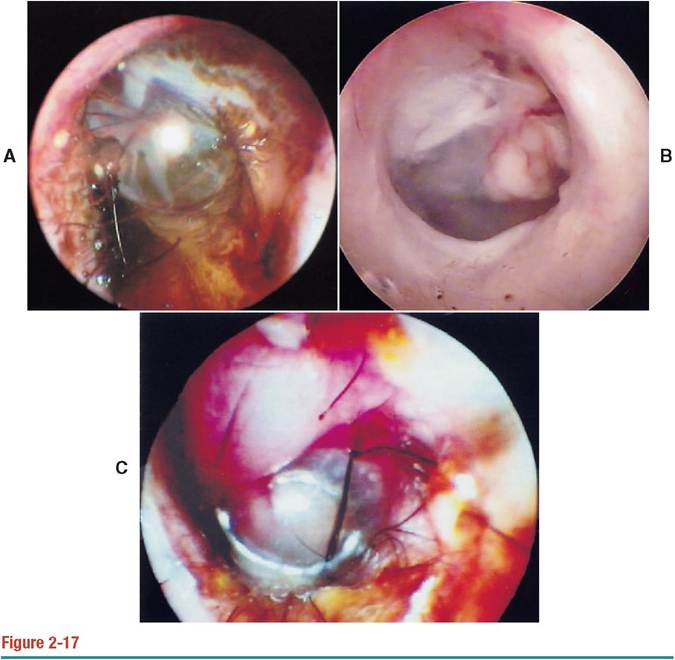
Examine for any change in shape and color of the eardrum.
A, Bulging eardrum in a Golden Retriever puppy with purulent exudate behind the eardrum. B, Granulomatous exudate behind the eardrum of a cat. C, Bulging eardrum in a 6-year-old German Shepherd with otitis media.epithelial cells or nonstaining sebaceous cells and few microorganisms, noninfectious causes of otitis such as seborrheic conditions should be considered. High-power (400?) examination is needed to characterize bacteria and yeasts. Large numbers of bacteria or yeast represent secondary invaders. When neutrophils are seen in addition to bacteria or yeasts, infection and inflammation of subcutaneous tissues must be considered. Ear mites are not often seen on stained ear swabs, but the eggs may be found. Clumps and clusters of vacuolated epithelial cells may indicate neoplasia. Inflammatory cells and acantholytic cells may also signify autoimmune disease.
To look for ear mites under the microscope, the examiner rolls swabs onto a slide containing a drop of mineral oil and applies a coverslip. Low-power examination reveals mites scurrying around on the slide, along with typical long oval eggs in the field.
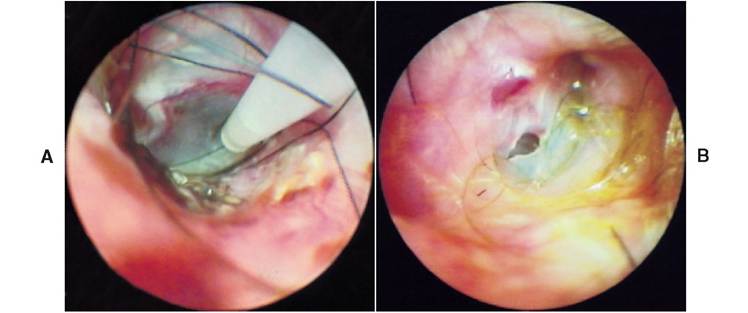
Figure 2-18
Using a 5 Fr polypropylene catheter to perform a myringotomy. A, The catheter is positioned under visualization at the 5 o'clock position. A gentle push on the catheter will make a small perforation in the eardrum. The malleus and vascular strip are visible to the left of the catheter in the dorsum of the eardrum. B, A small hole in the eardrum remains to allow exudates to drain and give access to the bulla so that it can be flushed and suctioned.
Skin Diseases Affecting the Ear
Pets with itchy ears may not have ear disease at all but may be responding to a localized pruritus associated with an underlying pruritic skin disease. Because many diseases found in the ear arise as a result of an underlying skin disease, the veterinarian should also carefully evaluate the pet’s skin to determine the underlying cause if possible.
Often, treatment for atopy, food allergy, or hypothyroidism diminishes the severity of the ear disease.Suggested Readings
August JR: Evaluation of the patient with otitis externa, Dermatology Reports, Solvay Veterinary 5(2), 1986.
Kwochka KW: Mites and related disease, Vet Clin North Am Small Anim Pract 17:1263-1284, 1987.
Little CJL, Lane JG: An evaluation of tympanometry, otoscopy, and palpation for assessment of the canine tympanic membrane, Vet Rec 124:5-8, 1989.
Reedy LM, Miller WH: Allergic skin diseases of dogs and cats, Philadelphia, 1989, WB Saunders. Simpson D: Atresia of the external acoustic meatus in a dog, Austr Vet J 75:18-20, 1997.
Sirigu P, Perra MT, Ferelli C: Local immune response in the skin of the external auditory meatus: an immunohistochemical study, Microsc Res Tech 38:329-334, 1997.
Stout-Graham M, Kainer RA, Whalen LR, et al: Morphologic measurements of the external horizontal ear canal of dogs, Am J Vet Res 51:990-994, 1990.
More on the topic Cytological Evaluation:
- Evaluation of a child presenting in the health care involves four key components, often referred with acronym HELP, i.e. History, Examination, Logical deduction and Plan of investigation. Present chapter outlines broad guidelines regarding history-taking, the first step in evaluation process.
- Functional Evaluation
- Particularities of Field Paratuberculosis Vaccination Evaluation
- LABORATORY EVALUATION OF GIT DISEASE
- Psychosocial Evaluation
- Nerve Biopsy Evaluation
- EVALUATION OF GENETIC DISORDERS
- CLINICAL EVALUATION IN NEUROLOGICAL DISEASE
- CLINICAL EVALUATION OF RESPIRATORY DISEASE
- CLINICAL EVALUATION OF GIT DISEASE
- Maintenance and Evaluation of the Marketing Plan
- Maintenance and Evaluation of the Marketing Plan
- Evaluation of the Patient With Renal Disease