Excessive Cerumen Production
The external ear canal is lined with both sebaceous and apocrine glands. The sebaceous glands are relatively superficial, surround hair follicles, and have ducts that open into the hair follicle below the surface of the epithelium.
The apocrine (tubular) glands are located in the deeper dermis, are unassociated with hair follicles, and are often referred to as the ceruminous glands (Figure 7-11).Cerumen is primarily a lipid-containing material produced by the secretory products of both of these types of glands. The sebaceous gland is a holocrine gland. Its secretion is composed of disintegrating desquamated glandular epithelial cells. The apocrine glandular secretion is a waxy acellular liquid. Cerumen, then, is composed of a mixture of sebaceous epithelial cells suspended in apocrine lipid secretion.
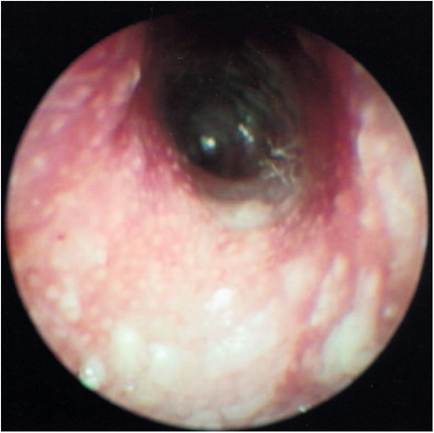
Figure 7-11
Ceruminous gland hyperplasia in its early stage. Polka dots indicate the glands with their ducts above the level of the ear canal epithelium. Clumps of the apocrine lipid secretion accumulate in this ear.
Increased ceruminous gland secretion in response to inflammation results in a more watery, humid cerumen. Imbalances in the ratio and concentration of the secretions of these two types of glands may play a role in allowing otitis externa to provide substrates necessary for infectious organisms to grow. That is why the use of ceru- minolytic ear cleaners alone can result in effective treatment for otitis externa.
As the number of hairs decreases along the length of the vertical ear canal, the number of sebaceous glands also decreases. The ceruminous glands are numerous along both the haired and nonhaired portions of the vertical ear canal.
Some authorities suggest that there are actually two types of cerumen, liquid and dry.
In humans, it is thought that residents of arctic climates favor the dry cerumen, whereas those who reside in temperate or equatorial climates tend to have more liquid cerumen. The author has observed both dry and wet cerumen in dogs and cats (Figures 7-12 and 7-13). Whether this is a genetic predisposition, as is suggested in the case of humans, or a feature of certain ear diseases, has not been determined.The hydrophobic properties of normal cerumen make it an important barrier to the entry of excessive moisture to the epithelial cells of the external ear canal. Certain components of normal cerumen such as lysozyme and interleukins are thought to provide an antibacterial and antiviral characteristic to cerumen. Routine ear cleaning in normal dogs and cats, which removes these important immunologic factors, is not necessary and may even predispose to otitis externa.
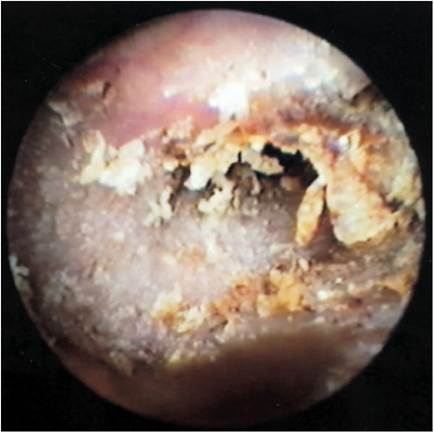
Figure 7-12
As the thick liquid lipid secretion from the apocrine glands dries out, it darkens. This is a dry cerumen.
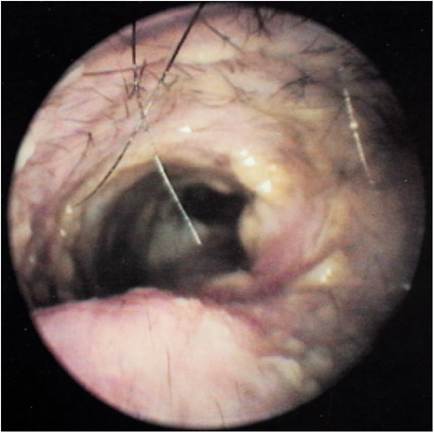
Figure 7-13
Wet cerumen tends to stay moist in the ear canal.
Under normal circumstances, cerumen that is produced along the vertical canal is transported laterally along the canal wall toward the pinna in conjunction with normal epithelial migration and is subsequently extruded. If cotton-tipped applicators are used to clean an ear canal full of cerumen and other debris, the material can be pushed toward the horizontal canal and eardrum, resulting in cerumen impaction. This condition is best treated with ceruminolytic agents or curettage of the inspissated cerumen.
A condition known as failure of epithelial migration results when the normal cerumen clearance mechanism is disrupted. Normally, keratinocytes originating from the central portion of the eardrum slide along the basal epithelium in the superficial layers along the entire ear canal and carry cerumen from the eardrum to the pinna.
Damage to the eardrum prevents the migration of these cells, allowing layering rather than promoting clearing of cerumen. The resulting accumulation can become quite large (Figure 7-14). Such ceruminoliths may be removed from the surface of the eardrum with a grasping forceps. Occasionally, soft cerumen makes grasping the entire cerumen plug impossible. These plugs are best prepared for removal by using warm flushing solution to soften the wax. Curettes and large-bore catheters connected to suction aid in their removal.Certain breeds predisposed to otitis externa, such as the Cocker Spaniel, Springer Spaniel, and Labrador Retriever, have a higher number of apocrine glands in the dermis of their ear canals than other breeds. A greater area of apocrine glands may be a predisposing factor in otitis externa. The density of glandular tissue is significantly
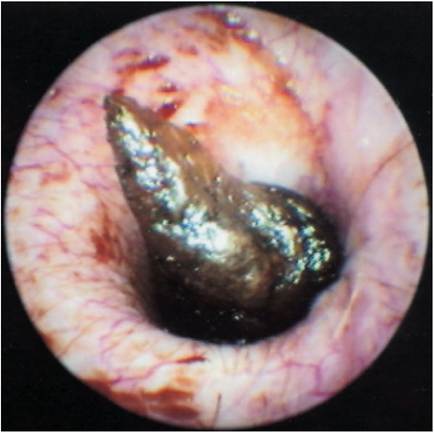
Figure 7-14
Cerumen plug extends from the eardrum into the vertical ear canal in this Miniature Schnauzer with vestibular disease. The plug put pressure on the eardrum resulting in circling. Removal of the wax plug resolved the vestibular signs immediately.
higher in the vertical (distal) ear canal, with a scarcity of glandular tissue and hair follicles in the horizontal (proximal) ear canal. In the presence of otitis externa, however, the proximal ear canal may also become infiltrated by distended apocrine glands. Cystic ceruminous glands called apocrine cysts are sometimes found in the ear canal (Figure 7-15).
Apocrine tubular glands are the major secretory glands in otitis externa. These glands increase substantially in size in response to the severity of otitis (Figure 7-16). The sebaceous glands apparently do not proliferate in otitis externa and do not increase in size. In fact, in chronic otitis the sebaceous glands are less active and are displaced by distended apocrine tubular glands. The apocrine tubular glands secrete their lipids and often dilate, but the total amount of cerumen produced may not increase because of the reduction in sebaceous secretions.
The secretion of the apocrine tubular glands may provide a nutrient-rich medium for microorganisms. It has been speculated that the presence of excessive apocrine tubular gland secretion coupled with the decreased sebaceous secretion in predisposed breeds facilitates growth of microorganisms. Many endocrinologic skin conditions affecting the ear stimulate the secretion of the apocrine tubular glands. Many of these same diseases are also immunosuppressive and may encourage the growth of microorganisms.
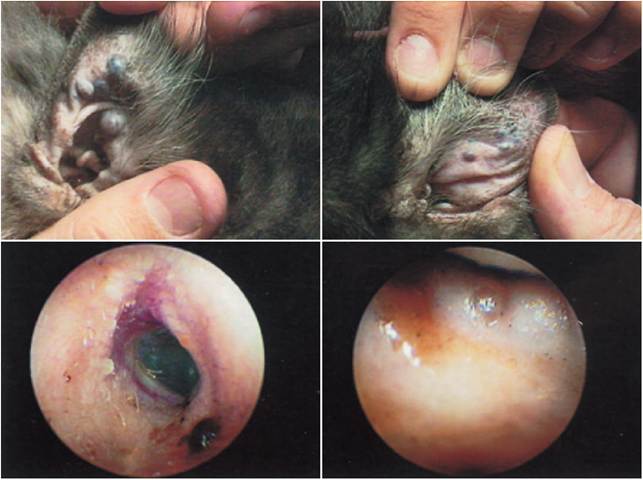
Figure 7-15
Ceruminous cysts in a Persian cat. Often seen as dark blue to black cystic structures on the pinna and in the ear canal, cystic apocrine glands may have a genetic predisposition in this breed.
Because cerumen is a hydrophobic lipid material, excessive cerumen production associated with otitis externa provides an occlusive coating of the infected epithelial tissues. Bacteria, yeasts, proteolytic enzymes, and other vasoactive substances in exudates remain sealed under the thick lipid coating. Treatment of bacterial or yeast otitis externa must include the use of ceruminolytic flushes to remove this lipid covering, to allow the topical antimicrobial agent to contact the organisms inhabiting the infected epithelium. Ear flushes also serve to remove (1) the pro-inflammatory fatty acids produced as a result of bacterial degradation of ceruminous lipids and (2) the proteolytic enzymes released by inflammatory cells.
After the ceruminous glands enlarge, they rarely return to pre-otitis size, and the ears produce excessive cerumen. Routine ear care must include frequent home ear flushes. Flushing the ears of affected patients to remove excessive cerumen becomes a preventive treatment. If the excessive cerumen is not removed, ceruminous otitis results. This condition is characterized by excessive buildup of ear wax, with bacterial degradation of the lipids. The resultant free fatty acids become triggers for inflammation, leading to erythema and pruritus. They are also the substrates that favor Malassezia growth.
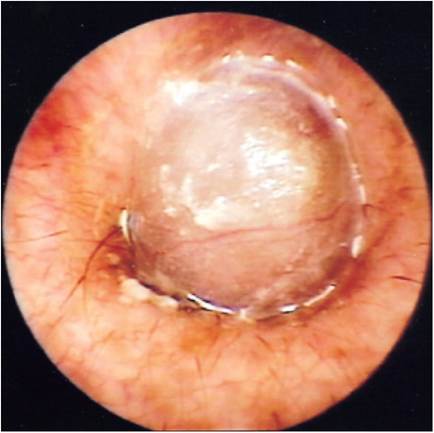
Figure 7-16
Apocrine cyst completely occluding the vertical ear canal. When this cyst was decompressed using a laser, there was significant debris accumulation between the cyst and the eardrum that had to be removed.
More on the topic Excessive Cerumen Production:
- Excessive Force and the Crisis of Colonialism
- Chapter 9 Simulating Land Use of Prehistoric Wetland Settlements: Did Excessive Resource Use Necessitate a Highly Dynamic Settlement System?
- Two hagiographical texts of the fifth century CE contain stories about demoniacs whose main symptom, excessive and insatiable hunger, was alleviated by the exorcistic cure of a saint.
- THE CONTROL OF MILK PRODUCTION AND LET-DOWN
- New production
- Net secondary production is equal to heterotroph growth
- Production of Knowledge
- TO WHAT EXTENT KNOWLEDGE ECONOMY VARIABLES COULD HAVE DRIVEN PRODUCTION
- PRODUCTION, TRADE, AND KNOWLEDGE ECONOMY IN ARAB COUNTRIES
- 20 Production