Herd-Level Prevalence
1.6.1 Dairy cattle herd-level prevalence
Due to the intensive nature of dairy farming and the long incubation period of paratuberculosis, MAP infection is prevalent and increasing in the dairy industry.
Very few countries have established low prevalence (20% (Belgium, Canada, Chile, Denmark, France, Germany, India, Israel,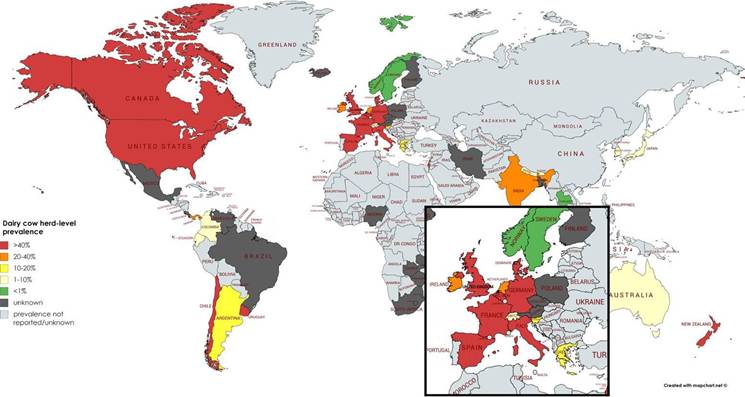
Fig. 1.1. Global dairy cattle herd-level prevalence of MAP infection. (Adapted from Whittington et al., 2019.)
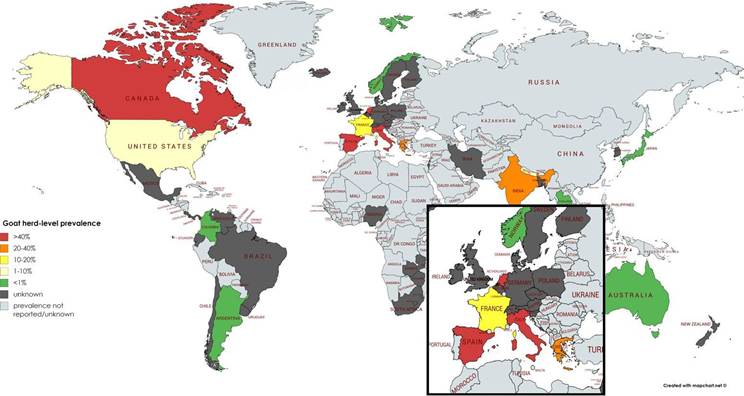
Fig. 1.2. Global goat herd-level prevalence of MAP infection. (Adapted from Whittington et al., 2019.)
Italy, the Netherlands, New Zealand, Panama, Republic of Ireland, Spain, UK, USA, Uruguay) (Whittington etal., 2019). Lombard et al. (2013) reported an apparent herd-level prevalence of 70% among American dairy farms in 2007, with Bayesian estimates being closer to 91%. A true herd-level prevalence was determined to be 46% for Canadian dairy farms using environmental cultures (Corbett et al., 2018). Elsewhere, true herd-level prevalence of MAP- infected herds was estimated to be 85% of dairy herds in Denmark, 20-71% of herds in the Netherlands and approximately 28-43% of UK herds (Geraghty et al., 2014). Some regions in Germany have an apparent herd-level seroprevalence of up to 85% (Khol and Baumgartner,
2011). Channel Island breeds are often considered at an increased risk for MAP infection; however, it is unclear whether this is due to increased susceptibility or due to increased exposure due to other farm-level factors (Sorge et al.,
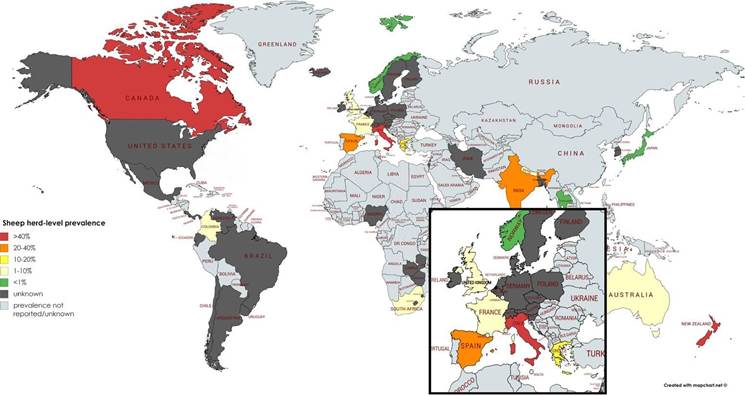
Fig. 1.3. Global sheep herd-level prevalence of MAP infection. (Adapted from Whittington et al., 2019.)
2012).
1.6.2 Beef cattle herd-level prevalence
Research investigating the prevalence of MAP infection in beef cows is limited. Prevalence is believed to be lower than that of dairy herds, possibly due to more extensive management, reducing transmission risk. Furthermore, lifespan of feedlot cattle (15-28 months) (Drouillard, 2018) is often much shorter than that of dairy cattle (5-7 years) (Hare et al., 2006) providing less opportunity for the infection to progress to clinical manifestations. In contrast to this, cowcalf herds may keep brood cows much longer (8-12 years) (Rae et al., 1993; Selk, 2018), potentially allowing for the manifestation, persistence and spread of paratuberculosis. The use of cull dairy cattle as either nurse cows or embryo transfer recipients may be a potential risk factor for introducing MAP into beef herds (Roussel et al., 2005). Herd-level prevalence is often estimated near 7% (7.9% Canadian and US beef herds) (Geraghty et al., 2014); however, these are likely underestimates (Dargatz et al., 2001). Current estimates are even higher for purebred cattle, with ~44% of American and British beef herds being positive (Roussel et al., 2005; Lawson and Caldow, 2014). This breed effect may be due to genetic susceptibility or the trade in purebred genetic stock.
1.6.3 Within-herd prevalence
A lower proportion of beef cattle is thought to be infected with MAP than dairy cattle; in a Western Canadian study, there was an apparent cow-level prevalence of 0.8% (Pruvot et al., 2014a). By comparison, apparent cow-level seroprevalence in Canadian dairy cows ranges from 1.3-7% (Tiwari et al., 2006). This lower prevalence in beef cattle could be due to the extensive management style of beef herds (Dargatz et al., 2001). Infected herds with older animals can be expected to have more visible clinical signs than herds who remove animals earlier than the typical MAP incubation period. Herds with more intensive management may expect more transmission between animals and contamination of the environment.
Cow-level prevalence is underestimated due to imperfect diagnostics. Where 2.2% of cows were detected as faecal shedders, 17% of them were tissue culture-positive at slaughter (Beaver et al., 2017). A regional study in the USA estimated a true prevalence of 8.8% of all beef cattle in a brucellosis certification programme (Hill et al., 2003). Similar results were reported from Missouri (USA) with an estimated true prevalence of 8% in beef cattle and 16% in dairy cattle, based on serum ELISA (Thorne and Hardin, 199 7). In another regional US study, 9.6% of cull dairy cows and 4.0% of beef cows were serum ELISA-positive (Pence et al., 2003).1.6.4 Sheep, goats and other ruminants
Mortality due to paratuberculosis in Australian sheep flocks is considerable, ranging from 6-8% (Bush et al., 2006). Regional herd-level prevalence in Australia ranges from 0-60%, with >5% of their national herd believed to be infected (2117 known MAP infected flocks in 2011). Australia is successfully using vaccination in paratuberculosis control (Windsor, 2015). There has been a relative lack of data on risk factors for paratuberculosis in goats (Gautam et al., 2018). However, there has been a successful eradication of MAP infection from a goat herd using extensive testing and removal of positive animals (Gavin et al., 2018). Similarly, through an intensive national campaign, Norway was able to eradicate MAP infections in their goat herds (Whittington et al., 2019). Infection with MAP in small ruminants often does not result in the same progressive diarrhoea as in cattle. These animals usually have progressive weight loss and, in sheep, impairments in their wool production (Salem et al., 2012). In New Zealand, 76% of sheep flocks and 46% of deer flocks are considered infected. In Ontario, Canada, true herd-level prevalence was 67% for dairy sheep and 83% for dairy goats, whereas within-herd prevalence was 35% for MAP-infected goat flocks and 48% for infected sheep (Bauman et al., 2016).
Without many large-scale studies on regional prevalence of MAP infection, comparisons are difficult; however, with its lack of pathognomonic clinical signs it may be reasonable to expect similar findings of relatively high prevalence within small ruminant populations without appropriate biosecurity or paratuberculosis control programmes in place (Windsor, 2015; Bauman et al., 2016). Consequences of paratuberculosis could be more troubling in developing countries that are heavily reliant on small ruminants for nutrition and trade but lack adequate infrastructure for detection and control.1.6.5 Wildlife
Mycobacterium avium subspecies paratuberculosis has been identified in >100 vertebrate species, of these, five (white tailed deer, roe deer, red deer, fallow deer, wild hare) are considered potential reservoirs for domestic cattle (Carta et al.,
2013). MAP was also isolated from rabbit faeces and urine; contaminated pastures could act as a potential reservoir for infection of cattle grazing (Daniels et al., 2003; Shaughnessy et al., 2013). There has also been a proposed risk for cattle and elk comingling (Pruvot et al., 2014b). Further, mature deer seem to be equally at risk for infection as younger counterparts.
1.7
More on the topic Herd-Level Prevalence:
- Herd-Level Prevalence and Within-Herd Prevalence in Infected Herds
- PREVENTIVE MEDICINE AND HERD FERTILITY MANAGEMENT
- “Attention must be devoted principally to raising the workers to the level of revolutionaries; it is not at all our task to descend to the level of the “working masses.” —Vladimir Lenin, 1901 (Vladimir Ilyich Lenin Internet Archives, 2022)
- Global Prevalence
- Mastitis continues to be a major cause of economic loss to the national dairy herd and I suspect that, combined with teat injuries, it is one of the greatest aggravations to the herdsman.
- Prevalence of the Metabolic Syndrome in the HIV-infected Population
- Prevalence of BTB in Ghana
- Introduction: Prevalence of Paratuberculosis in Cattle
- Prevalence and Epidemiology of BTB in Rwanda
- Quantifying Violence: Assessing the Prevalence of Trauma
- Travel to countries with high HIV prevalence
- Prevalence of BTB in Cattle Herds in Nigeria
- Incidence and Prevalence
- Tests Used in Prevalence Studies
- Epidemiology, Global Prevalence and Economics of Infection
- Prevalence of BTB in Cattle Slaughtered in Nigerian Abattoirs
- Factors affecting the level of dower