Quantifying Violence: Assessing the Prevalence of Trauma
The last decade or so has seen a shift from case-based to regional studies that apply a large-scale, population-based approach to the question of prevalence of violent interaction.
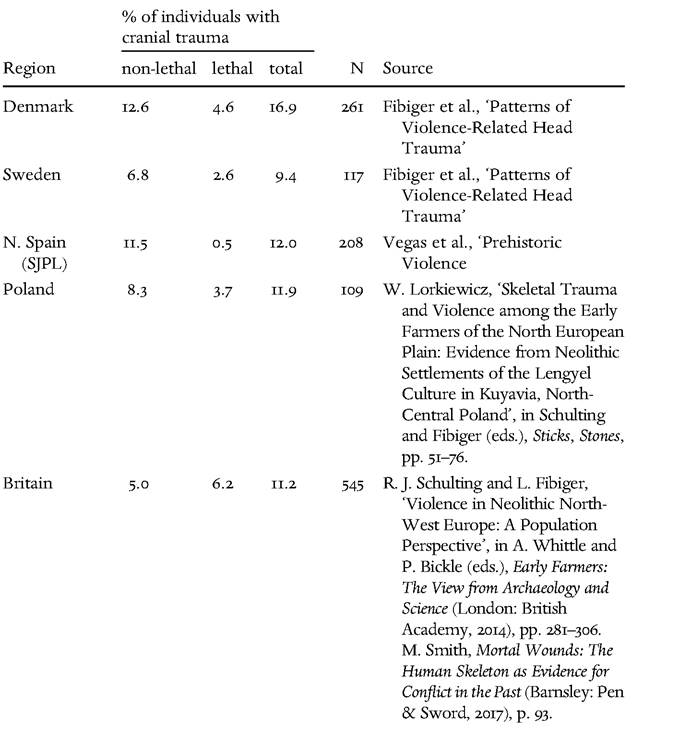
This has, for the first time, allowed researchers to put local data into a broader context, to identify patterns and to characterise regional and national evidence for violence within a broader European context (see Map 3.1). [153] This ‘big picture' approach is also important because it draws attention to normative funerary contexts; that is, places that reflect the largest proportion of the skeletal assemblages of the period but are often neglected in narratives in favour of the more spectacular mass graves sites. Rather than reflecting one- off, larger-scale violent events, these assemblages provide insights into ‘day-to- day' violence within society and are probably more representative of the lived experience of most individuals during the Neolithic.Neolithic chronology varies regionally, such that the data on healed and unhealed cranial trauma summarised in Table 3.1 range from the mid sixth millennium bce in Germany to the early second millennium bce in Scandinavia. This does not include projectile injuries, which will always be under-represented in skeletal remains, with many striking soft tissue only and so leaving no detectable traces on bone.[154] Thus, for example, while only one cranium from the Late Neolithic site of San Juan ante Portam Latinam (SJAPL) is reported as exhibiting an unhealed fracture, another six individuals have embedded arrowheads with no evidence of healing, while many others have broken arrowheads in close association with the skeleton, many of which were likely also implicated in the cause of death.[155] Injuries to the head
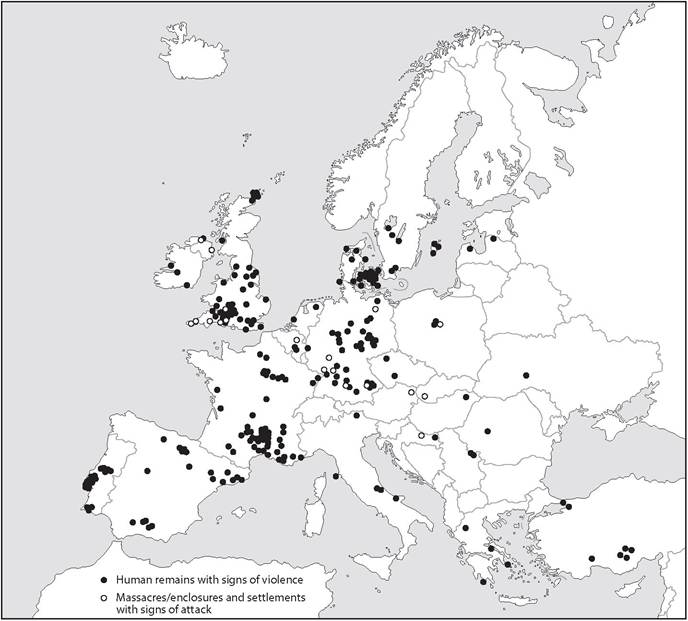
Map 3.1 Map showing locations of Neolithic human remains bearing injuries consistent with violence, and of settlements and enclosures with signs of being attacked and mass burials consistent with massacres.
On the one hand this distribution corresponds broadly with that of excavated human remains from Europe in general. However, on the other hand, the relative sparsity of locations in eastern Europe is more likely to reflect differences in the level of attention given the topic to date and in the respective publications and reports failing to reach a wider international audience. We suspect that many more examples from these latter regions will be brought to wider attention in years to come.may also have a significant impact on the individual without necessarily resulting in fractures. Thus, estimates of the prevalence of violence-related trauma in skeletal remains should be considered as very conservative.
With the exceptions of Portugal and northern Spain, there is remarkable consistency in the prevalence of lethal cranial trauma, ranging between around 3-5 per cent of the population. Including the above-mentioned unhealed projectile trauma at SJAPL would place it in the same category. What would these
Table 3.1 Skeletal trauma dating from the European Neolithic
MARTIN J. SMITH, RICKJ. SCHULTING, LINDA FIBIGBR
Table 3.1 (cont.)
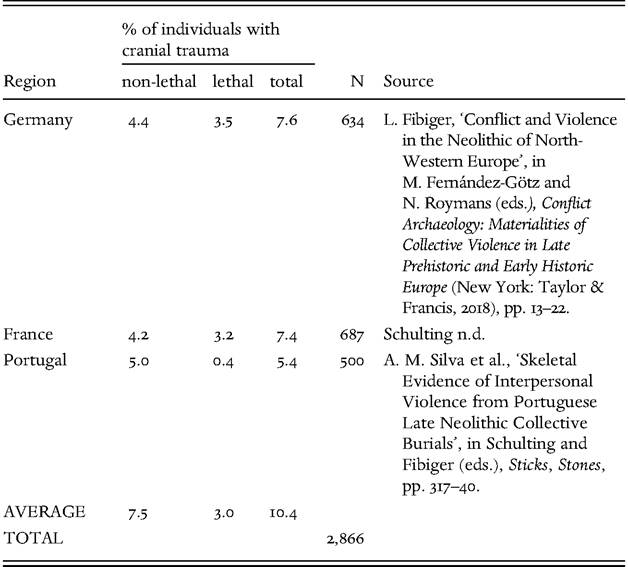
numbers have meant for people at the time? Considering that we are dealing with small-scale societies with settlements consisting of extended family groups or clans, the death of just three individuals in a community of a hundred would be the proportional equivalent of 3,000 deaths in a city of 100,000. This provides a context for sites like Talheim (38 individuals), Asparn-Schletz (67+ individuals) and Kilianstädten (26 individuals) (see Chapter 14 in this volume), which take on the character of genocide, potentially involving the elimination of entire communities or substantial portions thereof. Such events would have had long-lasting repercussions, and in the absence of a strong central political authority, the responsibility for what would be perceived as ‘justice’ falls into the hands of the surviving kin and allies of those killed.[156] While retaliation may be delayed, to
forego it altogether would be a dangerous sign of weakness. The wider economic, social and political circumstances are crucial factors in whether, when and how the memories of past injuries and insults are brought into play.[157]
More on the topic Quantifying Violence: Assessing the Prevalence of Trauma:
- Quantifying In
- Herd-Level Prevalence and Within-Herd Prevalence in Infected Herds
- Trauma
- CHILDHOOD TRAUMA
- Pinnal Trauma
- Head Trauma
- Concept of trauma
- Trauma
- Herd-Level Prevalence
- Global Prevalence
- Nonaccidental Trauma
- Assessing the Eardrum
- Prevalence of the Metabolic Syndrome in the HIV-infected Population
- Assessing the Ear Canals
- Assessing the Ming Empire
- Prevalence of BTB in Ghana
- Literature and Art, Nostalgia and Trauma
- Introduction: Prevalence of Paratuberculosis in Cattle
- Prevalence and Epidemiology of BTB in Rwanda