Assessing the Ear Canals
With the otoscope, the examiner evaluates the ear canals for the following:
• Patency or stenosis
• Color changes
• Proliferative changes
• Ulcerations
• Exudates (Figure 2-9)
• Foreign bodies
• Parasites
• Tumors
• Excessive hair or waxy accumulation.
The location of the lesion along the canal should be noted. If visibility is impaired by hair or excessive cerumen or exudates, then either plucking the hair plug or flushing the external ear canal is mandatory. Cytological and culture specimens of any exudates or secretions should be collected with a small cotton-tipped swab, curette, or catheter prior to initiation of cleaning by any method.
In otitis externa, proteolytic enzymes are produced that have a depilatory effect, so hairs may be absent on examination. After therapy has resolved the ear disease, hair regrowth is a good indicator that the treatment was successful.
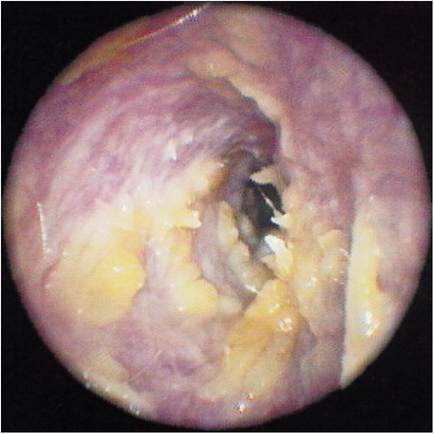
Figure 2-9
Otitis externa in a cocker spaniel. There is a yellow, creamy exudate present in the vertical canal. This cocker had a ceruminous otitis externa with large numbers of Staphylococci.
Flushing the Canals
Until a determination of the integrity of the eardrum is made, the choice of flushing solutions should be limited to nondetergent, nonfoaming types of flushing solutions. Tepid solutions (98° F) of saline or very dilute povidone-iodine solution are used to soften and loosen wax and debris. For gentle flushing, a bulb syringe should be used to irrigate the vertical canal, and a syringe and catheter should be used to irrigate the horizontal canal. This should be repeated until the ear canal is clean.
When ear disease is present, exudates accumulate along the ventral portion of the horizontal canal and remain in contact with the eardrum. Proteolytic enzymes elaborated as a result of inflammation break down the eardrum and weaken it. Therefore, even gentle flushing against a weakened membrane may cause it to rupture. Detergents and alcohols, along with many organic acids contained in ear cleaners, which are extremely irritating to the mucosa lining the bulla, may gain access to the middle ear in this manner. If this should happen, the tympanic bulla should be copiously irrigated with normal saline.
If the eardrum is visible and is normal, detergent ear cleaners are safe to use for flushing of the ceruminous ear canals. Various commercially available solutions designed to flush the ear canals are also safe for removing pus and serum from the ear canal where a detergent ceruminolytic is not required. Ear curettes of various sizes can be used to scrape large pieces of exudates off the ear canal.
More on the topic Assessing the Ear Canals:
- Hair in Ear Canals
- Stenotic Ear Canals
- Neoplasia of the Ear Canals
- Careful examination of a clean, dry ear canal in a dog or cat with otitis externa may reveal many conditions that affect the ear canal.
- Lateral Ear Canal Resection and Ear Canal Ablation
- Assessing the Eardrum
- Assessing the Ming Empire
- Assessing the Determinants of the Hong Kong Discount
- ASSESSING THE PERFORMANCE OF SAVING FOR CHANGE IN MALI
- Assessing Vaccine Efficacy in Different Animal Models
- Questions for assessing recent influential theory
- Quantifying Violence: Assessing the Prevalence of Trauma
- Inner Ear
- Ear Mites
- Flushing of the Ear Canal
- One of the most common ailments of dogs seen in a veterinary practice is ear disease.
- EAR DISORDERS
- The Normal Ear
- Ear Therapy
- Ear Cleaners