Ear Cleaners
One study looked at four commonly used ear cleaners to determine what ototoxic effects could be determined. The ingredients tested included squalene, dioctyl sodium succinate, carbamide peroxide, and triethanolamine.
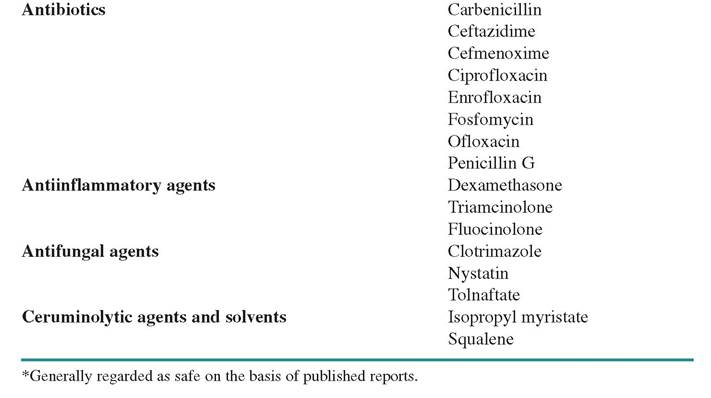
These ear cleaners were instilled into the middle ears of both dogs and guinea pigs with a normal BAER. Each product was instilled into one bulla of each test animal, only one time, through a myringotomy incision. Neurologic function and BAER were assessed every week for 28 days. Then the animals were sacrificed, and the inner ears were examined histopathologically. The untreated ear (normal control) of the same animal was used for comparison. Only the ear cleaner containing squalene showed no morphologic or neurologic changes.20 Another study comparing the vestibular and cochlear effects of the common topical antiseptics chlorhexidine, alcohol, and povidone iodine in sand rats showed that chlorhexidine and alcohol had a profound effect on both the vestibular and cochlear functions but that povidone iodine did not.21Tables 17-1 through 17-3 list drugs that have known ototoxic potential as well as those agents generally recognized as safe. These lists should be used as guidelines based on sound scientific studies for making therapeutic decisions. Until we have answers to the questions regarding which compounds are known to cause ototoxicty in dogs and cats, we should attempt to preempt ototoxicity while treating otitis. We should base the use of these topical otic products on current evidence, including laboratory studies in animals other than dogs and cats. By learning which medications and ear cleaners may be potentially ototoxic if the eardrum cannot be seen or is ruptured, and avoiding their use, we will “do no harm.”
| Aminoglycoside antibiotics | Amikacin Dactinomycin Dibekacin Dihydrostreptomycin Framycetin Gentamicin Kanamycin Netilmicin Ribostamycin Sisomicin Streptomycin Tobramycin |
| Nonaminoglycoside antibiotics | Erythromycin Ristocetin |
| Diuretics | Acetazolamide Bumetanide Ethacrynic acid Furosemide Mannitol |
| Antineoplastic agents | Actinomycin C and D Bleomycin Carboplatin Cisplatin Mechlorethamine Vinblastine Vincristine |
| Miscellaneous agents | Arsenic compounds Chloroquine Danazol Gold salts Pentobarbital Potassium bromide Quinidine Quinine Salicylates |
TABLE 17-2 Potentially Ototoxic Topical Agents
| Aminoglycoside antibiotics | All |
| Nonaminoglycoside antibiotics | Bacitracin* Chloramphenicol* Chlortetracycline* Colistin* Erythromycin Gramicidin* Hygromycin B Iodochlorhydroxyquinolone Minocycline Oxytetracycline* Pharmacetin Polymyxin B Tetracycline* Ticarcillin* Vancomycin Viomycin |
| Antiseptics | Acetic acid Benzalkonium chloride* Benzethonium chloride Cetrimide Chlorhexidine* m-Cresyl acetate Ethanol Iodine and iodophors Merthiolate |
| Antifungal agents | Amphotericin B* Griseofulvin* |
| Ceruminolytic agents and solvents | Carbamide peroxide* Dimethyl formamide Dioctyl sodium sulfosuccinate* Ethanol Propylene glycol* Polyethylene glycol 400 Triethanolamine Toluene |
| Miscellaneous agents | Cyclophosphamide Dapsone Detergents Dimethyl sulfoxide Diphenylhydrazine Mercury Potassium bromide Triethyl tin bromide Trimethyl tin chloride |
*Has an inflammatory effect on the middle ear.
TABLE 17-3 Safe Ototopical Agents*
References
1.
Little CLJ, Lane JG, Pearson GR: Inflammatory middle ear disease of the dog: the pathology of otitis media, Vet Rec 128:293-296, 1991.2. Cole LK: Microbial flora and antimicrobial sensitivity patterns of the horizontal canal and middle ear in dogs with otitis media, JAVMA 212:1549-1553, 1997.
3. deHoog M, van Zanten GA, Hoeve LJ, et al: A pilot case control followup study on hearing in children treated with tobramycin in the newborn period, Int J Pediatr Otorhinolaryngology 65: 225-232, 2002.
4. Strain GM, Merchant SR, Neer TM, et al: Ototoxicity assessment of a gentamicin sulfate otic preparation in dogs, Am J Vet Res 56(4):532-538, 1995.
5. Barlow DW, Duckert LG, Kreig CS, et al: Ototoxicity of topical otomicrobial agents, Acta Otolaryngol 115(2):231-235, 1995.
6. Hain TC: Ototoxic medications, Otoneurology Education Index: www.tchain/otoneurology/disor- ders/bilat/ototoxins.html.
7. Nuttall TJ: Use of ticarcillin in the management of canine otitis externa complicated by Pseudomonas aeruginosa, J Sm Anim Pract 39:1165-1168, 1998.
8. Jakob T, Wright CG, Robinson K, et al: Ototoxicity of topical ticarcillin and clavulanic acid in the chinchilla, Arch Otolaryngol Head Neck Surg 121(1):39-43, 1995.
9. Mansfield PD: Ototoxicity in dogs and cats, Comp Cont Ed Pract Vet 12(3):331-334, 336-337, 1990.
10. Igarashi Y, Suzuki, J: Cochlear ototoxicity of chlorhexidine gluconate in cats, Arch Otorhinolaryngol 242(2):167-176, 1985.
11. Igarashi Y, Oka Y: Vestibular ototoxicity following intratympanic applications of chlorhexidine gluconate in the cat, Arch Otorhinolaryngol 245(4):210-217, 1988.
12. Igarashi Y, Oka Y: Mucosal injuries following intratympanic applications of chlorhexidine gluconate in cats, Arch Otorhinolaryngol 245(5):273-278, 1988.
13. Pickerell JA, Oheme FW, Cash WC: Ototoxicity in dogs and cats, Semin Vet Med Surg (Sm Anim) 8(1):42-49, 1993.
14. Stypulkowski PH: Mechanisms of salicylate ototoxicity, Hear Res 46(1-2):113-145, 1990.
15. Brown RD, Daigneault EA: Pharmacology of hearing, New York, 1981, John Wiley and Sons.
16. Brummett RE, Harris RF, Lindgren JA: Detection of ototoxicity from drugs applied topically to the middle ear space, Laryngoscope 86(8):1177-1187, 1976.
17. Leake PA, Hradek GT: Cochlear pathology of long term neomycin induced deafness in cats, Hear Res 33(1):11-33, 1988.
18. Thomas J, Marion MS, Hinojosar: Neomycin ototoxicity, Am J Otolaryngol 13:54-55, 1992.
19. Ikeda K, Morizono T: Round window membrane permeability during experimental purulent otitis media: altered Cortisporin ototoxicity, Ann Otol Rhinol Laryngol suppl 148:46-48, 1990.
20. Mansfield PD, Steiss JE, Boosinger TR, et al: The effect of four commercial ceruminolytic agents on the middle ear, J Am Anim Hosp Assn 33:479-486, 1997.
21. Perez R, Freeman S, Sohmer H, et al: Vestibular and cochlear ototoxicity of topical antiseptics assessed evoked potentials, Laryngoscope 110(9):1522-1527, 2000.
More on the topic Ear Cleaners:
- Careful examination of a clean, dry ear canal in a dog or cat with otitis externa may reveal many conditions that affect the ear canal.
- Lateral Ear Canal Resection and Ear Canal Ablation
- Ear Therapy
- Flushing of the Ear Canal
- Appendix Ear Product Formulary
- EAR DISORDERS
- The Normal Ear
- Stenotic Ear Canals
- Ear Mites
- Hair in Ear Canals
- Structure of the Ear Canal
- Middle Ear
- Structure and Functioning of Ear
- Structure of the External Ear