Immunity and Immune-Based Diagnostic Tests
20.4.1 Immunological responses
Specific immune responses to MAP infections can be divided into proinflammatory and antiinflammatory reactions (see Chapter 17, this volume). The proinflammatory process is characterized by the production of IFN-γ and other cytokines involved in the cell-mediated responses, which attempt to control the infection by destroying MAP in activated macrophages (Coussens, 2001).
Shedding of MAP occurs sporadically and IFN-γ stimulates the production of immunoglobulin G2 (IgG2). The proinflammatory reactions may gradually be replaced by anti-inflammatory processes, characterized by the occurrence of IgG1 antibodies. Therefore, IFN-γ and IgG2 are mainly associated with proinflammatory responses and IgG1 with anti-inflammatory responses. Both responses may occur simultaneously due to a gradual shift between the two responses. IgG2 generally occurs at lower concentrations than IgG1 (Koets et al., 2001). The immune-based diagnostics are primarily based on the detection of IFN-γ, IgG1 and IgG2 antibodies using antigens derived from MAP.The speed of progression between disease stages is poorly characterized. Some infected cows produce antibodies several years prior to continuous shedding of detectable amounts of MAP, while antibodies may not be detectable in other animals during the early stages of infection, when MAP shedding is minimal. This phenomenon is illustrated in Fig. 20.1. It should be noted that this example cannot be considered a definitive understanding of the antibody response, because the appearance of antibodies is yet to be fully elucidated.
20.4.2 Antigens and antibodies
The choice of antigen for an immune-based test has a major impact on the test result. Antibody reactivity is not well characterized for the majority of MAP-specific antigens available. Koets et al.
(2001) characterized the ability of IgG1 and IgG2 to react with four antigens: two cytosolic antigens (heat-shock proteins), a cell wall component (lipoarabinomannan) and aTable 20.2. Examples of reported sensitivities and specificities, where the intended target condition and the given meaning differ considerably.
| Target condition | Case definition | Test under evaluation | Reported Se and Sp | Reference | Meaning of Reported Se |
| /WAP-infected | Faecal culture positive and ELISA negative | MAP0210c antibody ELISA | Se = 33.3%a Sp = 93.3%a | Li ef al. (2017) | Probability Oftesting MAP0210c positive in an animal with detectable faecal shedding of MAP and no antibodies according to a commercial ELISA |
| /WAP-infected | Faecal culture and ELISA positive | MAP0210c antibody ELISA | Se = 26.7%a Sp = 93.3%a | Li ef al. (2017) | Probability Oftesting MAP0210c positive in an animal with detectable faecal shedding of MAP and MAP- specific antibodies according to a commercial ELISA |
| Not specified; probably MAP- infectious | Faecal culture positive | Faecal PCR | Se = 70.2% Sp = 85.5% | Clark ef al. (2008) | Probability of testing faecal PCR positive among animals shedding detectable amounts of MAP |
aThe reported diagnostic sensitivities (Se) and specificities (Sp) are for an antibody enzyme-linked immunosorbent assay (ELISA) based on the MAP021 Oc antigen (Li et al., 201 7), while estimates for more antigens were presented in the paper.
336 S. Saxmose Nielsen
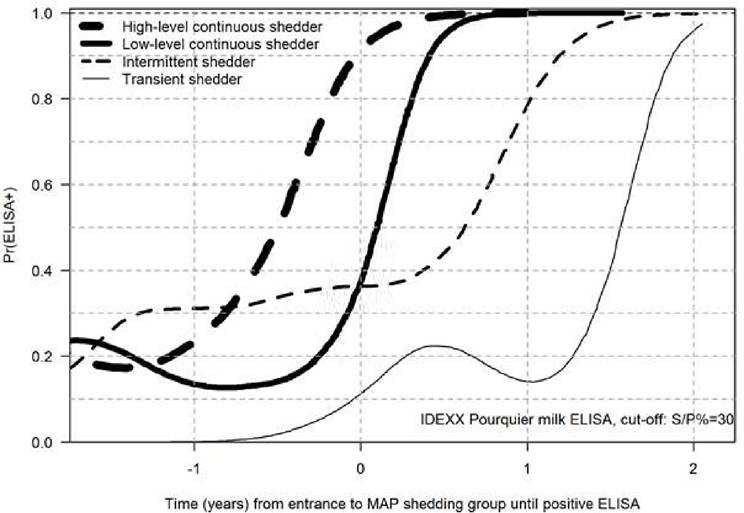
Fig. 20.1. Probability of testing positive using a commercial antibody enzyme-linked immunosorbent assay (ELISA) at various time points relative to the start of MAP shedding.
MAP-derived protein purified derivative (PPD-P) known as johnin, which is the MAP tuberculin. IgGl reactivity to all four antigens was elevated in cows classified as MAP shedders when compared with non-infected animals. Only PPD-P was associated with high levels of IgG2 in ‘non- shedders’, ‘MAP shedders’ and animals with ‘clinical paratuberculosis’. PPD-P was also associated with very high levels of IgGl in MAP affected animals. These results are complex and underline the importance of knowing the central components of a given immune-based test.
20.4.3 Types of tests and sample material
One of the most widely used immune-based tests is the indirect antibody enzyme-linked immunosorbent assay (ELISA), which detects antibodies in serum and milk samples. There is a consistent level of accuracy across different ELISAs, irrespective of whether they are used with milk or serum samples (Sweeney et al., 1995; Nielsen et al., 2002b). However, differences in the probability of testing positive during lactation exist between the two sample types. A serum ELISA is more likely to yield a positive reaction towards the end of lactation, whereas a milk ELISA is more likely to be positive at the beginning of lactation (Nielsen et al., 2002a). These differences can be used to optimize sampling but will not be discussed further in this chapter.
The IFN-γ response after stimulation of a whole-blood sample with MAP-specific antigens (e.g. PPD-P) has also been used in an ELISA- formatted test. Detection of IFN-γ depends on the processes for successful antigen presentation and presence of viable T cells, which are stimulated by the antigen to secrete IFN-γ.
Antigen presentation is reduced within 8 h of sampling. However, Jungersen et al. (2005) developed a method to rescue the costimulatory signals required for antigen presentation and T-cell reactivity, so sample processing can occur up to 24 h after sampling.20.4.4 Advantages and disadvantages of immune-based tests
The main advantages of immune-based diagnostic tests include that they are relatively inexpensive, can easily be adapted to high-throughput testing and the results can be available within 1-2 weeks in routine settings. Since antibody ELISA testing is cheaper than most agentdetecting tests, farmers are more likely to test their animals frequently, if frequent testing is required (see Section 20.6.2). The advantage of sampling milk over serum is that the milk has often already been collected for other purposes in milk-recording schemes and is easy to obtain from the animal. Since immune-based tests detect host responses to a MAP infection, they should be able to determine that an infection has already occurred and may have persisted. A prerequisite is that the performance of the test has been characterized at the various stages of infection. Repeated testing makes determination of the stage of infection easier.
A major disadvantage of immune-based tests is that they do not provide a direct measure of a MAP infection, infectiousness or of being affected by a MAP infection (see Section 20.2). Therefore, there is a need to correlate the immune response profiles to relevant stages of infection. False-positive reactions occur because in some cases the positive test results do not relate to the purpose of testing. For example, antibodies can occur prior to shedding of MAP. If the testing aims to determine whether the animal is infectious prior to this shedding, the detection of antibodies will be considered false positive, whereas the animal is actually infected.
False-positive reactions may also occur due to cross-reacting antibodies or laboratory errors. It should be noted that vaccinated animals can give a positive reaction to immune-based tests for a considerable period of time (Muskens et al., 2002) without necessarily having a MAP infection. These disadvantages make communication of test results more complex. None the less, with appropriate interpretation, immunological tests may be more reliable than microbiological tests, depending on the purpose of testing.
20.5
More on the topic Immunity and Immune-Based Diagnostic Tests:
- Application and Interpretation of Findings From PCR-Based Diagnostic Tests
- Evaluation of Diagnostic Tests Under Local Conditions
- Diagnostic Tests
- APPENDIX TWO Serological and Molecular Diagnostic Tests
- Quality Control of PCR-Based Diagnostic Assays
- Diagnosis Based on the Use of Ante-mortal Tests
- Immune-Based Diagnosis of Paratuberculosis
- Simple and non-invasive tests, confirmatorytests, follow-up tests
- IMMUNITY AMONG DIFFERENT ANIMAL GROUPS
- Commercial Diagnostic Kits
- INNATE IMMUNITY
- Tests Used in Prevalence Studies
- DIAGNOSTIC TECHNIQUES
- ACQUIRED IMMUNITY