Mycobacterium avium
5.2.1 Discovery of Mycobacterium avium
Avian tuberculosis is a chronic wasting disease of wild and domesticated fowl that is difficult to detect in its early phase. Advanced disease is characterized by weight loss, fatigue, ataxia, reduced egg production and ultimately death (Feldman, 1938; Thorel et al., 199 7).
When Koch first defined the aetiology of tuberculosis, it was assumed that a single type of tubercle bacillus was responsible for all forms of the disease. However, by the early 1890s, there was evidence that the avian tubercle bacillus, originally called Bacillus tuberculosis gallinarum, but generally known as M. avium, was distinct from the human (Mycobacterium tuberculosis) and bovine (Mycobacterium bovis) types (Anonymous, 1891; Maffucci, 1892). Whereas the mammalian isolates produced colonies with a ‘dry’ morphology that would not grow above 41°C and were virulent in guinea pigs but not birds, avian isolates typically had a ‘moist’ morphology, grew at temperatures >42°C and were virulent in birds and rabbits but not guinea pigs.By using these criteria to classify isolates from tuberculous animals, it was discovered that infections due to M. avium were common in swine. It had long been recognized that avian tuberculosis was contagious among birds and now it appeared that this disease could be spread to hogs. Investigations revealed that afflicted swine had usually been in contact with sick birds and, in several cases, had actually consumed offal from infected fowl (Feldman, 1939). Mycobacterium avium was also isolated from diseased cattle, sheep, deer, marsupials and non-human primates.
‘Corresponding author: christine.y.turenne@gmail.com
© CAB International 2020. Paratuberculosis: Organism, Disease, Control, 2nd Edition
(eds M.A. Behr et al.)
Although considered relatively resistant, mice, rats, squirrels, dogs, goats and horses could be infected experimentally (Feldman, 1938; Thorel et al., 1997).
5.2.2 Mycobacterium avium and human disease
Despite the broad host range of M. avium, humans seemed immune to infection. Between 1901 and 1911, the British Royal Commission on Tuberculosis conducted an extensive study to address the possibility of disease transmission between animals and humans. They concluded that M. bovis could be transmitted to humans via infected beef and milk. In contrast, the risk posed by M. avium-infected eggs and fowl appeared negligible (Miller, 1911). Even so, there continued to be sporadic reports of human disease caused by M. avium. Most publications were methodologically flawed and unconvincing, but when Feldman conducted a critical review, he identified 13 probable cases, dating back to 1905 (Feldman, 1938). In another attempt to resolve this issue, Branch (1931) collected strains described in previous studies and subjected them to a uniform set of tests. After assessing both morphological and pathological characteristics, he determined that several isolates were genuine examples of M. avium and thus represented authentic cases of human infection. Of the remaining strains, some were typical of M. tuberculosis, whereas others did not conform to known types. Branch suggested that these atypical isolates represented novel acidfast pathogens.
5.2.3 Mycobacterium paratuberculosis is a subspecies of Mycobacterium avium
DNA sequencing-based approaches are less subjective and more reproducible than traditional classification schemes, but results can seem at odds with phenotypic observations. Historically, the avian tubercle bacillus, the wood pigeon bacillus and the agent of Johne's disease were classified as separate species (McFadden et al., 1987; Saxegaard and Baess, 1988; Yoshimura and Graham, 1988). However, genetic analysis reveals extensive homology and current nomenclature identifies these organisms as subspecies of M. avium (Thorel et al., 1990).
Mycobacterium avium subsp. avium refers to the classic avian tubercle bacillus.
Mycobacterium avium subsp. silvaticum, also known as the wood pigeon bacillus, is an uncommon cause of tuberculosis in wild birds and deer. The wood pigeon bacillus was traditionally distinguished by a requirement for mycobactin upon primary isolation, but this siderophore-dependence is lost upon subculture. Mycobacterium avium subsp. avium and M. avium subsp. silvaticum exhibit similar morphological characteristics and both are bird pathogens capable of causing disease in mammals; as such, their high genetic similarity (ANI >99.9%) is not entirely surprising.Although not officially validated, the designation M. avium subsp. hominissuis is widely accepted and aims to distinguish human- and pig-derived strains from bird isolates (Mijs et al., 2002). Phylogenomic analysis of isolates from Asia, Europe and North America have revealed extensive diversity within M. avium hominissuis, including evidence for at least five distinct lineages (Uchiya et al., 2017; Yano et al., 2017). Additional studies are required to capture the true global diversity of M. avium hominissuis and elucidate the relationship between strain genotype, phenotype and pathogenic potential.
MAP refers to the former Mycobacterium paratuberculosis or Mycobacterium johnei, the agent of paratuberculosis or Johne's disease. A thorough history of Johne's disease/para- tuberculosis has been provided elsewhere (see Manning and Collins, Chapter 1, previous edition of this book), but it should be noted that in their initial description of ‘pseudo-tuberculous enteritis', Johne and Frothingham postulated that the avian tubercle bacillus was responsible. By use of multilocus sequence analysis, the phylogenetic relationships of all recognized M. avium subspecies were better established (Turenne et al., 2008). Out of the heterogeneous mix of environmental and opportunistic strains represented by M. avium hominissuis emerge two independently evolved pathogenic clones (Fig. 5.1.). One of these comprised the
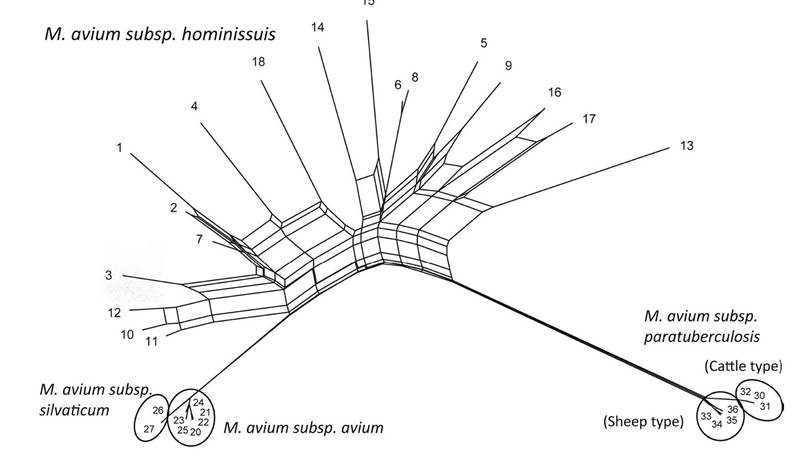
Fig.
5.1. Split network phylogeny of Mycobacterium avium species using the concatenated sequences of ten multilocus sequence analysis genes. (Adapted from Turenne et al., 2008, with permission.)avian subspecies (M. avium subsp. avium and M. avium subsp. silvaticum) whereas the other only included MAP strains, with separate phylogenetic branches observed for the sheep (S) and cattle (C) lineages. The two major sublineages of MAP were subsequently confirmed by whole genome sequencing (WGS) of >140 strains (Bryant et al., 2016). The MAP-C group is traditionally associated with cattle strains, but encompasses isolates from diverse hosts, including goats, sheep, deer, bison and humans. Similarly, the MAP-S group, traditionally associated with sheep strains, also includes isolates from goats, deer and camels. For a thorough discussion of MAP genomics, see Chapter 6, this volume.
Although not formally considered a subspecies of M. avium at this time, genomic analysis has recently revealed that M. Iepraemurium, the agent of murine and feline leprosy, is very closely related to M. avium (van Ingen et al., 2018). It has been suggested that M. lepraemurium evolved through massive gene decay and reductive evolution from a M. avium-like ancestor (Benjak et al., 2017).
5.3
More on the topic Mycobacterium avium:
- The Mycobacterium avium Complex
- Environmental Reservoir of the Mycobacterium avium Complex
- Mycobacterium avium Complex
- Mycobacterium Avium Complex Infection
- Cultivation of Mycobacterium avium subsp. paratuberculosis
- Proteins and Antigens of Mycobacterium avium subsp. paratuberculosis
- Molecular Genetics of Mycobacterium avium subsp. paratuberculosis
- Infection of Non-Ruminant Wildlife by Mycobacterium avium subsp. paratuberculosis
- Mycobacterium avium subsp. paratuberculosis in Animal-Derived Foods and the Environment
- Drug Susceptibility Testing and Antimicrobial Resistance in Mycobacterium avium subsp. paratuberculosis
- Host-Pathogen Interactions and Intracellular Survival of Mycobacterium avium subsp. paratuberculosis
- Comparative Genomics and Genomic Epidemiology of Mycobacterium avium subsp. paratuberculosis Strains
- TUBERCULOSIS, MYCOBACTERIUM BOVIS AND MYCOBACTERIUM CAPRAE INFECTIONS
- Mycobacterium spp. Infections
- Mycobacterium Tuberculosis
- Mycobacterium spp. Infection: Tuberculosis, Paratuberculosis
- Mycobacterium bovis Infection in Humans