Otitis Media Prevents Healing
Otitis media is a highly secretory condition. Copious mucus results from the increased number and activity of goblet cells lining the tympanic bulla. Purulent exudates result from inflammation within the middle ear.
The fluid may be thin and serous or thick and mucopurulent. The accumulation of mucus and pus creates a high fluid pressure between the middle ear cavity and the horizontal canal of the external ear canal. When the eustachian tube is inflamed or the exudate is very viscous, the fluid escapes from the middle ear cavity along the path of least resistance, which is through any perforation in the eardrum, and moves into the external ear canal. For healing of the tympanic membrane to progress, the mucus and pus must be removed from the bulla and ear canal (Figure 15-8).Effective treatment for otitis media diminishes production of mucopurulent fluid. Until the amount of fluid produced by the mucoperiosteum decreases, any attempt at eardrum healing is negated by the constant flow of fluid through the perforation. In addition, treatment for otitis externa reduces the quantity of exudates in the horizontal canal and alters the chemical composition of the exudates that move distally along the ear canal toward the eardrum. By properly treating the ear canal, the quantity of proteolytic enzymes decreases. The enzymes are not available to destroy the new epithelium that is attempting to heal the eardrum.
Depending on the severity of the otitis externa or otitis media, lysis of the malleus bone may be evident, and the germinal centers overlying this important structure destroyed. Extensive fibrosis may be present in the pars flaccida and around the annulus of the eardrum, occluding the vascular supply to the eardrum and leading to ischemia (Figure 15-9). In either case, the essential components for eardrum healing are removed and a chronic perforation remains.
Even if the otitis media is successfully treated and resolved, the eardrum may not heal completely closed. Often, a ring of hyperkeratotic epidermis surrounds the hole in the tympanic membrane; this condition represents a permanent perforation. Sometimes the eardrum will grow back only partially (Figure 15-10), and the middle ear is primed for inflammation. Any substance in the external ear canal, such as flush solution, exudates, loose hairs, epithelial cells, cerumen, or ototoxic otic drugs, can enter the middle ear and initiate an inflammatory response. Bacteria and yeasts gain access to the middle ear and provoke infection. Dogs with a permanent perforation of the tympanic membrane should not swim or get water in their ears. Veterinarians and groomers should be aware of this condition to ensure that no ototoxic ear cleaner or ototoxic topical medication enters the ears; otherwise, frequent flare-ups of otitis media result.
Chronic, persistent perforations of the tympanic membrane are common in dogs. In people with permanent holes in the tympanic membrane, the standard treatment is myringoplasty. This procedure is not performed in cats or dogs, however. An ongoing area of intense research is to identify substances that may be applied topically to the perforation to institute closure.
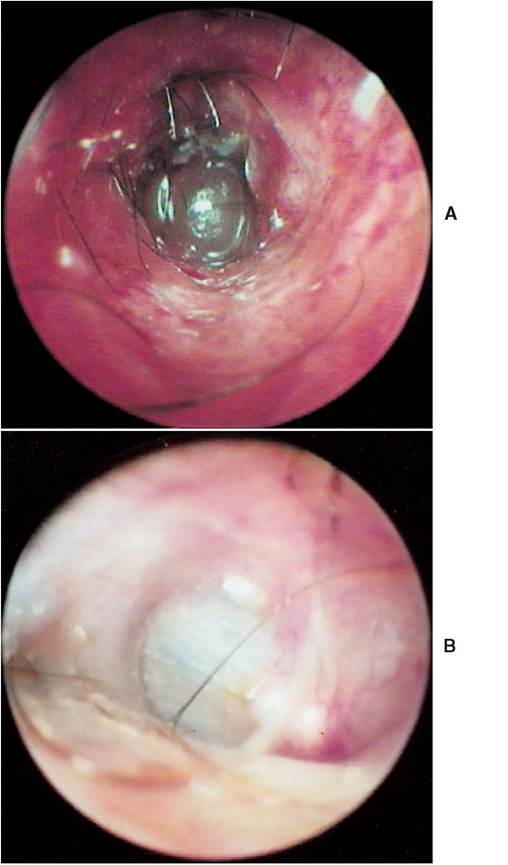
Figure 15-8
A, Severe mucopurulent discharge from the ear of an 8-year-old Shih-Tzu. The cytology revealed rods and neutrophils, and culture revealed Pseudomonas. The eardrum was not visible.
B, After 6 months of treatment consisting of systemic and topical enrofloxacin, periodic middle ear flushes, tris-EDTA flushes by the owner at home, and topical and systemic corticosteroids, the eardrum healed.
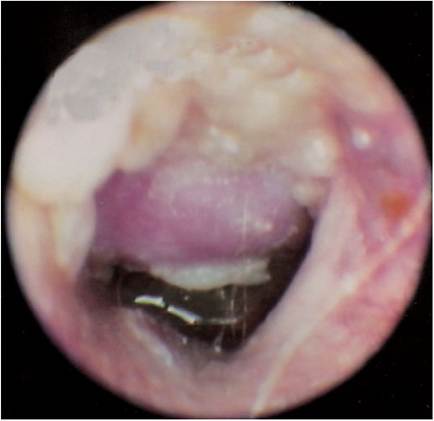
Figure 15-9
Chronic otitis media with extensive granulation tissue and fibrosis in the area of the pars flaccida, causing ischemia of the eardrum.
The affected dog has permanent chronic otitis media, which requires total ear canal ablation and bulla osteotomy.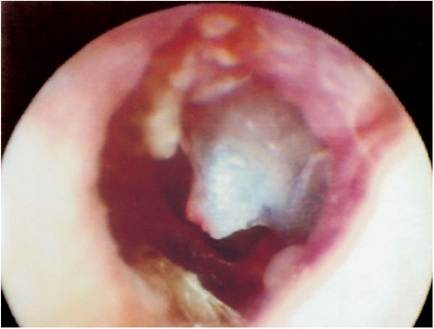
Figure 15-10
Chronic unstable otitis media. The eardrum has healed as much as it can. The middle ear mucosa is hyperemic, but no mucus or pus is seen. Any foreign substance that irritates the mucosa will result in otitis media.
Suggested Readings
Boedts D: Tympanic membrane perforations, Acta Otorhinolaryngol Belg 49:149-158, 1995.
Caye-Tomasen P: Changes in goblet cell density in rat middle ear mucosa in acute otititis media, Am J Otol 16:75-82, 1995.
Clymer MA: The effects of keratinocyte growth factor on healing of tympanic membrane perforations, Laryngoscope 106:280-285, 1996.
Gotthelf LN: Secondary otitis media: an often overlooked condition, Canine Pract 20:14-20, 1995.
Koba R: Epidermal migration and healing of the tympanic membrane: an immunohistochemical study of cell proliferation using bromodeoxyuridine labeling, Ann Otol Rhinol Laryngol 104:218-225, 1995.
Little CJL, Lane JG, Pearson GR: Inflammatory middle ear disease of the dog: the pathology of otitis media, Vet Rec 128:293-296, 1991.
Mattson C: Myringosclerosis caused by increased oxygen concentration in traumatized tympanic membranes: experimental study, Ann Otol Rhinol Laryngol 104:625-631, 1995.
Somers TH: Histology of the perforated tympanic membrane and its muco-epithelial junction, Clin Otolaryngol 22:162-166, 1997.
Steiss JE, Boosinger TR, Wright JC, et al: Healing of experimentally perforated tympanic membranes demonstrated by electrodiagnostic testing and histopathology, J Am Anim Hosp Assoc 28:307-310, 1992.
Truy E: Chronic tympanic membrane perforation: an animal model, Am J Otol 16:222-225, 1995.
More on the topic Otitis Media Prevents Healing:
- Otitis Media
- Primary Otitis Media in Cats
- Treatment of Otitis Media
- Otitis media is a common disease process that often goes unrecognized in most veterinary practices.
- Microbiology of Otitis Media
- Secondary Otitis Media in Dogs
- Pathogenesis of Secondary Otitis Media
- The Use of Corticosteroids in Otitis Media
- 14 Diagnosis and Treatment of Otitis Media
- Healing
- Healing Process
- Illness and Practices of Healing in the Texts of Qumran
- Towards the Healing of Schism
- 15 Healing of the Rupture Eardru
- Sites of ritual healing are known throughout the ancient Mediterranean world, particularly those related to the cult of Asklepios.