Healing Process
Unless the structures associated with the eardrum are completely destroyed, the eardrum attempts to heal. The mechanism for healing of a ruptured eardrum requires the presence of an adequate blood supply and a viable germinal epithelium.
Regrowth of the eardrum depends on these vital structures, so the ability of the eardrum to heal is determined by the extent of the damage to them.As discussed elsewhere, the germinal epithelium for the epidermal layer of the tympanic membrane is located in the area of the manubrium of the malleus and grows radially toward the annulus of the tympanic membrane from that location. Vascular supply to the germinal epithelium is derived from the blood vessels branching from the pars flaccida along the “vascular strip.” If the malleus is preserved and the vascular strip is not compromised, the process of healing can continue (Figure 15-6).
The mechanism of healing in experimentally induced acute perforations of the eardrum has been studied in the dog. Tympanic membranes were perforated using a technique of subtotal myringectomy or by electrocautery. In these experiments the attachment of the malleus to the tympanic membrane and vascular strip were preserved. Tympanic membrane healing was observed in all dogs otoscopically. The time required for complete regeneration of the ruptured eardrum ranged from 3 weeks to 4 months.
Cytologic studies of the way the tympanic membrane heals reveal that around the perforation border, keratinocytes on the external surface of the eardrum begin to proliferate. At the same time, fibrous connective tissue cells from the middle layer proliferate. The inner mucosal epithelial layer differentiates into ciliated and secretory cells only at the perforation border and cooperates with the proliferated
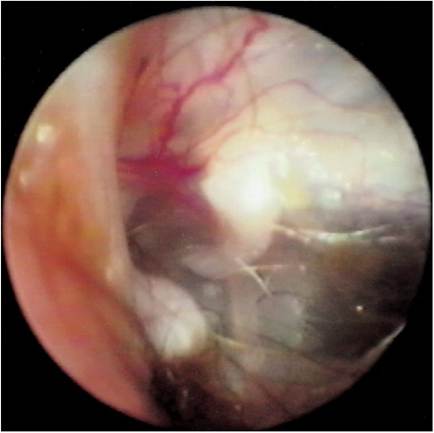
Figure 15-6
Prominent blood vessels demonstrated along the pars flaccida. This is the major blood supply to the eardrum.
keratinocytes to close the perforation. The superficial epithelial layers of the eardrum appear to be effective at rapidly moving toward the tympanic membrane perforation to form a temporary patch, but it is the slower-moving basal epithelial cells that are involved in permanent closure of the perforation (Figure 15-7).
The intensity of this process may be directly proportional to the oxygenation provided to the cells by the intact vasculature. Vascular compromise or ischemia may impede tympanic membrane healing. Experimentally, in rats, aeration of the ruptured eardrum with increased oxygen concentrations resulted in acceleration of the healing process. This finding may have clinical implications in a patient in which the ear canal is stenotic and the eardrum is ruptured. Decreased ventilation of the ear canal may slow the healing rate.
The effects of naturally occurring otitis externa or otitis media on the tympanic membrane are different from those of experimentally produced perforations of the tympanic membrane. Progressive pathologic changes interfere with the natural healing ability of the tympanic membrane. Inflammation, excessive fibrosis, tympanosclerosis, and hyperkeratosis are frequently found in and around the eardrum. Keratinized epithelial proliferation at the edge of the perforation often grows inward and localizes on the medial side of the tympanic membrane. A thick keratin layer protrudes into the middle ear at the periphery of a permanent perforation.
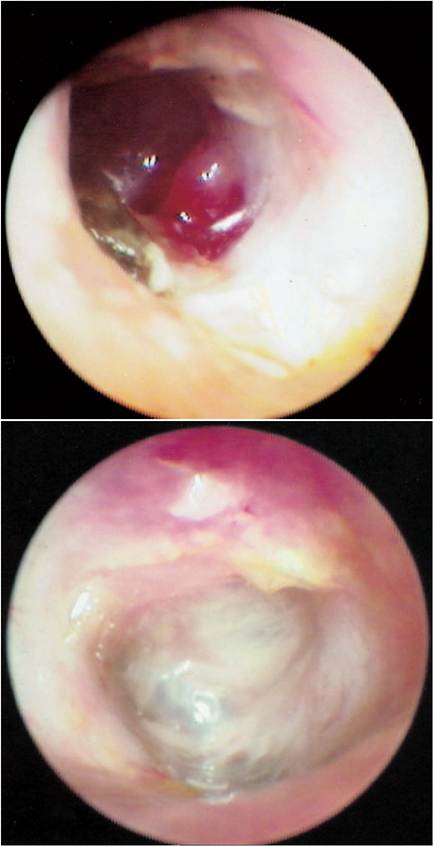
Figure 15-7
A, Chronic otitis media and ruptured eardrum in a 12-year-old Sheltie that was present for at least 6 months before treatment. B, Four months after treatment for the otitis media, the eardrum has healed.
More on the topic Healing Process:
- Healing
- Illness and Practices of Healing in the Texts of Qumran
- Otitis Media Prevents Healing
- Towards the Healing of Schism
- 15 Healing of the Rupture Eardru
- Sites of ritual healing are known throughout the ancient Mediterranean world, particularly those related to the cult of Asklepios.
- Orthoses for Positioning, Range of Motion, and Healing
- The cuneiform medical texts of Mesopotamia testify to the healing activity of one of the oldest literate cultures.
- CHAPTER 7 Illness and Healing through Spell and Incantation in the Dead Sea Scrolls
- CHAPTER 21 Healing with Demons? Preternatural Philosophy and Superstitious Cures in Spanish Inquisitorial Courts
- ONBOARDING PROCESS
- MOBILE PAYMENT PROCESS
- THE PORTFOLIO MANAGEMENT PROCESS
- The Contagion Process
- The Spiritual Process of Islamisation
- The Process of Aryanisation and Brahminisation