Causes of Rupture
Tympanic membrane perforation occurs in dogs and cats for a variety of reasons, the most common being chronic otitis externa. Otitis media results from the destructive effects of proteolytic enzymes on the thin epithelial layers of the membrane.
These enzymes are released from bacteria, inflammatory cell degradation, and ulcerations along the ear canal produced as a result of otitis externa; the enzymes then gain access to the sensitive respiratory lining of the tympanic bulla through the perforation.Traumatic perforations of the tympanic membrane also occur as the result of either excessive fluid pressure achieved during flushing of the ear canal or traumatic
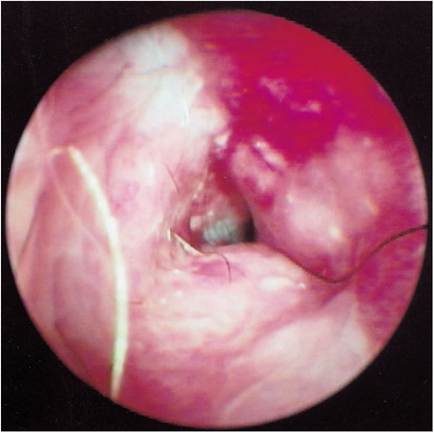
Figure 15-1
The eardrum of a 10-year-old German Shepherd is ruptured. Copious mucoid debris filled the ear canal. This ear canal is edematous and the eardrum cannot be visualized. Flush solution drained from the dog's nose and throat during the flushing process, confirming that the eardrum was ruptured and the eustachian tube was open.
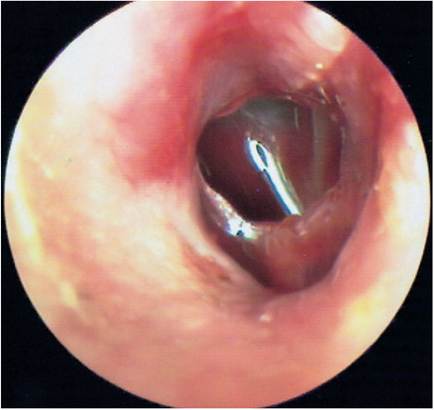
Figure 15-2
Traumatic myringotomy created by using a cotton-tipped applicator that was pushed too far into the horizontal canal.
use of instruments during cleaning of the ear canal (Figure 15-2). Myringotomy, a traumatic perforation of the eardrum, may be iatrogenic or may be intentionally induced in therapy for otitis media.
Cats with respiratory disease may rupture their eardrums through sneezing. Increased air pressure builds within the eustachian tube during the violent act of sneezing, and that air pressure is transmitted through the eustachian tube to the middle ear cavity. When the pressure in the tympanic bulla exceeds 300 mm Hg, the eardrum ruptures (Figures 15-3 and 15-4).
Rarely, ascending respiratory infections in dogs and cats resulting in suppurative otitis media may cause fluid pressure buildup inside the tympanic bulla.
Without an exit point for the fluid, the increasing pressure within the tympanic cavity weakens the tympanic membrane, resulting in perforation. Children often suffer from this painful condition and require insertion of ventilation tubes in the eardrum to equalize the pressures between the tympanic bulla and the ear canal. In dogs and cats, myringotomy is indicated to relieve the pressure.Nasopharyngeal polyps found in dogs and cats either grow along the eustachian tube toward the oropharynx or enlarge into the tympanic bulla. A large polyp within the tympanic bulla pushes against the eardrum, creating pressure necrosis, and its continued growth results in the ultimate destruction of the tympanic membrane (Figure 15-5).
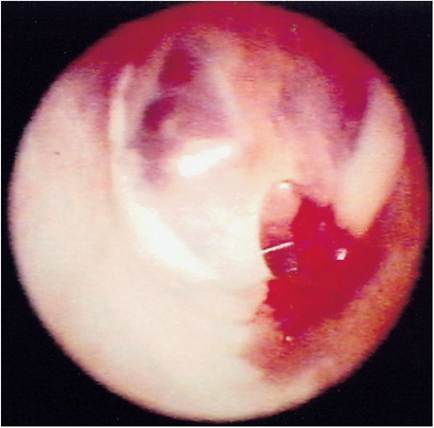
Figure 15-3
The patient, a young kitten with upper respiratory disease, was presented with the complaint of sneezing and blood in the ear. Close examination of the eardrum revealed an acute perforation caused by increased air pressure in the bulla created by sneezing.
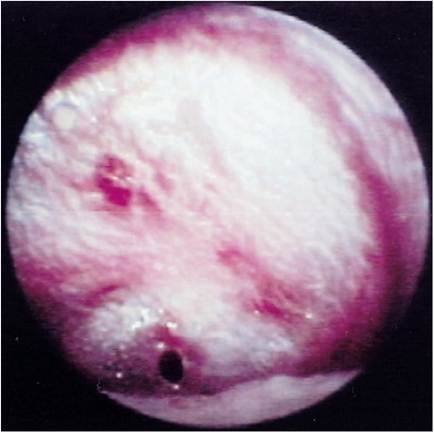
Figure 15-4
Another example of an eardrum with a small peripheral perforation caused by sneezing. The eardrum in this patient is thickened, perhaps as a result of herpesvirus infection.
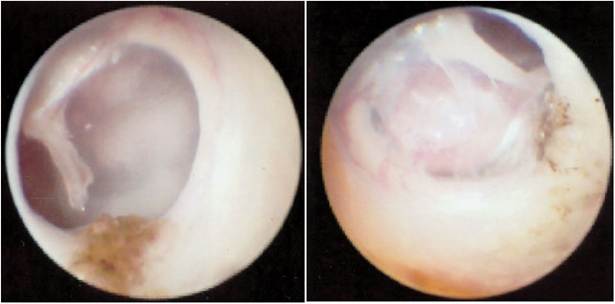
Figure 15-5
Left, Normal eardrum and tympanic bulla in a cat. Right, A polyp mass growing within the bulla pushing against the eardrum.
More on the topic Causes of Rupture:
- Intestinal Obstruction and Rupture
- 15 Healing of the Rupture Eardru
- The Great Rupture and its Consequences: Rival Authorities and Fragile Institutions, c. 1810 to c. 1870
- ST-Segment Elevation Myocardial Infarction
- ANTI-MALARIAL AGENTS
- UROLITHIASIS (BLADDER STONES)
- Although a century has passed since its outbreak, the First World War retains much of its mystery.
- It is hard to dispute that the religious movement (or process of religious change) known as the European Reformation caused division and displacement on an unprecedented scale.[799]
- What Was It? What Was It Called?
- Latin America, defined here as the nineteen American republics that once constituted almost all of the overseasterritories of the monarchies of Spain and Portugal, now accounts for 8 per cent of the world's population and 13 per cent of its land area.
- Antenatal testing and mother-to-child transmission
- The Nguyen-Trinh Divide: A Civil War Subdivides
- INFECTIOUS MONONUCLEOSIS
- Law and Violence