Signalment and History
It is uncommon for a patient to present to the veterinarian with a history of acute otitis media. However, iatrogenic rupture of the eardrum during ear cleaning can lead to an inflammatory acute otitis media.
A foreign body that has become lodged in the ear canal can cause acute otitis media. Often plant awns and foxtails work their way through the eardrum and cause a considerable bacterial infection and inflammatory reaction in the ear canal.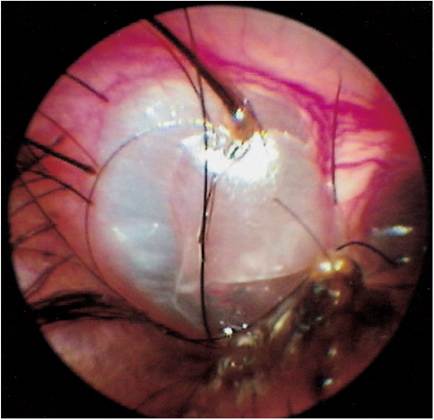
Figure 14-2
The TM is opaque and cystic. Serous fluid behind the eardrum causes increased pressure on the eardrum.
More commonly, a dog with otitis media will have a history of recurrent or chronic bacterial external ear infections. Perhaps the pet owner will present all the external ear medications already tried on the pet; that is a signal for the veterinarian to look deeper in the ear canal for middle ear disease. Chronic otitis media is almost always suppurative, with large amounts of fluid draining into the ear canal. The presence of liquid in the ear canal may signal otitis media (Figure 14-3).
In dogs and cats with otitis media where the eardrum is open, a copious, malodorous liquid discharge is often present when the ear canal is examined with the otoscope. Some patients produce so much exudate that it overflows onto the periaural region of the face; in a floppy-ear dog, there will be dried exudate on the ear flap adjacent to the external opening of the auditory canal. Head shaking to relieve the pain and tickle associated with liquid exudate is very common in otitis media. It may be wise to check for otitis media in cases of aural hematoma. Pain on palpation of the base of the ear canal or pain on manipulation of the pinna should also alert the clinician to otitis media.
Some patients with otitis media are reluctant to have their mouth opened and may have histories of reluctance to chew hard food.
This is due to inflammation, swelling, and pain within the bulla, which is located adjacent to the temporomandibular joint.When otitis media affects the nerves that course around the base of the ear or through the tympanic bulla, the patient may show signs as subtle as keratoconjunctivitis sicca on the ipsilateral side. This results from damage to the palpebral branch of the facial nerve. When otitis media affects the sympathetic nerves from the facial and trigeminal nerves coursing through the middle ear, the patient may show mild signs of Horner’s syndrome (enophthalmos, ptosis, and miosis) (Figure 14-4). Some patients
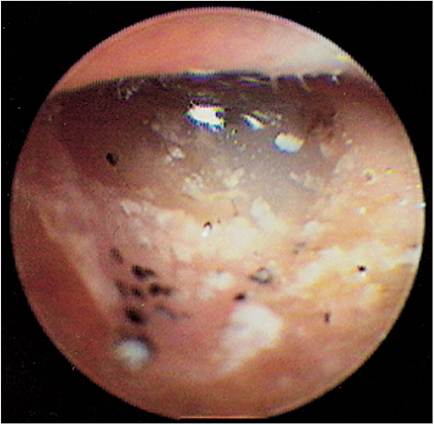
Figure 14-3
Otitis media in a cat. Liquid discharge filling the horizontal canal. Flecks of thick, inspissated mucus can be visualized floating in the fluid.
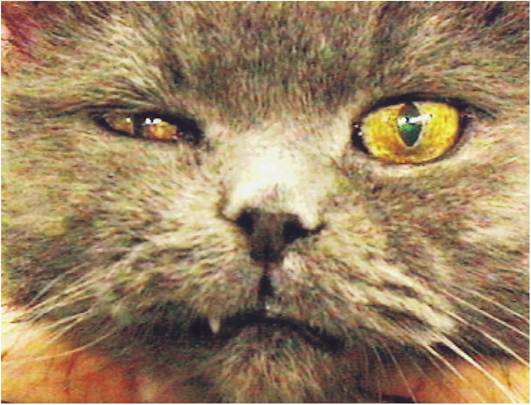
Figure 14-4
Horner's syndrome in a cat with cerumen gland adenocarcinoma extending into the tympanic bulla. The eyelid opening is small, the pupil is pinpoint, and the eyeball rolls inward (not pictured). may show pain, head tilt, or, with facial nerve palsy, a drooped lip, drooped ear, or loss of the ability to close the eyelid, leading to exposure keratitis.3 Since the facial nerve courses in and around the ear canal, it is easily affected by swelling, inflammation, and trauma from the dog scratching at the base of the ear. Facial neuropathy should be suspected if there is drooping of the facial muscles and skin or drooling of saliva because the lips and facial muscles cannot create an oral seal. Peripheral vestibular disease with nystagmus and circling may be evident if the infection and inflammation have affected the inner ear.
An owner may present a patient for a hearing deficit. These cases should be evaluated for otitis media. Fluid in the middle ear dampens hearing.
If this fluid is the result of previous flushing, it is usually absorbed within 7 to 10 days, and the patient regains the hearing. When the eardrum is ruptured or when the ossicles of the middle ear have sclerosed, air-conduction hearing is reduced. High-pitched sound waves cannot be effectively transmitted from the ear canal to the cochlea. If a tumor or a polyp has filled the middle ear, air-conduction hearing is eliminated. Bone-conduction hearing is usually still present in these patients, but the pet can only hear the lower range of tones. (Bone-conduction hearing can be demonstrated by placing your fingers in your ears and listening to the sounds around you.) If there is hearing loss detected, this is usually as a result of bilateral ear disease. Unilateral hearing loss is difficult to assess in animals.If there is pharyngeal drainage of mucus and exudates resulting from otitis media, the patient may be presented for inspiratory stridor. In these cases, a pharyngeal examination may reveal a nasopharyngeal polyp interfering with breathing or thick mucus draining from the auditory osteum in the nasopharynx, covering the caudal pharynx, and occluding the airway (Figure 14-5).
Otitis media with an intact, bulging eardrum may be very painful for the patient. Simply manipulating the pinna can lead to behavioral changes consistent with pain. Many dogs with otitis media cry out when the base of the skull is palpated at the junction of the ear cartilage and the skull. Some dogs even bite their owners while they are trying to administer medication because of the intense pain. Strong pain relievers are indicated in these patients. After the eardrum ruptures or is intentionally perforated by myringotomy, the pressure decreases and the pain significantly diminishes.
More on the topic Signalment and History:
- Signalment and History
- Signalment and History
- Vaughn Marc M.. The History of Ukraine and Russia: The Tangled History That Led to Crisis. History Demystified,2022. — 164 p., 2022
- 1 Introduction: from Imperial History to Global History
- The history of Ukraine as a territory, not unlike that of many other places, countries, and peoples, has its origins in the kind of historical writing that would probably be characterized today as global or transnational history.
- Mark von Hagen's essay 'Does Ukraine Have a History?' (1995) initiated a new discussion of Ukrainian history in the pages of the Slavic Review.
- Bang Peter F., Bayly C.A., Scheidel Walter (eds.). The Oxford World History of Empire. Volume Two: The History of Empires. Oxford University Press,2020. — 1352 p., 2020
- In recent decades the boundaries that used to delimit separate domains of British history, imperial history, area studies and the histories of former colonies have been traversed promiscuously.1
- In the history of Inner Asia, by which I mean the history of steppe empires from the Xiongnu (established in 209 bce) to the Manchu conquest of China (1644 ce),
- Where does Russian history end and Ukrainian history begin?