Stenosis
Stenosis presents a special problem in examination of the ear canal. Instruments cannot be inserted through the narrowed canal, and the integrity of the eardrum cannot be determined otoscopically.
Occasionally, a short course of potent corticosteroids, applied topically, injected directly into the stenotic tissue, or administered parenterally, decreases the inflammatory infiltrates and reduces edema (Figure 7-10). In addition, corticosteroids decrease the amounts of glandular secretions, making them less viscous so that they are easier to flush out of the ear canal; they also reduce the secretion and dilation of ceruminous glands. If corticosteroids successfully increase the lumen diameter, adequate visualization of the ear canal and tympanic membrane becomes possible.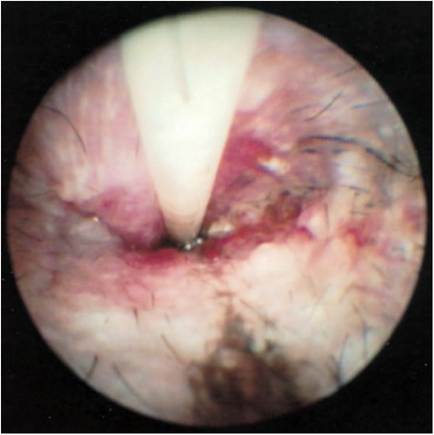
Figure 7-10
Potent corticosteroids can be infused through a small catheter through a stenotic portion of the ear canal to reduce inflammation.
When medical therapy for stenosis is ineffective because of severe pathologic changes to the ear canal, surgical ablation of the vertical canal, horizontal canal, or both is required. Surgical treatment of stenotic ears relieves the pain associated with chronic otitis and allows the remaining ear canal to be ventilated.
More medical literature on Medic.Studio
More on the topic Stenosis:
- Stenosis
- Mitral Stenosis
- Stenotic Ear Canals
- Trauma
- Assessing the Eardrum
- Contraindications for operative and diagnostic hysteroscopy
- Preconceptional evaluation of women with heart disease
- Urgent vs non-urgent gastrointestinal cases
- Defects of Tubular Bone or Spinal Growth Present at Birth
- Myocarditis or Acute Coronary Syndrome?
-
Infectious diseases -
Internal diseases -
Obstetrics and Gynaecology -
Pediatrics -
Veterinary medicine -
-
Conflictology -
Ecology -
Economy -
Finance -
History -
Law -
Medicine -
Philosophy -
Religious studies -