Government and Administration
City-State Background
The principles of fiscal and administrative organization of the Aztec Empire were adapted from those operating in Aztec city-states. One of the basic principles of Mesoamerican administration was the definition of polities in terms of subject peoples rather than territory.[1717] A city-state, for example, consisted of all of the people subject to its king, rather than a set area or territory.
Thus polities often lacked discrete territorial boundaries, and the villages subject to adjacent kings frequently were interspersed with one another (making it impossible to draw clear administrative boundaries). Another important city-state practice adopted by the empire was the system of taxation. City-states collected a variety of taxes in money, goods, and labor.[1718] The Triple Alliance used similar organizational principles to collect its taxes in money and goods.Fiscal Organization
The Aztec Empire did not cover a single contiguous range of territory; the map of the empire (Map 24.1) shows many blank areas. This configuration is partly a consequence of the practice of targeting only specific key towns for conquest. Another reason for this pattern lies in basic Mesoamerican patterns of non-territorial political control, mentioned earlier. The areas included in the provinces add up to 170,000 square kilometers.[1719]
Most scholars agree that the main motivation for Aztec imperial expansion was economic. This does not mean that religious and social motives were unimportant to the soldiers and officials who created and ran the empire. There was an elaborate mythological justification for warfare and imperial expansion, and soldiers gained status for themselves and their families by performing well in battle. But some scholars have overemphasized these motivations and have paid insufficient attention to the economic and political forces that generated Aztec imperialism.[1720] Kings, nobles, and commoners all benefited greatly from the growing quantities of goods moving from the provinces into the imperial capitals.
These goods arrived through three main channels: commerce, gifts, and taxes.(1) Commerce. Professional merchants from the Basin of Mexico traded widely both within and outside of the provinces. The pochteca were long-distance merchants organized into a guild with restricted admission and self-governance practices. Based in 12 key Basin of Mexico cities, these merchants went on lengthy expeditions throughout the empire and beyond. Much of their trading was entrepreneurial, and many individual pochteca became very wealthy. They also traded on commission from the emperor, as well as serving as his informants, spies, and even agents provocateurs in enemy regions. The pochteca ran the central marketplace (in Tlatelolco, Tenochtitlans twin city), where they served as market judges. Their commerce brought in large quantities of goods to the imperial capital.[1721]
(2) Gifts. Kings and nobles throughout northern Mesoamerica gave each other expensive gifts as part of the process of diplomacy. Provincial notables sent expensive gifts to the emperor, and in the case of some border states these gifts were sent in place of taxes.
(3) Taxes. The tax system was the most important mechanism by which the imperial capitals obtained resources from the provinces. Although Mesoamericanists have traditionally used the term “tribute” for these payments, they in fact correspond more closely to the definition of taxes as used in economic history:[1722] payments were regularly scheduled, recorded in official written documents, and collected by professional tax collectors. “Tribute,” from a comparative perspective, refers to single lump-sum payments made by subject polities to their conquerors or overlords. Although the Aztec Empire demanded tributes of newly conquered polities, one of the first tasks of imperial incorporation was to establish regular taxation. Taxes at the city-state level were assessed by household, based on the quantity of land farmed.
At the imperial level, tax obligations were assessed by province and recorded in pictorial documents.The Matricula de Tributos is a surviving pre-Spanish tax record, and its early colonial copy, the Codex Mendoza, is the clearest and most heavily studied tax roll.[1723] The taxes for each tributary province in the Codex Mendoza (Map 24.1) are listed in these documents. The page for the province of Tepecoacuilco, a resource-rich area located in the present State of Guerrero (Figure 24.2), shows how the taxes were recorded. Glyphs for the names or the towns that made up this province are listed down the left side and across the bottom of the page, starting with the head town (Tepecoacuilco). At the top are images of nine cotton textiles, each with a feather that indicates 400 items. These were paid twice a year, for an annual total of 7,200
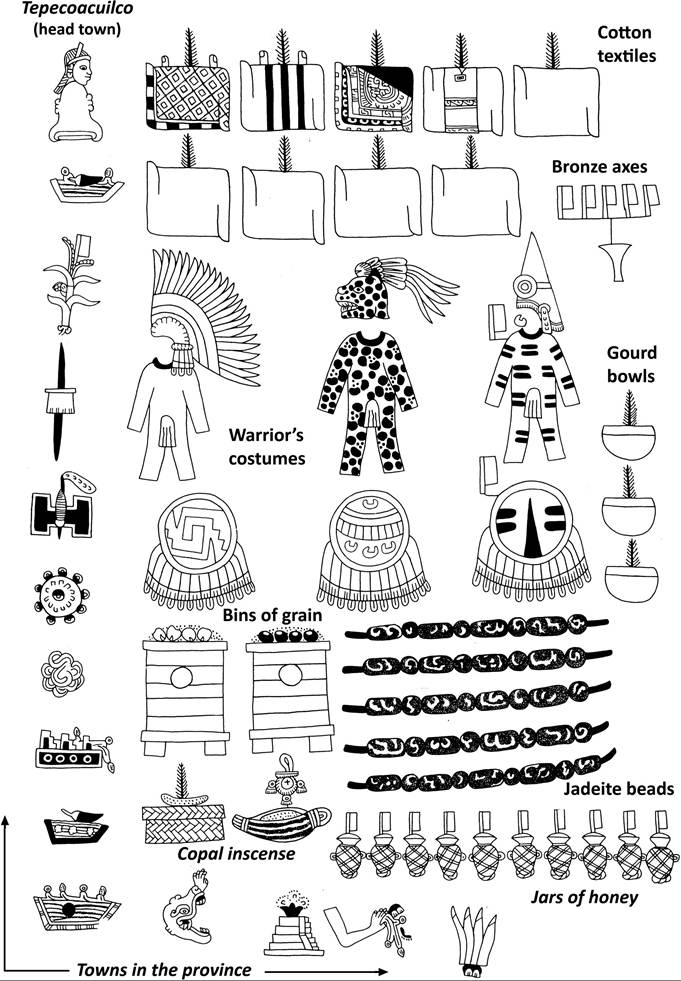
Figure 24.2. Tax list for the province of Tepecoacuilco, as depicted in the Codex Mendoza, f. 37r.
Source: Berdan and Anawalt 1992, vol. 4, f. 37r. Reproduced with permission of Frances F. Berdan.
textiles. These textiles were one of the forms of money in the Aztec economy, and this was a considerable sum (the other major currency item was cacao beans, of much lower value than textiles). Then come 22 warrior costumes with shields (a flag stands for 20); 100 bronze axes; 1,200 gourd bowls; two large bins of grain; and five strings of precious jadeite beads. Also listed are 400 baskets of copal incense plus 8,000 balls of unrefined copal (the bag symbol means 8,000); and, finally, 200 jars of honey. When the annual income in the Codex Mendoza is added up for all provinces, the totals are impressive.
Each tax province had a head town which served as the base for the collection and shipment of taxes. These head towns were used as the names of provinces; Tepecoacuilco, for example, was the name of a preexisting local city and polity, and then it was used as the name of the imperial tax province as well.
Although scholars sometimes call these head towns “provincial capitals,” they in fact had few administrative roles beyond tax collection. The city-states included in the Tepecoacuilco province, for example, were not subjects of the king of the citystate of Tepecoacuilco; their only obligation to him was to provide their share of the imperial taxes.Taxes were collected by a battery of officials called calpixque. There were several types of calpixque, from low-level officials (commoners) who ran errands and organized labor on public works for local kings to the heads of the imperial tax system, who were nobles. Tax records like the Matricula de Tributos were kept by the highest level of calpixque in Tenochtitlan. Each province had two high-level calpixque, one in Tenochtitlan and one in the provincial capital, who was aided by a series of lower-ranking tax collectors.[1724]
Control of the Provinces
Although scholars have traditionally emphasized the indirect nature of control of the provinces, recent research suggests that the empire may have wielded more power in some provincial areas than has been thought. The nature of imperial control varied considerably throughout the empire, but three major categories of province, based on location and context, can be identified.
More on the topic Government and Administration:
- In 1999 the central government in Jakarta allowed the Provincial Government of Aceh to implement precepts of ‘syari’at Islam’, that is, Islamic law, in religious, cultural and educational matters.
- Administration and Army
- Administration
- 6 Integrated Administration and Control System
- Administration of Cities
- The central administration
- Effective Administration
- Effective Administration
- Administration of the Empire: Satraps and Satrapies
- Organizational Power II: Fiscal Administration
- Administration of the Law
- Administration of the Law
- Imperial Administration
- Transport Program Administration