Military and Economic Base
Central Mexican Core Zone
The core zone of the Aztec Empire was the Basin of Mexico, a hydrologically closed basin at 2,200 meters above sea level. A series of lakes covered the floor of the basin, and the plains surrounding the lakes were filled with settlement in Aztec times.
The Aztec period (1100-1520 ce) was a time of rapid demographic growth (at an annual rate over 1 percent), leading to a population of 1,600,000 in 1519 and a regional density of around 200 persons per square kilometer. This population explosion led to major programs of agricultural intensification, including terrace construction on most hillslopes, irrigation along major rivers, and the reclamation of swampy lands in the central lakes through construction of highly productive raised agricultural fields. Food shortages and famines became problems in the final decades of the preSpanish period.The growth of Aztec city- states was accompanied by the growth of an interlocking system of periodic marketplaces. These markets greatly impressed Cortes and other Spanish writers, and the extensive exchange of both luxury goods and utilitarian items has been amply documented by archaeological research.[1711] The city of Tenochtitlan was founded on an island in the lakes. Its initial growth was due to two factors: its role in the market system, and its successful military activities as a subject of the Tepanec Empire. After the formation of the Triple Alliance in 1428, Tenochtitlans growth accelerated, and by 1519 the city had a population of nearly 200,000 people.
The Mesoamerican World System
The various processes of political and economic growth and change described in the preceding were not limited to the Basin of Mexico. Archaeological and documentary research in other parts of Mesoamerica reveals parallel processes in most regions, from the Maya of southern Mexico and Central America to the northern edge of the Mesoamerican region.
As described by the chapters in Smith and Berdan,[1712] most parts of Mesoamerica witnessed population growth, the expansion of city-states, and the growth of markets. The entire area of Mesoamerica became integrated through two processes: commercial exchange of goods, and the establishment of extensive elite networks. Writing systems and art styles used by widely scattered elites became homogenized, and elite travel led to extensive marriage alliances and common participation in state ceremonies.These macro-regional processes have been analyzed in a highly modified version of Wallersteins world systems approach that takes art styles and religious networks into consideration.[1713] This dynamic system of political expansion, commercial exchange, and elite interaction established the context in which the Aztec Empire expanded. Archaeological research using refined chronologies has shown clearly that in the Mexican state of Morelos, provincial peoples participated in world-system exchange networks both before and after Aztec conquest and incorporation.[1714]
Warfare and Expansion
Between 1430 and 1520 ce, the Aztecs extended their domination over a large part of northern Mesoamerica. How did they conquer such a large area in only 90 years? The Triple Alliance counted on strong military forces, and most of the new territories were subjugated during military campaigns. All men received military training during their youth, whether they were nobles or not, and they could be required to participate in military activities at any time. The army was composed primarily of conscripted common people (macehuales), who rose in the military hierarchy based upon the number of enemies they captured. The most experienced and proficient soldiers belonged to special categories known as Eagle Warriors and Jaguar Warriors. These soldiers were renowned for their prowess and were celebrated in poetry and art. Contributions of supplies and warriors were demanded of polities previously conquered by the Triple Alliance.
These practices, in the context of the demographic dominance of the Basin of Mexico, allowed imperial forces to become almost invincible.[1715]Spanish chronicles detail the process of military campaigns. First, the Aztecs looked for a legitimate reason to launch a new expedition. Such reasons included the murder of long distant merchants, the failure of a local king to attend an imperial ceremony to which he had been invited, or a refusal to provide supplies or warriors to Aztec armies when they passed by. In such cases, Aztec officials dispatched emissaries to ask the king if he were going to surrender without any resistance—a proposition that was always rejected. Then, Aztec leaders reassembled their military forces and sent them to the battlefield. Typical warrior equipment consisted of a padded cotton armor, a wooden shield to prevent injuries, and different kinds of weapons: swords whose edges were composed of rows of razor-sharp obsidian blades, spear thrower, and bows and arrows.
The battle began with the sound of drums and shell trumpets. The battlefield objective was less to kill the enemy—even if some actually died—than to capture
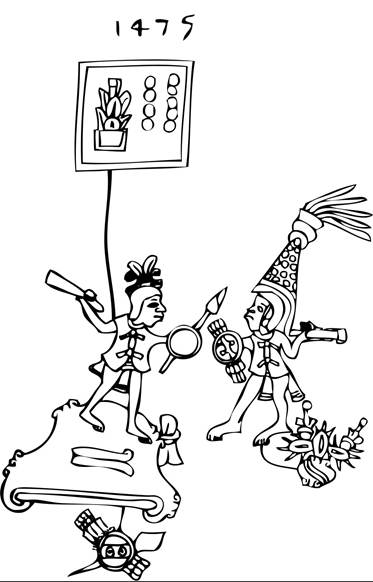
Figure 24.1. The Aztec conquest of Cuetlaxtlan, as depicted in the Codex Terreriano- Remensis, f. 37r.
Redrawn by Maelle Sergheraert.
enemy soldiers to sacrifice to their gods back at the capital. When the enemy finally surrendered, battle ceased and the winner imposed tax payments.
In their campaigns of expansion, the Aztecs concentrated on conquering the major cities. The size of Aztec armies is a contentious issue. Some were as small as 7,000 to 8,000 soldiers, but for one well-described campaign (against the city of Coixtlahuaca) some 200,000 warriors participated.21 When a city-state capital was subdued, imperial rule was initiated over the entire area of the polity and all of its population, not just the individual city that was defeated. This principle is illustrated in many of the depictions of conquest found in Aztec pictorial histories, where the name of the defeated city is tied to the symbol for altepetl. Figure 24.1 shows the conquest of Cuetlaxtlan in the year 10 reed, or 1475 CE (Cuetlaxtlan is province no. 41 in Map 24.1). The Mexica warrior is on the right, linked to the glyph for Tenochtitlan (a cactus growing out of a rock). He defeats a warrior whose domain is the entire altepetl (the hill emblem) of Cuetlaxtlan (the tied cord element). The element composed of a shield and arrows under the hill is a symbol of military defeat. By employing this
strategy of conquest, the Aztecs did not have to conquer all of the towns and villages, only the most important towns in each province.[1716]
More on the topic Military and Economic Base:
- Building a GoodJobs Economy
- THE THEORY AND PRACTICE OF EMPIRE-BUILDING
- Qatar
- Implementation Issues for the 2008 Constitution
- Conclusion
- Index
- NIGERIA: PLURALISM AND THE POLITICS OF ISLAMIZATION
- TRANSFORMATION OF TRADITIONAL AFRICAN POLITICAL INSTITUTIONS
- GHANA
- North Korea: the last Stalinist state