Historical Overview
Mesoamerican Background
Aztec society was the last of a millennium-long sequence of indigenous urban state societies in central Mexico. The Aztecs took advantage of a variety of social, cultural, and imperial practices and institutions developed by their predecessors.
Teotihuacan (1-600 ce) was the first large powerful state in the region. This city, with over 100,000 inhabitants, was the second largest urban center in the indigenous New World (after Tenochtitlan). Its unusual urban plan—a strict orthogonal layout—was later adopted (along with other traits) by the rulers of Tenochtitlan to signal their legitimacy as heirs to the great ancient cities of the past. Teotihuacan forged one of the earliest empires in Mesoamerica, conquering an area of some 20,000 square kilometers in central Mexico.[1705]By this time, the basic technological regime of Mesoamerica was established, with few major innovations until the arrival of Europeans. Urban centers were associated with one or more of a group of highly intensive agricultural methods, including canal irrigation, hillside terraces, and raised fields.[1706] Domestic activities and craft production employed stone tools, particularly the volcanic glass, obsidian. Bronze metallurgy was introduced from South America after Teotihuacan and prior to the Aztec period. Many decorative items were made of bronze, as well as some tools (primarily sewing needles and awls), but this technology was not applied to warfare or agriculture. The fall of Teotihuacan was followed by several cycles of the rise and fall of urban states; the major pre-Aztec examples in central Mexico were Xochicalco (700-900 ce) and Tula (900-1100 ce). The fall of the latter city set the scene for the development of Aztec society.
Chronology of Expansion
Aztec society can be dated from approximately 1100 ce until the Spanish conquest of1519- 1521.
It was a blend of two main traditions: (1) central Mexican traits that extended back more than a millennium to Teotihuacan and beyond; and (2) traits brought into central Mexico by groups who migrated from northern Mexico in the eleventh and twelfth centuries. These two traditions were synthesized by groups of competing city-states (altepetl) that covered the landscape of central Mexico starting around 1100 ce. Part of a general trend of city-state formation across much of Mesoamerica,[1707] the Aztec polities consisted of a modest urban center and the surrounding farmland.[1708] These city-states, ruled by a king (tlatoani) and a council of nobles, were parts of regional systems of interacting polities that correspond well to Mogens Hansen's concept of “city-state culture.” City-state cultures consist of landscapes that are culturally and linguistically united (although not necessarily homogeneous) but politically fragmented; well-known ancient examples include Classical Greece and Sumerian Mesopotamia.[1709]In the dynamic political landscape of central Mexico, Aztec kings sought to expand their areas of control, and by 1400 ce several small empires had been formed through conquest. Several ethnic groups (all speakers of the Nahuatl language) were localized in different areas, and these formed the basis for the organization of polities above the city-state level. Within the Basin of Mexico, the largest of these were the domains of Texcoco, capital of the Acolhua peoples in the eastern Basin of Mexico, and the more powerful Azcapotzalco, capital of the Tepanec peoples in the western part of the Basin. In the Tepanec War of 1428 ce the armies of Azcapotzalco were attacked by the armies of Tenochtitlan (capital of the Mexica peoples), Texcoco, and several other cities. Upon the defeat of Azcapotzalco, Texcoco and Tenochtitlan joined with Tlacopan (a dissident Tepanec city) to form the “Triple Alliance.” These three cities agreed to begin a program of expansion and share the resulting tax payments.
By the time Cortes arrived in Tenochtitlan in 1519, the provinces and states controlled by the empire covered an area of approximately 170,000 squre kilometers, with a population of 6,000,000 (Map 24.1). Although the empire officially remained an “alliance” until the end, in fact the power and influence of Tenochtitlan grew steadily over the decades to the point where the kings of this city could be considered the rulers of the empire; indeed they assumed the title huey tlatoani (“high king”).[1710] In Mann's terms, the kings of Tenochtitlan were able to increase both their despotic and their infrastructural power over the course of the empire's 90-year existence.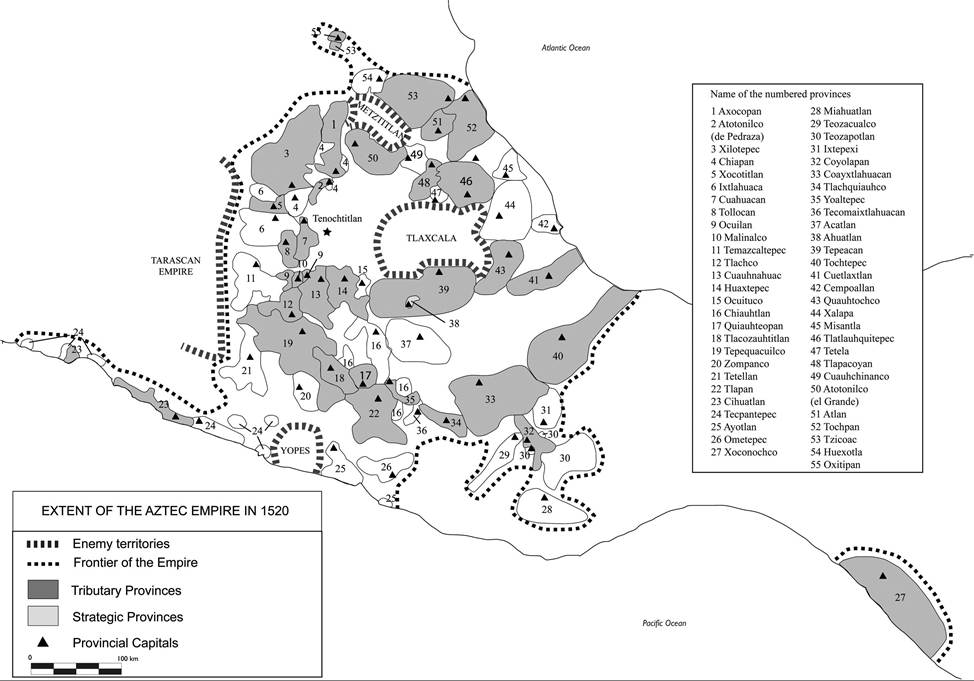
674 MICHAEL E. SMITH AND MAELLE SERGHERAERT
Map 24.1. The Aztec Empire, 1520.
Redrawing by Forest and Sergheraert based on Berdan, 1996, The Aztec Imperial Strategies. Copyright: Maelle Sergheraert.
More on the topic Historical Overview:
- Historical Overview (Part One)
- Historical Overview (Part Two)
- TWO Personal status law in Egypt: an historical overview
- Observations on the Problem of “Historical” and “ Non-historical ” Nations
- Overview
- Overview
- Overview
- OVERVIEW
- Overview
- Overview
- OVERVIEW
- Overview
- OVERVIEW
- Overview
- An overview
- 12 Overview
- Overview
- Overview