Historical Overview (Part One)
The Mughal Empire was officially established in 1526, with the Central Asian conqueror Zahir al-Din Muhammad Babur's (1483-1530) victory at Panipat over Ibrahim Lodi (r. 1517-1526), the last of the so-called Delhi Sultans who had ruled much of northern India since the early thirteenth century.
Babur hailed from an illustrious lineage, descended on his mother's side from none other than the celebrated Mongol ruler Chingiz (a.k.a. “Genghis”) Khan (ca. 1160-1227), and on his father's side from one of late antiquity's other great Eurasian conquerors, Amir Timur Gurgan (a.k.a. “Tamerlane”; 1336-1405).[1872] Timur himself had sacked Delhi in the late fourteenth century, a fact that his descendant Babur would later use in part to justify his own claim to rule India. Indeed, the cultural and political institutions, not to mention the cultural memory, of the Timurid imperial world would play an important part in the later development of Mughal institutions and especially the court's royal symbology.[1873]But Babur's early interest in India, and his sense almost from birth that he had a legitimate claim to rule northern India, also highlights an important aspect of cultural and political life in pre- and early modern South Asia, namely that it had always been a part of the wider world beyond the Indus, both influencing and being influenced by developments in Central and West Asia. Modern nationalist characterizations of ancient India as an essentially and exclusively “Hindu” civilization, one that was closed to outside influences and cultural entanglements, tend to ignore the plain historical fact that there has always been a vigorous traffic, in both directions, along the trans-Indus corridor that runs from Persia and Central Asia down through the Indo-Gangetic Plain to Bengal, dating back to antiquity—a set of overland networks that complemented and in some cases overlapped with the more well-known maritime networks of the Indian Ocean world.[1874]
Babur had been born and raised in that vibrant “crossroads culture” of Central Asia, in the part of the world where the Indic, Chinese, Turkic, Persianate, and even Greco-Hellenic worlds had all intersected and overlapped at one point or another throughout history.[1875] Though for a long time he was seen, at least from the perspective of modern colonial and nationalist South Asian historiography, as little more than a rugged warrior in a long line of Muslim conquerors who had invaded India purely out of religious zeal, more recent scholarship has given us a much more nuanced picture of Babur as a kind of “renaissance man” with a complex biography and competing motivations.[1876] Indeed, the picture that emerges from Babur's own memoir is that of a man who was deeply introspective and often conflicted, but also extremely worldly, literary, and intellectually curious, particularly with regard to what he considered to be the strange wonders of India.
Though he famously wrote quite matter-of-factly about his distaste for certain aspects of life in India, less attention has been paid to the parts of his memoir in which he waxed eloquently, and at some length, about aspects of India's history, culture, and natural world that fascinated and intrigued him.Babur did not have much time after his initial conquest of northern India to build on his success, dying a mere four years later. His successor, Humayun (r. 1530— 1540, 1555-1556), is almost universally viewed in modern historiography as rather weak and ineffectual, and not entirely without reason. Indeed, Humayun's early tenure was wracked by squabbles with his rebellious brothers and other challenges to his authority, and within barely 10 years after assuming the throne Humayun had lost all of his Indian territories to a former officer in his father's own administration, the Indo-Afghan chieftain Sher Shah Suri (1486-1545). The resulting “Afghan interregnum” nearly smothered Mughal imperial ambitions in their infancy, and moreover, although Sher Shah and his successors' dominion over northern India was brief, most historians agree that they deserve considerable credit for actually initiating some of the early modern political, economic, and even cultural reforms that would later be made famous by the resurgent Mughals.[1877] However, after a 15year exile—initially at the Safavid court in Iran and then, with Safavid support, in Kabul where he began to re-establish his independent rule—Humayun returned to India in 1555, defeated the Surs, and re-established Mughal power in northern India, only to die unceremoniously in a fall from the steps of his royal library barely a year later. “He tumbled through life,” British colonial historian Stanley Lane-Poole derisively quipped, “and he tumbled out of it.”[1878]
This characterization of Humayun as utterly hapless and incompetent is, however, somewhat unfair, and recent scholarship by Eva Orthmann and others has begun to cast him in a much more complex new light.
He had an abiding interest in the astronomical sciences, for instance, fashioning the rituals, decorative schemes, and even dress code of his peripatetic court in coordination with the signs of the zodiac.[1879] It is also to Humayun, arguably, that credit goes for initiating the IndoPersian synthesis in painting that would ultimately come to be seen as distinctly “Mughal,” after bringing several notable Safavid court artists with him back to India. One of the first Mughal translations of a Sanskrit work, the Hitopadesha, is often attributed to his patronage (though some have recently doubted the attribution). And one could even make the case that Mughal historiography, properly speaking, begins with the patronage of Humayun, to whom the erstwhile Timurid historian Ghiyas al-Din Khwand-Amir dedicated the early chronicle Humayun Ndma (a.k.a. Qanun-i Humayum).[1880]Nevertheless, thanks to Babur's early death and the lingering impression of Humayun's career as inconsistent (to put it generously), it is the latter's son and successor, Jalal al- Din Muhammad Akbar “the Great” (r. 1556-1605), who is usually viewed in modern historiography as the true founder of the enduring Mughal state. After ascending the throne at the tender age of13 and fending off several notable early challenges to his rule, Akbar managed, with the guidance ofhis regent Bairam Khan, to secure the core Mughal strongholds of Delhi, Agra, Lahore, Multan, Gwalior, and Ajmer, and went on to rule most of northern India for roughly the next five decades.
Like his almost exact contemporaries Elizabeth I (r. 1558-1603) and Philip II (r. 1556- 1598), Akbar has enjoyed an almost mythic reputation in modern scholarship and popular memory, with his era widely seen as a kind of golden age for Mughal art, culture, and politics. Bollywood films like Mughal-e Azam (1960) and Jodhaa- Akbar (2008) have continued to feed this image, with the latter having also been recently reinvented as an immensely popular TV serial (2013-2015).
Of course, much of this adulation is well deserved. Besides numerous successes in terms of consolidating and expanding Mughal territories, Akbar and his ministers are also rightly credited with doing much to rationalize the Mughal bureaucracy and revenue system, patronize the literary and visual arts, and promote a tolerant and pluralistic state ideology that has hardly been rivaled in global history before or since. Indeed, in almost direct contrast to the contemporaneous European dictum of cuius regio eius religio (wherein the ruler's religion was deemed to be the religion of the realm), Akbar's government and those of nearly all of his successors promulgated a state policy known in Persian as sulh-i kull—often translated as “peace with all,” but perhaps better rendered as “universal civility” or “civility toward all.”[1881]We will discuss some of the key features of these reforms and the Mughal state ideology in greater detail in the following, but for now suffice to say that from about the middle of Akbar's reign the Timurid court in India blossomed into the undeniably paramount power in southern Asia, and continued to expand in size and cultural/ political influence over the subsequent century. One of the most notable features of the Mughal state in these years was its strong partnership with the royal houses of various Hindu clans and chieftancies of northern and western India, known as Rajputs (i.e., the “Sons of Kings,” from Sanskrit raja-putra). Whereas Babur had faced an almost immediate challenge to his nascent authority in India from the powerful chieftain Rana Sangha, already from Humayuns reign we begin to see the glimmer of a mutually beneficial series of Mughal-Rajput alliances, especially with the clan based in Amber known as the Kacchawahas. Raja Bharamal Kacchawaha, in fact, had supported Humayun in his conflicts against both the Afghan Surs and the Sultans of Gujarat, and in 1561 he became the first Rajput ruler to enter into an official matrimonial alliance with the Mughals by offering his daughter in marriage to Akbar—thus securing the loyalty of the house of Amber for the Mughal state, and at the same time gaining the financial, political, and military backing of the Mughal emperor for the Kacchawahas vis-à-vis their own local and regional rivals such as the Rathor and Sisodia Rajputs.[1882] In time, numerous other Rajput houses aligned themselves with the Mughals, and given the prevalence of intermarriage between the Mughal royal family and Rajput princesses, it would not be a stretch to argue that, from Akbar onward, in many ways the Timurid state in India was actually a “Mughal-Rajput” state.
Throughout the entire period Rajput rulers and nobles served as Mughal army commanders and vital allies, even in military conflicts with other “Hindu” rulers—a potent reminder that in early modern India one's religious affiliation did not necessarily determine one's political allegiance.A good example is Raja Bharamal's grandson, Raja Man Singh (1550-1614), whose aunt was married to Emperor Akbar, and whose sister was married to Emperor Jahangir.[1883] Though his actual military and political career had its ups and downs, nevertheless, by the end of his life Man Singh was the highest-ranking Mughal commander other than the emperor's own sons. He was also a major patron of Mughal-Rajput art and architecture, for instance with the construction of palaces such as Rohtas, where the inscriptions are in both Sanskrit and Persian, or in a number of major temples dedicated to the Hindu god Krishna, but built in a “recognizably Mughal style” (e.g., the Govinda Deva temple in Vrindavan, begun ca. 1590).[1884] Architectural historians such as Catherine Asher and Ebba Koch have noted how such projects not only created and maintained a visual and material connection between Man Singh's own family and the local Vaishnava religious communities as patrons, they also, by extension, furthered the Mughal state's reputation as supporters and protectors of those same non-Muslim communities. At the same time, Rajput communities themselves were growing increasingly acculturated to Persianate literary and political idioms, as reflected (to take just one example) in a Persian inscription commemorating the completion of the Man Singh palace in Jaipur, dated 1008 AH / 1599 CE, in which he is described as a “second Anushirwan” (anushtrwan-i sant)—i.e., the celebrated ancient Persian king renowned for his justice and wisdom—because of the justness of his rule (saltanat).[1885]
Akbar's successor Jahangir (r. 1605-1627) has not fared particularly well in modern historiography, in large part due to the widely held impression that his reign was simply an extension of his father's, with “no significant political or military developments” to distinguish it.[1886] This lukewarm characterization is only further exacerbated by allegations—not all of them entirely unfair, it should be acknowledged—of Jahangir's lifelong struggles with substance abuse (both alcohol and opium), and of his tendency to delegate (some might say abdicate) his authority to others.
For instance, some of the most notable military, political, and diplomatic successes under Jahangir were, some might argue, actually achieved by his son Prince Khurram (later known as “Shah Jahan”). Meanwhile, Jahangir's elevation of Queen Nur Jahan and her family's so-called junta of Iranian nobles to positions of considerable governmental authority has also been criticized as an unseemly, even unmanly, abandonment of the ruler's own responsibilities.Nevertheless, as with his grandfather Humayun, this portrayal of Jahangir is also somewhat unfair, even if there is a certain amount of truth to it.[1887] For one thing, as Humayun's own earlier example so clearly demonstrates, Jahangir's ability merely to retain and further consolidate the vast territories that were, by then, considered to be the core Mughal dominions in “Hindustan”—i.e., the trans-Indus Corridor and the Indo-Gangetic Plain stretching roughly from Kabul to modern Calcutta— could fairly be viewed as a substantial achievement in its own right. Moreover, Jahangir did have several notable military-political achievements all his own, including quashing an early rebellion led by his own son Khusrau, who had the backing of a number of powerful and influential factions in the Mughal military and political establishment; successfully defending the Mughals' northwest frontier against repeated incursions by the Uzbeks;[1888] and consolidating the Mughals' tenuous hold over the rich province of Bengal and some of the adjacent territories. Jahangir's reign also saw the Mughal conquest of the notoriously inaccessible mountain fort of Kangra (in modern Himachal Pradesh), as well as a significant push in the Mughals' forward policy in the Deccan, including the final containment of the celebrated African former slave turned kingmaker Malik Ambar (15481626), who had been attempting to rally an alliance of Deccan power brokers to challenge Mughal authority over territories Akbar had acquired via a treaty with the Sultanate of Ahmadnagar in 1600.[1889] And in 1615 Jahangir achieved a significant detente of sorts with the powerful Rajput kingdom of Mewar, which had continued to resist the advance of Mughal power all through Akbar's reign. This truce was negotiated, incidentally, by a diplomatic duo of Mulla Shukr Allah Shirazi (a.k.a. “Afzal Khan”; d. 1639), an Iranian emigre who would later go on to serve as Shah Jahan's prime minister in the 1630s, and Rai Sundar Das (a.k.a. “Raja Bikramajit”; d. 1623), a Brahman courtier who was also a close confidant of Prince Khurram/ Shah Jahan—yet another reminder of the continuing diversity of the Mughal military and political elite.[1890]
Though he could be imperious (then again, what emperor isn't?), Jahangir nevertheless showed a remarkable intellectual curiosity, not only continuing his father's policies of “universal civility” (sulh-i kull), but also actively seeking out eclectic religious figures such as the Hindu yogi Jadrup, and extending the court's hospitality to the Europeans who were beginning to arrive in the subcontinent in increasing numbers. A contemporary text from the period, the Majalis-i Jahangiri (Jahangir's Assemblies), describes the religio-philosophical debates that Jahangir routinely hosted at court, while other contemporary sources (including the emperor's own memoir) depict Jahangir's keen interest in art, literature, and the natural sciences. Indeed, one modern scholar has gone so far as to describe Jahangir as epitomizing “Francis Bacon's ideal of the king as an observer and investigator of Nature.”[1891]
This attitude of civility, intellectual curiosity, and multicultural patronage was also a marked feature of the Mughal nobility more generally by Jahangir's time. Perhaps no one better exemplifies this tendency than the celebrated grandee ‘Abd al-Rahim Khan-i Khanan (1556-1627), whose father Bairam Khan had served as regent to the young Emperor Akbar, and whose own illustrious career as a courtier, general, and patron extended well into Jahangir's reign. ‘Abd al-Rahim's court at Burhanpur, from which he was one of the key directors of Mughal military and diplomatic policy in the Deccan, was almost proverbial for its array of distinguished poets, painters, and other intellectuals, which was perhaps rivaled only by that of the imperial court itself. ‘Abd al-Rahim himself was also widely admired for his own multilingual literary pursuits. It was he who personally translated Babur's memoirs (originally in Chaghatai Turkish) into Persian at Emperor Akbar's request, and ‘Abd al-Rahim was also a poet of considerable repute in his own right, who composed experimental verse in Persian as well as Hindi and Sanskrit. He is even said to have known Portuguese.[1892] ‘Abd al-Rahim is just one particularly noteworthy example, but there were a great many Mughal and Rajput nobles who engaged in similar literary and artistic pursuits, both through their own work and through their patronage.[1893] In other words, “Mughal culture” was not exclusively defined by
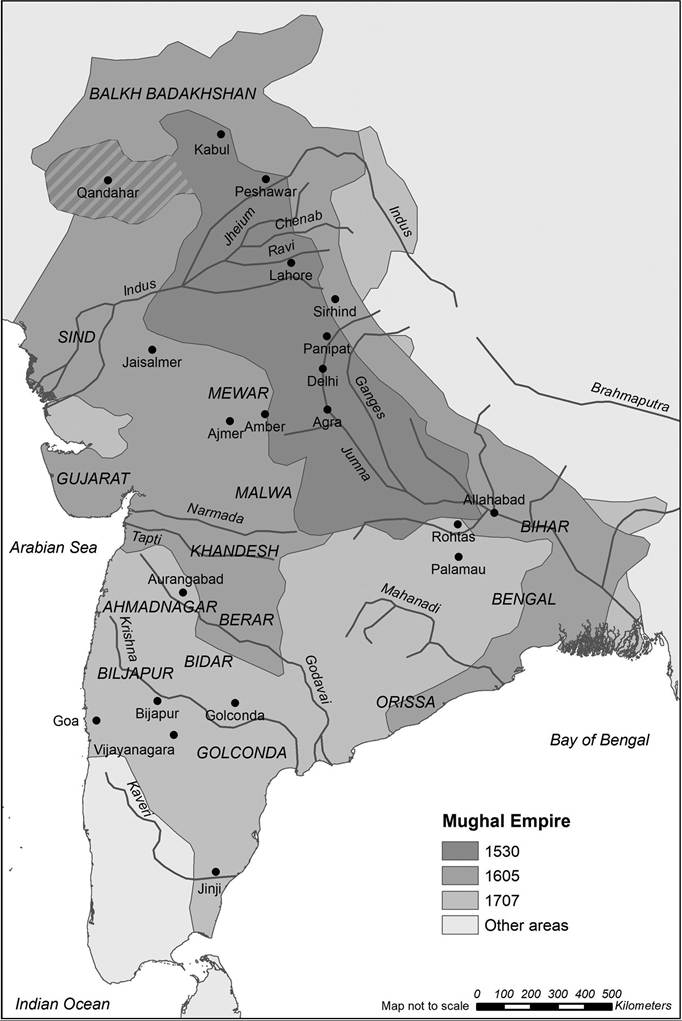
Map 27.1. The Mughal Empire.
Copyright: Rajeev Kinra with Peder Dam.
the whims and peccadilloes of this or that emperor, even if, obviously, the emperor wielded immense influence.
To continue with the narrative, however, whatever Jahangir’s personal failings may have been, by the end of his reign the Mughal Empire was as firmly established as it had ever been. It controlled virtually all of northern India, either directly or through client states, including vital commercial maritime coastal regions such as Gujarat and Bengal, and its aggressive military and diplomatic policies vis-à-vis powerful Deccan Sultanates had given it considerable influence in southern India as well. As noted earlier, Prince Khurram/Shah Jahan deserves his fair share of credit for this state of affairs given the leading role he played in actually implementing much of Jahangir’s military and diplomatic policy (especially in Mewar and the Deccan) throughout the 1610s. And, after becoming emperor himself in 1628, Shah Jahan would continue the Mughal tradition of delegating considerable responsibility for regional governance and further military expansion to his own sons.[1894] Eventually, four of those sons would engage in one of the most infamous wars of succession in all of Mughal history (see later discussion in this chapter), but in the interim Shah Jahan would make his own mark over a reign of three decades. This period saw many military successes, especially early on, which advanced the Mughals’ “forward policy” in the Deccan and further consolidated imperial power on the northwest frontier and in the Indo-Gangetic Plain, as well as notable setbacks such as the loss of Qandahar to the Safavids in 1649 (and the inability to retake it, despite several attempts), as well as a costly yet ultimately unsuccessful campaign in Balkh and Badakhshan (1645-1647). Of course, much of Shah Jahan’s fame as a ruler also rests on his patronage of monumental architecture, such as the Taj Mahal, Jahangir’s tomb in Lahore, and a new capital city known as Shahjahanabad (i.e., the area now known as “old Delhi”).
Many would also consider Shah Jahan’s reign to be the high-water mark of Mughal painting, and, somewhat less famously, but no less importantly, he was also an important patron of the literary arts in multiple languages (especially Persian, but also Sanskrit and Hindi). Meanwhile, continuing the tradition of his father and grandfather, he also showed favor to Sufi mystics in his realm, extending patronage not only to the center of the Chishti silsila in Ajmer, but also developing close ties with prominent Sufis of the Qadiri order such as Miyan Mir (d. 1635) and Mullah Shah (d. 1661). His court assemblies were renowned for the diversity of attendees from all over the world, and his bureaucracy was staffed by a large number of Hindu clerks and secretaries, some of whom, like munshi Chandar Bhan Brahman and Raja Raghu Nath, achieved positions of considerable acclaim, responsibility, and intimacy with the ruler himself.[1895]
More on the topic Historical Overview (Part One):
- Historical Overview (Part Two)
- Historical Overview
- TWO Personal status law in Egypt: an historical overview
- part four Political and Historical Though
- PART ONE The Historical and Constitutional Context of Roman Law
- This chapter will first discuss historical journals and reference works that deal in whole or in part with Galician-Ukrainian topics.
- Observations on the Problem of “Historical” and “ Non-historical ” Nations
- Overview
- Overview
- Overview
- OVERVIEW
- Overview
- Overview
- OVERVIEW
- Overview
- OVERVIEW
- Overview