Lordship, Community, and Territory, and the Making of the Delhi Sultanate
Four interrelated elements from the brief narration of the politics of the Sultanate need to be foregrounded as we turn to consider thirteenth- to sixteenth-century social and cultural transformations that helped in creating and sustaining the sensibility of empire for such a long period of time.
The first relates to the constant migrations of Muslims that occurred into the subcontinent from the northwest, starting from the invasions of Mu‘izz al-Din Ghuri at the end of the twelfth century, peaking at different moments, but continuing relatively uninterruptedly through the thirteenth into the sixteenth centuries. Other than emigres, there were also some converts, their numbers as well as their prominence increasing in the social and political affairs of the Sultanate into the fourteenth century. The impact of these new participants in Sultanate society was felt at different levels: emigres, and in one instance a slave convert (Khusrau Khan Barwarid 1320), became sultans, both constituted the military, administrative, and courtly elite, and they populated the army and urban settlements in significant numbers and at different levels. The presence of these people introduced
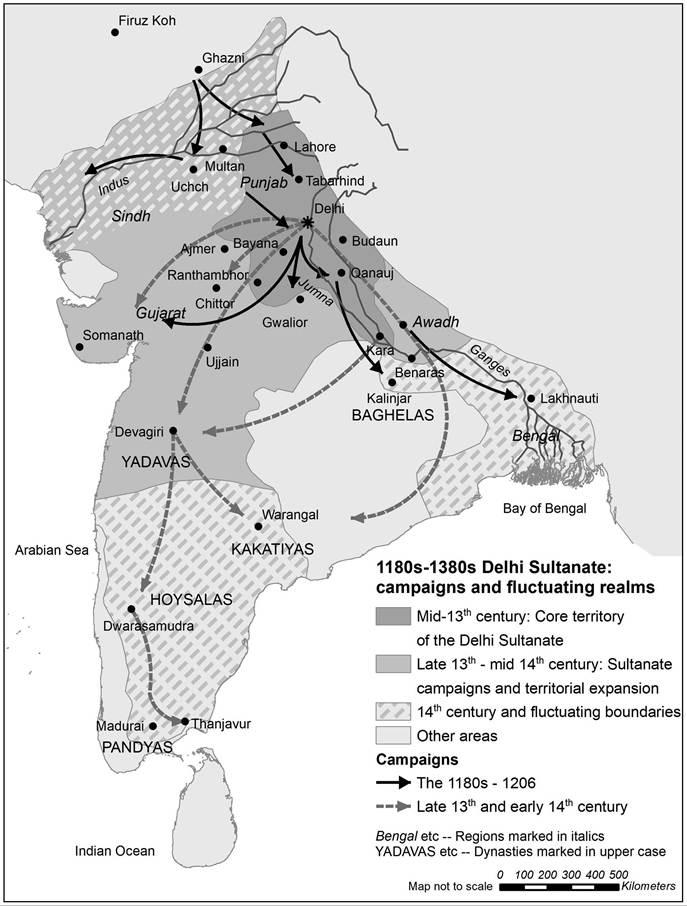
Map 20.1. The Delhi Sultanate
Copyright: Sunil Kumar with Peder Dam.
considerable complexity and heterogeneity in the polity which Persian literary records frequently recounted—not usually as a positive development but as a challenge to both the political integrity of the Sultanate and the quality and homogeneity of an urbane, united Muslim community.[1542]
This brings us to the second point critical to understanding the social and cultural moorings of the Delhi Sultanate—the non-Muslim “Other,” often referenced in Persian chronicles as “Hindu,” a term signifying in the thirteenth and fourteenth centuries a resident of al-Hind, the lands beyond the River Indus (Sindhu), and not a religious community.
Sultanate sources from this period were usually careful to discriminate among those they described as “Hindu”—elites were referenced by their titles: Ray/Rana (king/chieftain); thakhur, khut, muqaddam (“big-men”; clan/lineage/village leaders). They would use the caste name “Brahmin” to designate the priests, the pious literati, or an occupational term (which had more covert caste insinuations) to describe the baqqal (grocer/merchant), or mali (gardener). Everyone else, including the bandits in the countryside, was described as “Hindu.” Although the terminology might appear vague, it was remarkably nuanced in making a precise class of non-Muslims anonymous; “Hindu” then came to possess a relatively expansive sense to identify an infidel who was also outside the urbane traditions of decorum.[1543]Non-Muslims appeared briefly in Sultanate texts, usually as antagonists defeated soundly by the “armies of Islam,” but their rare and unexpected appearance as “Ranagan and Thakurran” as allies and adjunct members in the armies of the Delhi sultans, warns us about reading the sanitized Persian records too literally.[1544] During the thirteenth and fourteenth centuries, and especially after the Chinggisid invasions, Persian records produced for the Sultanate foregrounded the sense of a united Muslim community which abided by its traditions and retained its monolithic character. Not only did these texts ignore fissures within the Muslim community caused, for instance, by immigration that we have just discussed—we need to therefore read their gloss on rebellion, sedition, apostasy, or heresy far more critically—but the content of their narratives frequently challenged their simple “Hindu-Muslim” binaries.[1545] In chronicles that otherwise have little to say about “Hindu” participation in the Sultanate, we need to recollect the earlier mentioned example of Balbans eldest son, Prince Muhammad, who was married to the daughter of Rai Kalu.
Recollect also the daughter of the Bhatti pastoral chieftain married to Sultan Firuz Shah Tughluq's father, an affinal tie that brought a maternal uncle, Rai Bhiru/Pheru, into the monarch's intimate circle, and who protected him from court intrigue and an assassination attempt.[1546] These instances may be only from courtly circles, but they surface randomly at every level of Sultanate society, emphasizing how the Sultanate could not have survived at different junctures without the skilled service of masons and laborers who constructed their capitals and hydraulic systems, or the food and other supplies brought to Sultanate cities and its armies while on campaign by merchants (baqqals and banjaras), or the translators (tarjumanan) who guided its soldiers and administrators through unfamiliar territories. The nature of the Persian records makes it difficult to ascertain the scale of this collaboration, and as we approach the fifteenth and sixteenth centuries, as the example of the Brahmin author Vidyapati clarifies, we have to appreciate not only the escalated scale of this collaboration, but also the circulation and appropriation of knowledge and cultural mores that penetrated previously inviolate textual restraints.[1547] The point is worth stressing because the complex relationship between the Muslim and non-Muslim included both intense battle and collaboration. These relationships should not be excised within mutually exclusive linear narratives or equally problematic processes of acculturation between the binaries of “Hindu and Muslim.” It might be more useful to consider this as a “dialogic world” with multiple nodes of power that had their own precise configuration and histories, in conversation, responding and learning from their interactions because they possessed both the requisite skills to process multiplicity and the political agency to use contingencies creatively.This point might be further clarified if we remain attentive to the third aspect of the Sultanate, which describes its regimes as “Muslim” and “Persian” in their orientation.
Such a synchronic typology was deliberately constructed in the Persian records of the period and it glossed the quality and the processes that were captured in such an orientation. We remain ignorant of the concerted efforts made to socialize emigres and converts into a community of Islam, a Sunni jamaa ummah, or the nature of the resistance provoked by such crusades. The Delhi Sultanate was impacted by earlier intellectual developments within the Sunni Muslim community in the central Islamic lands which had reached a general consensus regarding the mode of accessing God's revealed law embodied in the Shari‘a and the role of jurists and theologians, the ‘ulama, as the possessors and transmitters of this textualized knowledge. Mysticism, especially after the intervention of al-Ghazali (d. 1111), also emphasized the importance of this corpus of knowledge, and many Shari‘a-minded ‘ulama could also be mystically inclined. There were, on the other hand, many Sufi teachers, pirs, and shaykhs who did not give the textualized juridical interpretation of the Shari‘a canonical status, suggesting that an intuitive, interior truth that novices could gather through rigorous spiritual training from a guide, a pir, was a possible, even preferable alternative.[1548]Mystic idea and belief in miraculous interventions by God's agents in the lives of mortals was widely prevalent in Afghanistan and North India during the twelfth and thirteenth centuries. But after the Chinggisid invasions it was the ‘ulama that felt the urgency to recreate the Sunni jamaa ummah out of the disparate emigre communities fleeing into North India. This ambition received the support of the Delhi sultans. Critically, the Delhi sultan and his military cohort could not intervene in the realm of the Shari‘a—they lacked the requisite knowledge, the social backgrounds, and the comportment. Instead of a direct intervention, they empowered the ‘ulama by constructing monumental sites where the Shari‘a and the Persianate urbane traditions of Islam could be taught.
They constructed mosques and festival grounds, spaces of congregational assembly, education, and the reproduction of Islam.[1549] Education remained informally organized through the thirteenth century, but by the fourteenth century and starting from ‘Ala al-Dins reign (1296-1316) there were signs of a nascent but ambitiously conceived program of endowments of madrasas (schools).[1550]A textually organized orthopraxis that could discipline the customs and traditions of the little communities of Muslims, insinuating them within the vast Muslim fold, served as an important mode of disciplining that appealed to the Delhi sultans. Throughout the thirteenth and fourteenth centuries there were periodic public inquisitions, mahzars, and exile of antinomian preachers and those mystics attempting to establish hospices in the urban centers of the Sultanate. The popularity of Sufi practice always made intervention in this arena fraught with danger, and only some sultans—Iltutmish and Firuz Shah Tughluq, primarily—managed to escape censure by successfully deflecting the responsibility for these coercive moves largely onto the ‘ulama.[1551]
The response to these measures was very mixed. The effort to ensure stability and status quo was supported by the predominantly Persianate secretarial staff assiduously recruited by the Delhi sultans. It is in their histories that Delhi was given the stature of Qubba-i Islam, the sanctuary of Islam, an epithet that placed the Sultanate capital as the center, the most important town for Muslims in Hindustan. But the process met with strong resistance and there was considerable ambiguity even among the chroniclers, many of whom were also mystically inclined. Chroniclers like Barani and ‘Isami included eulogies to their respective pirs in their histories. These authors described Delhi as Qubba-i Islam or Hazrat-i Dehli (Sanctuary of Islam or Majestic Delhi), and it remained unclear whether such a regard for Delhi was because of its sultans or the many shaykhs, resident and buried in the capital.[1552] All the various claims and counterclaims for the lordship of Delhi were not as significant as the basic detail that by the fourteenth century Delhi had gained a more general credibility as the capital of the Sultanate and of the Muslims in Hindustan.
Fluctuations in its territorial extent and the success or failure of its regnant monarch as a military commander and protector of Muslims could mean rise and decline in the fortune of the residents of Delhi; it did not diminish the import of the capital rendered in so many texts as the axial city of Islam in Hindustan. We need to keep in mind therefore, that beyond the rise and fall of the great monarchs and their empires the hegemonic thrall of Delhi as the center of power and culture was also the product of Sufi ability to convince believers that their masters, buried in the city, protected Muslims in Hindustan.The fourth and final point extends this carefully fashioned idea of community and studies it in relationship to concepts of “lordship” and territory as they developed during the Sultanate. “Lordship and community,” of course, has a specific cachet of meanings relating to master, vassal, and the church in medieval Europe.[1553] In different ways this chapter has already suggested that the sense of “lordship and community” under the Sultanate was very different from that of feudal Europe. It could be argued that conceptually there was an inverse relationship between community and lordship in the Sultanate world, since organic hierarchies within the community were disrupted when individuals of humble social status were invested with high military command.[1554] But this conclusion would not be entirely correct since the Sultanate was constantly beset by political turbulence as the deracine sought to perpetuate their power, attempting to transform governorship into social capital, trying to establish themselves as lords and aristocrats of a local community.[1555]
Although these events were ubiquitous from the mid-thirteenth century, these historical processes were glossed by Persian chroniclers and reported from the perspective of Delhi. These texts condemned ingrate governors for their alliances with the natives, in the process frequently erasing past records of their glorious service to their master. Instead their silences and evasions evicted these governors from the community of Muslims since they had gone native. In the Persian records, Sultanate territory and the Muslim community could slide into each other and appear coeval. As a result, alliances with groups of non-Muslims beyond the territorycommunity dyad sanctioned by Delhi were treated with acute suspicion. This is where the condominium of interests between the ‘ulama, the administrative elite, and the Delhi sultans proved to be very useful. The rebellion of Tughril, the slave governor of Bengal in 1280, and Ala al-Din Khalaji's clandestine march into Deogir in South India from his governorship in Kara in 1296 were regarded as a challenge to Delhi's authority, not just because of the governor's temerity at not sharing revenues with Delhi, but because the raising of resources and local military personnel, establishing a homestead and transforming his governorship into a homeland amounted to sundering his and the province's links with Delhi, the Qubba-i Islam, the Sanctuary of Islam.[1556] The formal declaration of independence by the governor and assumption of the title of sultan was moot; his actions were already suspect since they had crossed the discursive frames in which lordship and community were conceptualized.
In an unexpectedly coherent fashion, this idea of lordship and community was also imbedded in Sufi ideas. In the table-talks (malfuzat) of the Sufi pirs gathered by Sijzi and Qalandar (early fourteenth century), lordship of the Muslim community was granted by God to his special friends, awliya. Like Sultanate governors, these awliya had prescribed territories demarcated as their ministry. But there was also a hierarchy among these friends, and fourteenth-century Sufi literature was clear in identifying that the pir of Delhi, Nizam al-Din Awliya, was the sultan of all the shaykhs.[1557] The epistemic correlation of the table-talk literature with Persian court chronicles was important in Sufi discourse, though it always remained unstated but nevertheless quite unmistakable, that lordship of the Muslim community resided with the pir and not the reigning Delhi sultan.
Through the fourteenth century, the expansion of the Sultanate into the Deccan and its eventual loss of control due to the increasing efforts of governors to entrench themselves in their homelands made it difficult to leave the relationship between lordship and community inchoate. A Sufi biographical encyclopedia of the midfourteenth century, the Siyar al-Awliya, (The Lives of Saints), was the first to unequivocally clarify the paramountcy of the pir over the sultan. In this important rendition there was marked tension in the discussion of lordship and territory: if the sultan of all the shaykhs reigned over the hearts and soul of the Muslim community, the deputies of the pir possessed little historical agency over their spiritual territories.[1558] But unlike Sultanate governors, the pirs deputies possessed moral qualities of lordship and, as revered members of local communities, received the allegiance of their respective congregations.
The territorial and social expansion of the Sultanate and the Muslim community placed stress on old formulations regarding lordship and territory, and these underwent considerable shifts in the fifteenth century. Some of these were a consequence of the social profiles of the Afghans under the Lodi and Sur dynasties, and others of the manner in which Sufi-sultan relationships had started to be already narrated in the late fourteenth century. Quite uniquely among Sultanate chroniclers, the accounts of the Afghans foregrounded their ethnicity, emphasizing that this was sustained by their agnatic ties and cultural mores. In this recounting, Afghan rusticity was carried as a noble badge of honor; community was foreshortened to privilege blood lines and Afghan ancestry, claiming that these ties also provided Afghan lineages a unique, primordial standing within the Muslim community. With a more pliable, historical sense of the community, Afghan chronicles had little hesitation in recounting the humble social origins of their protagonists, their heroic ventures in transcribing their own fate, and their innate moral spirituality that drew the benediction of Sufi pirs. Together with the exigencies of alliances that cut across blood lines during state formation under the Lodi and Sur dynasties and their discipleship with Sufi masters that did not adhere to agnatic boundaries, the social organization of the Afghan lineages altered considerably. Despite the appearance of new kindred groups, the vocabulary of “brotherhood” and neo-eponymous lineages was still relevant in their inflated claims to precedence. What remained as a source of friction were notions of lineage and individual prerogative—lordship within the community—and the material manifestation of these claims by demands over rights to territory. Under the more intrusive rule of Ibrahim Lodi (1517-1526) there was fierce opposition to the sultan's attempts to subvert the autonomy of the Afghan chieftains, a crisis that eventually led to the fall of the dynasty.[1559]
The Afghans were not unique in the shaping of certain aspects of a new moral political code in the fifteenth century. The competitive dyad over precedence between the sultan and the Sufi, first explicitly narrated in the mid-fourteenth century Sufi text, the Siyar al-Awliya, was eventually resolved in favor of the Sufis and their recognized precedence over both the spiritual and temporal domains. Aspects of this discursive engineering were visible in the literary production that occurred in the fifteenth century in Malwa, Gujarat, and the Bahmanids in the Deccan; in all of them the Sufi connection would dominate.[1560] The particular resolutions of this relationship could differ considerably: in his fifteenth-century retrospective account of Sultan Firuz Shah Tughluq, ‘Afif keyed in the prospective sultan's search for benediction from the great Sufi pirs before ascending the throne of Delhi. This was the sign of Firuz Shah's piety, eventually manifest in his Shari‘a-minded rule, an aspect that the monarch had also self-reflexively broadcast.[1561] The combination of these qualities set him apart as a paradigmatic Muslim monarch. The astute historical resolution by ‘Afif needs to be appreciated here: even as Firuz Shah Tughluq presided over the material dissolution of the Delhi Sultanate, he was credited with lordship blessed by “the friends of God” together with the (no longer quite that abstract) concept of upholder and protector of the Shari‘a, the individual who could congeal political fragmentation. This was, of course, of salience to the Muslim community in the face of its many divisions. ‘Afif's reading of Firuz Tughluq's reign reoriented the long history of the Delhi sultans and of the Sufis in Hindustan very creatively, but it could also do so effectively because such a past could now be mobilized around Hazrat-i Dehli.
More on the topic Lordship, Community, and Territory, and the Making of the Delhi Sultanate:
- The Delhi Sultanate, the Mogul Empire and the Modern States
- 20 The Delhi Sultanate as Empire
- Sultanate Regimes, Territories, Economies, and Politics
- Vehicular Pollution in Delhi
- In our view, there are only two plausible methods available to judges when they decide cases as a matter of common law, the ‘natural' model of decision-making and the ‘rule' model of decision-making.
- Industrial Pollution in Delhi
- Territory and geography
- CHAPTER 5 TERRITORY OF HETMAN UKRAINE
- The Territory of Ukraine and Its History
- Territory
- History and Territory
- The Territory Resists the Map