Revolutinary Challenges to Empire: Popular Sovereignty and Industrialisation
At the very moment when the power and prestige of the Romanovs' empire was reaching its apogee, developments were occurring which in time put its viability into question. The most immediate and obvious problem was Russia's acquisition of most of Poland as a result of the peace settlement that concluded the Napoleonic wars.
From 1815 until the empire's demise, the Polish and Jewish communities of these newly acquired territories were to be more troublesome to Russia's rulers than all the other minority populations of the empire combined. Incorporating the world's largest Jewish community was bound to be difficult for the empire, but Russia bungled the problem to an unnecessary degree. Government policy wavered between assimilation of the Jews and quarantining most of them in a so- called Pale of Settlement, formed for the most part within the territory of the old Polish Commonwealth. Subjected to much legal discrimination and increasingly to pogroms by the local Slavic population, the Jews reacted by playing a very disproportionate role in the revolutionary movement which emerged from the 1860s. Their role in the growth of the empire's financial and industrial sectors was also very great and deeply unpopular among much of the Christian population. In time this encouraged the development among many Russian conservatives of a pathological anti-Semitism which focused on the Jews all the fears and resentments aroused by the empire's rapid modernization and growing political instability.14The Poles proved an even greater and more immediate problem. Napoleon had restored an independent Polish state in the form of the Duchy of Warsaw. This state had been a loyal French client, as well as the base and jumping-off point for his invasion of Russia in 1812. Scores of thousands of Polish troops had fought for Napoleon between 1806 and 1814.
This confirmed Alexander I in his view that an independent Poland posed an unacceptable threat to Russian security. Not merely did Poland occupy a key position across the most dangerous potential invasion routes from the west, Polish landowners also dominated vast swaths of the Ukraine and Belorussia, much of which had traditionally belonged to the Polish Commonwealth. Rooting their claims in history, the Polish elites saw all these territories as belonging to the Polish state, whose restoration was their overriding political goal.Alexander sympathized with the Poles. He believed that the partition of Poland in the late eighteenth century had been a crime and that the Polish desire for a separate national political identity must be met for reasons both of justice and of political stability. He was convinced that the needs of Russian security and Polish national identity could only be reconciled by making the Russian tsar simultaneously the king of an autonomous Poland, located within the Russian Empire but granted a free constitution. Many of his advisors from the start warned him of the dangers of this policy, stressing the difficulties of combining the roles of Russian autocrat and constitutional king of Poland. Still in his liberal phase, in 1814-1815 Alexander tended to believe that his generous concessions to Polish aspirations would secure Polish loyalty and satisfaction. He also saw Polish autonomy and constitutionalism as the first step in the introduction of similar principles to the Russian core of his empire. Though the emperor held to this dream for a number of years after 1815, in time he came to believe that Russia was unready for constitutions and that liberal reforms would merely result in her falling prey to the revolutionary conspiracies which bubbled intermittently in Europe in the years following Napoleon’s demise.[2259]
By the early 1820s many of the dire warnings of Alexander’s advisors were turning out to be true. Many members of the Russian elite were outraged that their tsar had granted to the Polish enemy rights and freedoms which he denied to Russia.
This was to be a major element in the so-called Decembrist revolt of 1825, whose aim was the overthrow of Russian autocracy and, among a minority of its supporters, of the Romanov dynasty. Meanwhile, tensions also grew between St. Petersburg and the Polish elites, many of whom pressed for greater power for their parliament and continued to dream of full independence. Rebellion broke out in 1830 and was crushed only after a full-scale war. For a generation after 1830, an uneasy peace ruled in Poland based on memories of the failed rebellion and the unremitting repression of Nicholas I’s regime. When Nicholas’s son, Alexander II, introduced liberal reforms into the empire and tried to rule through a greater measure of consent, matters in Poland once again got out of hand. The 1863 rebellion resulted in even fiercer fighting and even more total repression than had been the case in 1830.[2260]From 1863 down to 1914, repression remained the core of Russian policy in Poland. The 1863 rebellion was widely interpreted as evidence that the Poles were irreconcilable enemies and would exploit any signs of weakness and conciliation. From St. Petersburg’s perspective, fear of Polish disloyalty was a constant source of worry should the empire find itself at war in Europe. The policies introduced to reduce Polish landholding, constrain the use of the Polish language, and restrict Polish civil rights became models which were subsequently sometimes extended to other non-Russian peoples, with unfortunate results. Repression bred of fear of non-Russian disloyalty became a self-fulfilling prophecy.[2261]
The other challenges to the Russian Empire’s viability which lurked beneath the surface in 1815 were more fundamental but took longer to mature. The principles underlying the French Revolution were of course a threat to all empires, not just Russia. Popular sovereignty struck at monarchical legitimacy. It also immediately raised the question of who exactly were the sovereign people.
In France this was not too serious an issue. In the long-established French polity, ethnicity and territory to a great degree coincided. The principle of universal citizenship and popular sovereignty could be proclaimed confidently in part because ethnic solidarity was assumed to be self-evident. France was already a long way toward being a protonation, and not too much resistance was likely should its government introduce policies designed to complete the process. But in the multiethnic empires of central and eastern Europe, with their intermingled populations, the spread of “French” principles was certain to lead to mayhem.[2262]By 1914 this threat was becoming a nightmare for the region's rulers, those of Russia included. Earlier in the nineteenth century the most immediate danger caused by “French” principles was a military one. From the start, the French republic had included the universal obligation to serve in the army as one of the core elements of citizenship. The levee en masse of 1793 had been made permanent in the Loi Jourdain of 1798, which underpinned conscription policy under Napoleon. In 1813 Prussia, needing to mobilize all its meager manpower resources to secure its independence, adopted the same principle of universal conscription. Universal conscription based on principles of citizenship threatened to make the Russian military system redundant. Russian soldiers were, in the overwhelming majority of cases, peasants conscripted into the army for 25 years. These men formed a separate military “estate,” divorced from the civilian society into which they were born. No army based on such principles could match the numbers of enemy forces recruited through a system of short-term universal service. In wartime, the latter could in addition be swollen by recalling to the colors the many reservists who had completed their military service and had returned to civilian life. But for Russia to adopt Franco-Prussian military principles had revolutionary implications.
The army was at the core of the tsarist political system. It was the crown's bulwark against internal rebellion as well as external enemies. Russian subjects were not citizens. Most of them were serfs or state peasants, and even the latter suffered many disabilities. To recruit these men for a few years, teach them military skills, and then send them back to their villages was to invite anarchy and social revolution. To create a Russian army based on universal service implied the end of serfdom and a radical transformation of tsarist society and the relationship between rulers and ruled. For a number of decades after 1815, this challenge could be postponed. All European governments quailed before the political implications of universal military service. Most peoples—with the French in the lead—loathed the prospect of surrendering their sons to the state. Only the victories of the Prussian army in 1866-1871 forced this issue back on to the agenda.[2263]If the French Revolution was one key divide between pre-modern and modern history, the other was the Industrial Revolution. Napoleonic-era warfare still belonged to the pre-industrial era. Basic military and naval technology had not changed fundamentally in the last two centuries. Russian industry could more or less sustain the immense war effort of 1812-1814. Even here, strains were evident. The Russian textile industry could not uniform all the empire's troops. Russian small-arms were often inferior to their English equivalents. Above all, Russia could not remotely match Britain's commercial and financial power. But the key changes of the early Industrial Revolution were just over the horizon in 1814. The first postwar generation witnessed the coming of the railway and the transformation of the iron industry.
By the time of Russia's next major war in 1854-1856, the Industrial Revolution was having a major impact. Russia lost the Crimean War in large part because its armies still fought and moved with the technology of the pre-industrial era against more modern enemies.
British and French rifled muskets out-ranged Russian artillery and inflicted devastating damage on massed Russian infantry formations at ranges beyond the latter's smoothbores. Russian reinforcements and supplies reached the Crimea on horse and foot. The British and French transported men and equipment by rail and steamship. Alexander II received his first news of events on the battlefield by telegraph via Paris. Bankruptcy forced Russia to make peace even more emphatically than defeat on the battlefield.[2264]The cost of defeat could easily have been higher. The British prime minister, Lord Palmerston, dreamed of restricting Russia to her pre-Petrine borders and ending her role as a European great power. Fortunately for Russia, Napoleon III saw no French interest in using his army to pursue a purely British cause. Even so, defeat inflicted severe damage both to Russian prestige and to the security of her Black Sea territories. Deprived of the right to have a navy or coastal fortifications in the Black Sea, Russian territory was wide open to attack by the British and French fleets, should the sultan choose to open the Straits to them. Since in Crimea and the North Caucasus Muslim populations traditionally looked to the Ottomans for support against Russia, this was an additional threat, which partly explains Russian “encouragement” for Crimean Tatars and Circassians to decamp to the Ottoman Empire after 1856. The Polish rebellion of 1863 posed the same threat of nonRussian revolt being supported by foreign enemies, but this time in the empire's crucial western borderlands, within striking distance of the centers of Russian political, military, and economic power. It soon became apparent that the French and British were unwilling to start a European war for Poland's sake and the immediate danger receded. But the basic nightmare that external weakness and the growth of anti-Russian minority nationalism would combine to destroy the empire not just remained right down to 1914, but grew even sharper. This was the inevitable result both of the increasing hold of nationalist doctrines on the peoples of eastern Europe (including the minority peoples of the Russian Empire) and of the enormous growth of German power after 1871.[2265]
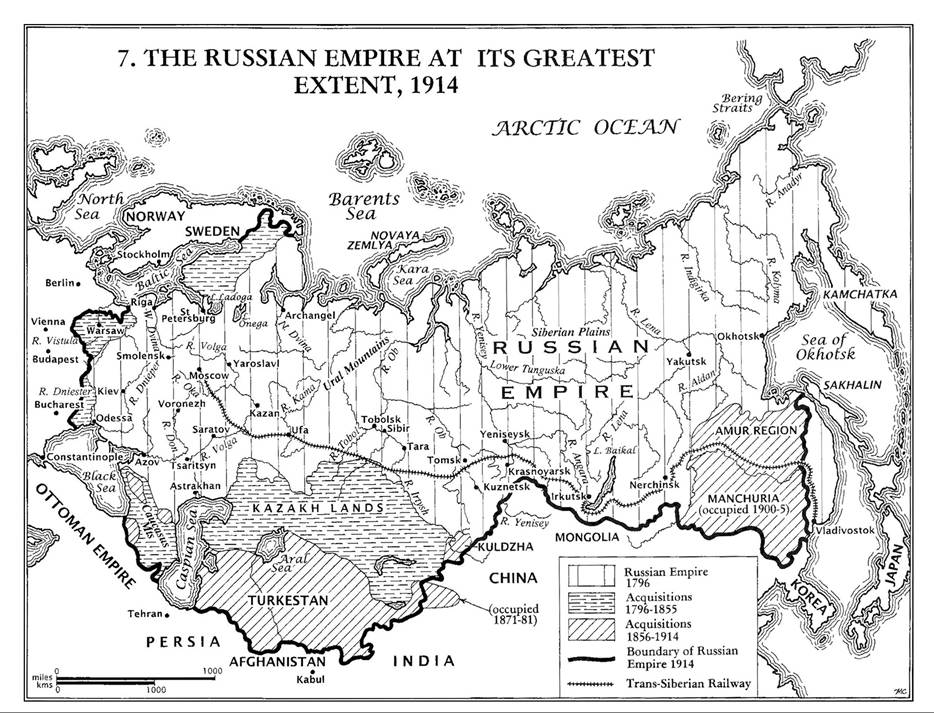
Map 35.1. The Russian Empire at Its Greatest Extent, 1914.
Source: Lieven, 2000, Empire: The Russian Empire and Its Rivals, xxxvi-xxxvii. Copyright: Dominic Lieven.
THE RUSSIAN EMPIRE (1453-1917) 973
More on the topic Revolutinary Challenges to Empire: Popular Sovereignty and Industrialisation:
- In 1848, commenting on the quashing of the Viennese popular uprising against the Austro-Hungarian Empire, Karl Marx predicted the only way the ‘bloody birth throes of the new society can be shortened, simplified and concentrated, [would be through] revolutionary terror'.1
- The previous two parts have focused upon the challenges for documentary trade finance and how some, but not all of those challenges might be met by technology, principally through the mechanism of digitizing trade documents.
- What caused the new popular revolt in late 2013?
- Declaration of State Sovereignty of Ukraine (1990)
- Practical and Popular Religion
- Religion and Popular Uprisings
- LIBERAL PLURALISM AND MALAY AND ISLAMIC SOVEREIGNTY
- SEEING SHARIA'S RESURGENCE— MUSLIM ACKNOWLEDGEMENT, POPULAR SENTIMENT, AND FEARS
- Religious life at the popular level
- PART V POPULAR PROTEST AND RESISTANCE
- Sovereignty and jurisdiction
- PKR LEADERSHIP: STRUGGLING FOR MALAYSIAN PEOPLE’S SOVEREIGNTY
- CHAPTER I THE SOVEREIGNTY OF THE STATE1
- Jihad, sovereignty and jurisdiction
- MALAY AND ISLAMIC SOVEREIGNTY
- the Zaporozhians return to RUSSIAN SOVEREIGNTY