The colonial empires in Africa
At first glance Sub-Saharan Africa seems to have been far more stable than the Middle East, India and South-East Asia, but in fact here too important changes were taking place as the development imperative began to exercise its influence.
Initially, as the European Powers digested their recent conquests in Africa, they decided that, owing to the scarcity of administrators and the vast geographical distances involved, the most efficient type of political control was ‘indirect rule'. This involved allowing tribal chiefs to exercise power at the local level and the use of customary law to settle disputes and regulate society. An intellectual justification for devolving power to chiefs was provided by anthropologists, who argued that ordinary Africans should be allowed to evolve politically and socially at their own pace and be protected from the tempest of modernity. In reality, however, indirect rule did not always involve a simple perpetuation of tradition. For example, in areas such as south-eastern Nigeria, where no strong tradition of chiefs exercising power existed, leaders were imposed on the local population and in Bechuanaland (Botswana) long-exercised restraints on the abuse of power by chiefs were removed. All the European Powers engaged in such practices, even the French, who in public espoused the idea of assimilation, but it was the British who, inspired by the activities of Lord Lugard as governor of Nigeria from 1912 to 1919, turned ‘indirect rule' into a doctrine.see Map 4.3
In contrast to the position in much of the world, colonial control over SubSaharan Africa was not greatly disturbed by the First World War, but during the inter-war period a series of factors led to the undermining and revision of the ‘indirect rule' system. One of the most important was that in some areas of Africa the development of industrial-scale commodity production either began or accelerated.
These industrial commodities included the gold and diamond mines of South Africa, the copper mines of Northern Rhodesia (Zambia) and the Belgian Congo, and the tin mines of northern Nigeria. This led to a number of consequences, such as urbanization, unionization of workers and a vast increase in migrant labour, all of which undermined the traditional forms of control. In addition, the development of these products and cash crops, such as cocoa, for the world market meant that Africa was increasingly susceptible to fluctuations in commodity prices. The result was that in the 1930s the Depression had a marked effect on a number of colonies, causing discontent with colonial rule and sometimes violent strike movements, such as that in the Northern Rhodesian copper-belt in 1935.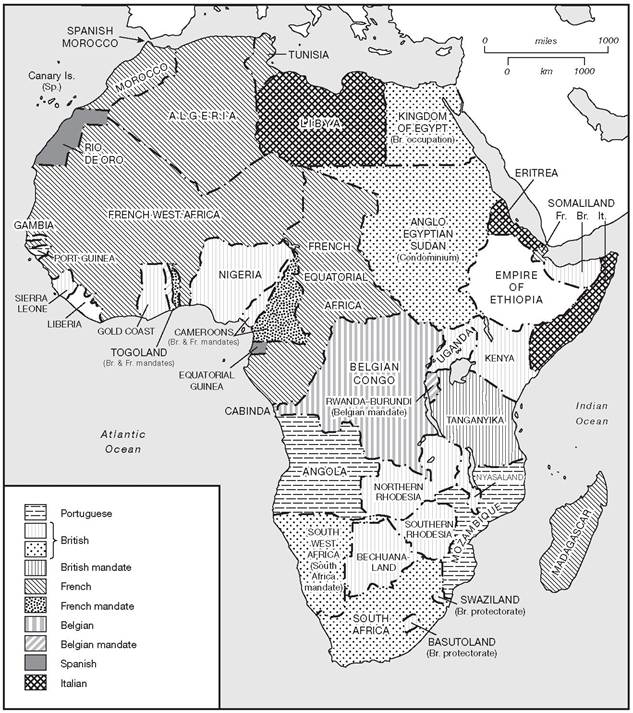
Map 4.3 Africa in 1922
Source: After Holland (1985)
The unrest that emerged in the 1930s was not nearly as serious as the problems that Britain had to face in India, but there was fear for the future unless reforms were introduced. This led both Britain and France to consider, particularly in regard to West Africa, plans for encouraging development through improved agricultural methods and increased welfare provision. Furthermore, the serious disturbances that racked the West Indies between 1934 and 1938 reinforced this British interest in reform, for they demonstrated what could happen if colonies were neglected. The intended reforms did not, however, sit comfortably with the continuation of ‘indirect rule', but rather mirrored the efforts elsewhere in the empires to make colonial administration more rational and efficient. Thus, on the eve of the Second World War, ideas about empire in Africa were beginning to come into line with practice elsewhere.
In addition to the changes arising from increased economic activity, there were other challenges to the reliance on ‘indirect rule'.
In British West Africa one important factor was that the educated indigenous bourgeoisie in the coastal cities were beginning to organize political movements against colonial control and the ‘indirect rule' system. Before the scramble for colonies in the nineteenth century this group, which was heavily influenced by Western political thought, culture and religion, had played an important role in the civil society of the trading ports. However, as European rule expanded, they had been marginalized in favour of the chiefs and had found that a colour bar increasingly blocked their entry into the professions or, if they were employed by the state, their prospects for promotion. This naturally led to discontent and gradually, in areas such as Sierra Leone, the Gold Coast and Nigeria, local urban-based political organizations appeared that were critical of British rule.In British East and Central Africa conditions were very different. Here the problems that emerged centred on the existence of white settler communities. Influenced by white control over South Africa and the granting of self-government to white-dominated Southern Rhodesia in 1923, the settlers in Kenya, although a small minority of the total population, attempted to persuade London to agree to devolve power to themselves, and to form Kenya, Uganda and the mandate of Tanganyika into a union. Concerned about unrest and influenced by the concept of trusteeship, the British government was reluctant to concede to the settlers, but this did not prevent fear among the African elite that the latter might eventually get their way. The result of this, and problems over land pressure, was that ethnic groups, such as the Kikuyu, began to form their own political organizations to represent their interests. The stage in Africa was thus being set for the battles of the post-1945 period.
More on the topic The colonial empires in Africa:
- Colonial Empires and Some Comparisons
- EUROPE’S COLONIAL EMPIRES: DISTINCTIVE FEATURES
- CHAPTER FOUR The European colonial empires, 1900-45
- British, Danish and French colonial projects on the coast of West Africa, 1780s and 1790s
- While cities have always been important in the fortunes of the Indian subcontinent, most of India’s vast population has lived in villages and hamlets whether in pre-colonial, colonial or even post-colonial times.
- Colonial and post-colonial distortions to traditional rule
- This chapter will explore ritual violence in the form of close combat in precolonial western Africa (and the African diaspora) during the period of European contact from the mid fifteenth century until the late nineteenth century, a period which saw an end to the slave trade and the start of European colonisation.
- Africa, West Africa
- Empires and power
- From Territorial to Neo-colonial Imperialism
- Africa’s ‘Wind of Change’
- Colonial spas
- Classics and Empires of Nostalgia
- Disease and colonial countermeasures
- The Colonial Era
- The second half of the eighteenth century witnessed a rise in new colonial projects and exploration.