The Great Powers, power politics and the states system
see Map 1.1
Only five European states undisputedly held Great Power status when the twentieth century opened — Britain, France, Germany, Austria-Hungary and Russia. The statesmen of 1815 would have recognized this arrangement, although Germany
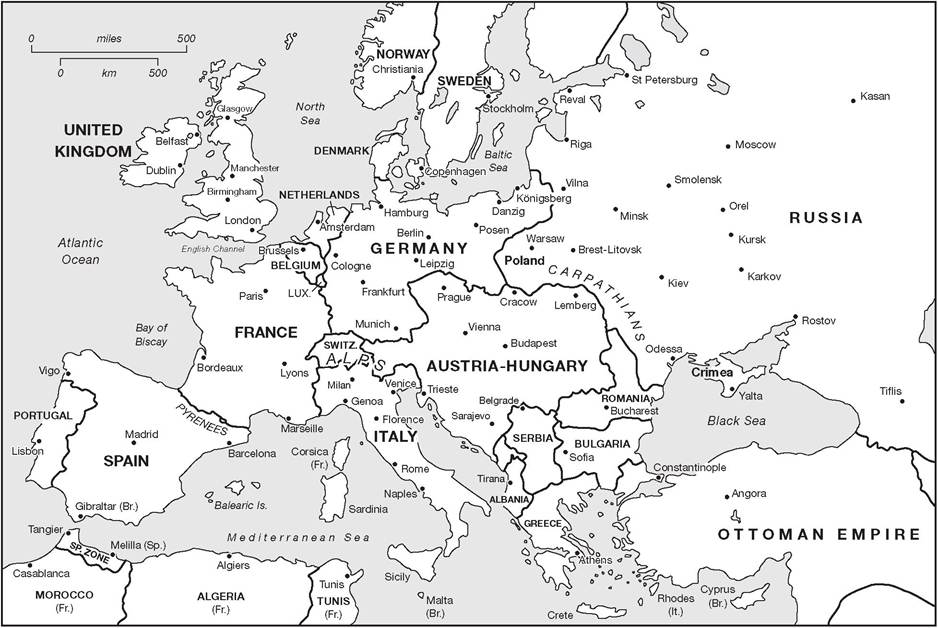
Map 1.1 Europe in 1914
Source: After Rich (1992)
(then Prussia) had greatly expanded its power and that of Austria (Austria-Hungary after 1867) had shrunk just as swiftly.
At the crudest level, the term ‘Great Power' applied to those states with the greatest capacity for war. Here, in the calculations of diplomats and strategists, the hard currency of power counted: size of population, territory, finance and industrial output.see Table 1.1
On this scale the five did not measure up equally, and clear-cut comparisons are problematic. Russia had by far the largest population, but Britain, France and Germany had large literate urban populations and this pool of educated workers and soldiers helped to offset numbers in the era of machine production and complex weapons. Still, mass conscript armies recruited on the basis of universal military service required numbers: by 1900, Russia called up 335,000 men annually, Germany 280,000, France 250,000, Austria-Hungary 103,000 and Italy 100,000. Because of the low birth rate in France, its military planners looked on with unease at the growth of Germany's population. Austria-Hungary suffered another problem — its birth rate was fastest in the backward regions of the empire. France and Britain could call upon their empires for reserves, but the wisdom of the day assumed rapid mobilization and decisive opening battles, in which there would be no time to train colonial levies. Britain, at any rate, with its far-flung maritime empire, did not adopt conscription but instead concentrated on its fleet.
Although unable to match the British, all the Great Powers assembled modern battle fleets in the years before 1914, partly in response to real threats, but also as symbols of their place in the first rank of states. Great Power armies required a large manpower pool and high birth rates; battleships, modern field weapons and railways required heavy industry. Britain and France produced coal and steel in quantities appropriate to their Great Power status, even if Germany began to dwarf them both, as well as Russia, by 1914. Austria-Hungary, Berlin's chief ally, exceeded only Italy in its industrial output. Following unification in 1861, Italy regarded itself as a contender for Great Power status, but while moving steadily towards demographic equality with a declining France, it nonetheless lacked the necessary levels of literacy, secure coal supplies, railways and productive capacity to bear this title with confidence.Table 1.1 Total populations of the Great Powers, 1890-1913 (millions)
| 1890 | 1900 | 1910 | 1913 | |
| Russia | 116.8 | 135.6 | 159.3 | 175.1 |
| United States | 62.6 | 75.9 | 91.9 | 97.3 |
| Germany | 49.2 | 56.0 | 64.5 | 66.9 |
| Austria-Hungary | 42.6 | 46.7 | 50.8 | 52.1 |
| Japan | 39.9 | 43.8 | 49.1 | 51.3 |
| France | 38.3 | 38.9 | 39.5 | 39.7 |
| Britain | 37.4 | 41.1 | 44.9 | 45.6 |
| Italy | 30.0 | 32.2 | 34.4 | 35.1 |
Source: Adapted from Kennedy (1988, p.
255)The ability to generate revenue in order to purchase armaments, train soldiers and build railways was another important power indicator. Once again, clear-cut comparisons are problematic. A look at defence spending in the decade before 1914 indicates that all five Great Powers had the financial strength to enter into an arms race. Germany and Russia, in terms of absolute outlay, outpaced the rest, with Britain and France holding their own. Austria-Hungary stayed ahead of Italy, but could not keep up with the big players. Britain spent far more than any other Great Power on warships, while on land Russia, Germany and France (‘a poor third') not surprisingly dominated. Other important differences existed. Britain, France and Germany, the states with the highest per capita income, spent much more of their national wealth on defence than Russia (though it was in absolute terms still a giant) and Italy, which could not bear a similar burden. Although France did not spend as much as Germany, the financial assistance it extended to St Petersburg proved significant in speeding up Russia's economic and military development after 1905. Indeed, paradoxically enough, despite the impressive steel output and undisputed wealth in the years before 1914, the German government had reached the limits of what its fiscal and political structure could raise for defence.
see Figure 1.1
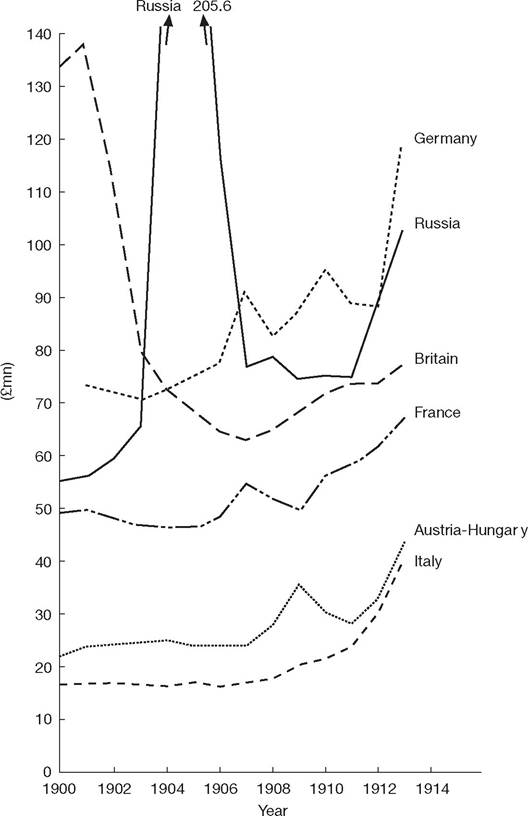
Figure 1.1 Defence expenditure of the European Great Powers, 1900-13
Source: D. Stevenson (1996)
Note: The high levels of defence expenditure in 1900-02 for Britain reflect the costs of the Boer War, while the high levels in 1904-05 for Russia reflect those of the Russo-Japanese War.
Monroe Doctrine
The doctrine declared by President James Monroe in 1823 in which he announced that the United States would not tolerate intervention by the European Powers in the affairs of the Western Hemisphere.
However, formal recognition of Great Power status resulted not just from statistical reckoning but also from inclusion in the inner circle of diplomacy, especially the drafting of the general peace treaties and territorial adjustments. Normally the rights of Great Powers could not be neglected in international affairs, while smaller states were routinely ignored and subject to Great Power management. Like the rules of any club, diplomatic etiquette reflected the ‘pecking order'. The heads of state and foreign ministers of the Great Powers met at congresses (the last in 1878), not conferences; generally only they exchanged ambassadors (diplomatic officials of the highest rank), not ministers. Nonetheless, diplomatic practice also accommodated the fuzziness of these distinctions. One might be invited into the Great Power club even without the hard credentials of membership. Italy was a ‘courtesy' Great Power. The Powers treated Italy like a Great Power in an effort to entice Rome into one alliance or another. Similarly, after 1892, the Great Powers upgraded their representatives in Washington to ambassadors. In 1895, Britain deferred to the Monroe Doctrine over the Venezuelan border dispute. By 1900 the United States also had a formidable industrial economy. Yet, though treated as a ‘courtesy' Great Power — the Americans participated in the conference on equatorial Africa in 1884—85 — even Italy carried more political weight where it counted most, that is, in Europe.
Notwithstanding the importance of armed strength, military success alone was not enough to allow a state to join the top rank. In 1898 the United States forced the Spanish out of Cuba and the Philippines. Spain, however, with little industrial and financial muscle, pulled no weight in Europe. At best, the victory only confirmed the United States as a regional power in the Western Hemisphere. Even so, in 1902—03, when Britain, Germany and Italy sent warships to force Venezuela to make good on debt payments, the Americans discovered that they lacked the military, economic or diplomatic means to forestall European gunboat diplomacy.
In Italy's case its humiliating defeat in Africa at the hands of Abyssinian (Ethiopian) tribesmen at Adowa in 1896 confirmed its reputation as ‘the least of the Great Powers', and the conquest of Libya in 1911 from the Ottomans did little to overturn this impression. The Russo-Japanese war of 1904—05 illustrates another case. The war originated from a clash of rival ambitions to dominate Manchuria and Korea. Japan struck first, with a surprise attack on the Russians at Port Arthur, followed up by a series of rapid victories over the inefficient Russian armies along the Yalu River and in Manchuria. In May 1905, with superior gunnery, the Japanese navy annihilated the Russians at the Battle of Tsushima.Europe saw the Japanese triumph and the resulting revolution in Russia as degrading Russian power and causing an elevation of Japan's standing. Yet St Petersburg was down but not out. Given Russia's reputation as a first-rate power, everyone understood that with time Russia would again exercise its strength.
The inexact relationship between military potential and international status can in part be explained by the elusive nature of power. Statesmen form perceptions of the relative strength of other states based on multiple sources of information, everything from newspapers and personal experiences to secret intelligence. This information is compiled and filtered through complex bureaucracies which are no less subject to human error and bias. Statesmen may strive to form concrete judgements about the realities of international power, but these judgements are frequently inconclusive or wrong. For example, apart from Japan's ally, Britain, European governments generally underestimated Japanese power before the 1904—05 war. What changed afterwards was not the reality of Japanese power (military efficiency, population and armaments) but European perceptions of it. Even if the problem of perception could be overcome, power would remain a slippery concept. It is not reducible to ‘military capacity', measured by plotting industrial output, manpower and finance.
All forms of power must be weighed in relation to potential challenges. It must operate within a geographical, political, intellectual and even cultural context, and must be projected over time and space.Take, for instance, the security situation of Austria-Hungary, a multinational state encompassing Germans, Magyars, Romanians, Italians, Slovaks, Croatians, Czechs, Serbs, Slovenes, Ruthenians and Poles, all united under the Habsburg monarchy. It had survived the Napoleonic Wars as a Great Power and thereafter acted as a key enforcer of the European order. It also united much of Central and South-Eastern Europe under one dynasty, thus providing a useful check to Russian ambitions in the region. Indeed, the empire's survival can be partly explained by the fact that the other Powers had recognized that its collapse would spark a crisis fatal to European stability and peace. In the latter half of the nineteenth century, the rise of nationalism and national self-determination — exemplified by German and Italian unification — placed strains on the empire's precarious political and economic ties. In an effort to solve the problem, the Ausgleich (compromise) of 1867 reconstituted the empire into two autonomous states under Emperor Franz Josef — in Austria, Germans would dominate the subject nationalities, while in Hungary Magyars would do the same. The Ausgleich appeased the Hungarians, but also made it difficult to co-ordinate security policy because each half of the empire had its own government, parliament and budget. Not only were resources scarce, but, as was the case with Germany's fiscal problems, translating resources into armed strength proved difficult. The size and quality of the army suffered — in 1866 it was one of the largest armies, by 1914 it was one of the smallest — while challenges to security and internal cohesion multiplied. The decline of the Ottoman Empire in the Balkans, the rise of Balkan nationalism — including Serbia's drive to unite the Slavs — and the breakdown of relations with Serbia's Slavic patron, Russia, over what should replace the Ottoman order in the Balkans, all generated an unfavourable balance between capabilities and vulnerabilities with far-reaching consequences.
self-determination
The idea that each national group has the right to establish its own national state. It is most often associated with the tenets of Wilsonian internationalism and became a key driving force in the struggle to end imperialism.
Further complicating the problem of measuring power is that intangible elements, such as the quality of political and military leadership and diplomatic skill, also count. In the negotiations leading to the renewal of the 1905 Anglo- Japanese Alliance, for instance, the outcome was determined not by raw power, but by diplomatic skill. The Japanese not only dodged a commitment to send troops to fight with the British army against Russia in India, but they secured in 1907 a British commitment to ship Japanese troops to Manchuria in the event of war with Russia. To put the problem another way, power is not an object — something one possesses — but a relationship. It might be helpful to think about power in the abstract: A exercises power over B when A gets B to do something it would not otherwise do. The Japanese influenced the British to accommodate their needs. Austria-Hungary increasingly found it lacked both the levers to compel its troublesome nationalities to live happily under the Habsburg Monarchy and the military means to deter Serbia, Russia, Romania, Greece and Italy from exploiting that weakness. Accordingly, whether A imposes its will by force or persuasion, the pull of an idea or even through deceit, does not matter. All represent the exercise of power. Another example might be useful here. In 1904, France and Britain concluded an Entente (flexible agreement), settling their long-standing overseas rivalry. After 1905, when Germany appeared more threatening, the two Powers also co-ordinated military plans. Although the Entente and the military talks did not commit Britain to go to war in 1914 alongside France in the way a formal alliance certainly would have, the connection (or even the sense of obligation) made itself felt in London. As Sir Edward Grey, the British foreign secretary, wrote: ‘The Entente and still more the constant and emphatic demonstrations of affection... have created in France a belief that we shall support them.... If this expectation is disappointed, the French will never forgive us.' Britain made its decision in 1914 on strategic grounds, but the moral pull of the Entente did have a real impact.
Another reason why it is misleading to focus exclusively on the hard components of power is that the instruments of power in one political, geographical or strategic context do not necessarily work in another. The Boer War (1899—1902) provides a telling example. Britain, the world's greatest seapower, with overwhelming military, financial and industrial resources at its disposal, found itself humiliated when two tiny and backward Afrikaner republics resisted British annexation. Two years of brutal and bitter guerrilla warfare exacted a disproportionate toll on the British, who finally achieved their victory in 1902. Battleships, factories, manpower and money, the assets of a global giant, deterred the other Great Powers from directly assisting the Boers, but could not be converted into a swift victory over a small yet determined guerrilla army in southern Africa. Nevertheless, this ability to resist did not make the Boers more powerful than the British even for a short time. The Boer War (like the American war in Vietnam decades later) only underscored the limits of the instruments of power when moved from one context to another. Depending on the international situation, Britain's overseas empire, the source of British prestige and strength, could also be a source of weakness. For much of the nineteenth century, British maritime supremacy made the empire invulnerable, but by the turn of the century the upsurge in overseas expansion and naval building, combined with Britain's lack of European allies, left parts of the empire vulnerable to encroachments, especially by France and Russia. Britain's alliance with Japan and the ententes with France and Russia were thus a political response to an increasingly threatening global environment.
Naturally, what preoccupied statesmen most of all was how to exercise power in the European states system. Since there was no common sovereignty — that is, one great monarch or one coercive government to decide things — states had to influence the behaviour of other states. In this anarchy of states, war (state-led violence for political purposes) was the ultimate means by which states imposed their will or defended their independence, but war among the Great Powers had never been constant. Indeed, one scholar called the states system the ‘anarchical society' because war and the pursuit of order through co-operation have both been constant facts of international life. The cost of general war forced statesmen to turn to methods of achieving political goals through consensus building and mutual security rather than war. This was, for instance, the chief consequence of the Napoleonic Wars. Tactically superior and zealously patriotic revolutionary armies had marched from one decisive victory to another to install French imperialism and Napoleon as Europe's common sovereign. Lessons were learned. A letter from the British prime minister to the Russian tsar in 1805 captures the essence of the consensus or system-building drive that Bonapartist ambitions had inspired. The wartime allies, he wrote, should found the peace on ‘a general Agreement and Guarantee for the mutual protection and security of different Powers, and for re-establishing a General system of Public Law in Europe'. What emerged after 1815 was a system of collective Great Power supremacy and security designed to contain international violence and to prevent another hegemonic threat — the so-called Concert of Europe.
Concert of Europe
The nineteenth-century European system of regulation of international affairs by the Great Powers. Although much of the historical literature argues that the system was successful in keeping the general peace of Europe because it was based on a ‘balance of power', more recent work has stressed the importance of shared rules of conduct, values, goals and diplomatic practices in relations between the Great Powers.
To understand why this Concert broke down in the twentieth century requires an insight into why it worked in the first place, and continued to do so despite the 1848 revolutions and mid-century wars. Historians disagree, but the typical answer is that after Napoleon's defeat the balance of power was restored. The balance metaphor suggests a self-adjusting alliance mechanism: when any one state gains inordinate power and drives towards supremacy, the others close ranks to form a blocking coalition, thus restoring the equilibrium. According to this view, the wars of 1914—45 can be explained as two failed bids by Germany to impose its mastery over Europe. To be sure, the web of roughly counteracting military capabilities helped to check national ambitions, but the balance of power should be viewed not solely as a system of mutual military deterrence, but also as one of co-operation. The Vienna settlement was founded on a series of interlocking treaties binding the Great Powers into a co-operative balance, expressed in a set of rules or customary law, designed to safeguard Great Power rights (security and independence) and to regulate changes in the European order. Cooperation made for containment. The makers of the Vienna settlement had not lost sight of the fact that France still possessed the raw resources to play a fundamental role. French participation in the inner circle after 1818 signalled its place among the Great Powers. Inclusion carried with it rights and responsibilities: the right to participate in the management of the system and the responsibility to manage it well. Although later governments voiced pretensions of Napoleonic grandeur, France, like the other Powers, became contained within and, for the most part, content with the European balance.
Despite mid-century setbacks, the system lasted because it satisfied the vital interests of the only states with the potential capacity to upset it — the Great Powers. The treaties in the main were upheld, and the Powers co-operated among themselves to make adjustments and distribute compensation at ad hoc conferences or congresses. Crucially, states did not view their own security as requiring the elimination of another Great Power or the end of the balance as a whole. Moderate aims were pursued with a willingness to work with others to achieve them. Statesmen understood that overly ambitious goals at the expense of the other Great Powers or of the status quo would be regarded as a breach of the ‘Public Law in Europe' and thus might provoke a self-defeating backlash. Yet the rules were not followed because of mutual deterrence alone. Adherence brought concrete and lasting benefits: security, status and control.
Otto von Bismarck's policy of a rapid revolution in the international status quo followed by renewed co-operation illustrates this point. German unification was completed by cunning diplomacy and Prussian military efficiency in wars against Austria in 1866 and France in 1870. Rather than allow the upheaval caused by these wars to destroy the Concert, the German chancellor took the lead after 1871 in rebuilding co-operation in order to safeguard the newly unified Germany. At the Congress of Berlin in 1878, the Great Powers compelled Russia to moderate its excessive claims against the Turks after the 1877 Russo-Turkish war. At the Berlin conference of 1884—85, rules designed to isolate Europe from Great Power rivalry over the partition of Africa were agreed. Thus while much changed after 1815, Concert diplomacy remained ‘a habit of mind' and statesmen and diplomats continued to pursue their national interests and short-term gains without deliberately jeopardizing long-range stability. These generalizations, admittedly more true of 1815—48 than 1871—1900, require qualification and explanation beyond the space available. What should be stressed is that the international system (and peace) endured because the Great Powers had far more to gain by upholding it than by destroying it.
Broadly, what had changed by 1900? The rapid pace of modernization after 1870 is most striking. Modernization flowed as a consequence of the scientific, French and industrial revolutions, characterized by rationalization, secularization, urbanization and industrialization. Political, social and economic life moved from the control of a narrow elite to become subject to wider influences; the movement of people from rural areas to large urban, industrial communities structured along class lines promoted a rise in population; and mechanized production displaced the primacy of agriculture. One estimate that exemplifies this change holds that the value of international trade over the period from 1800 to 1913 may have risen from one-thirtieth to one-third of world production. Modernization wore away old institutions and the fabric of traditional social, cultural and economic life. At the political level, publics began to exert influence through parliaments, political parties, pressure groups and the press. Elites everywhere struggled to moderate calls for changes at home, and the most outspoken groups called for expansion abroad. This political tension must be set against the background of a
much wider intellectual revolt: Nietzsche declared God dead, Darwin proved Genesis a myth, Freud unearthed the subconscious and Einstein swept away traditional thinking about time and space. Uncertainty, disorientation and the myth of a decaying civilization rushing towards disaster also expressed itself in the arts. Technology at the same time inflated the destructiveness and speed of modern warfare. Mass armies could be transported by rail to deliver knockout blows. Mobilization required general staffs and detailed plans. War plans and the arms race altered the character of foreign policy: the instinct or habit for cooperation and moderation gave way to fear and excess. In the minds of statesmen, dark images of the future military balance mixed with unease about whether the states system would continue to grant safety, status, influence and, indeed, even survival, to all the Great Powers for much longer.
However, caution is required when applying terms such as modernization. Its impact should not be exaggerated. After all, in 1900 two-thirds of Europe's inhabitants were still peasants. Old practices and methods always co-existed alongside emerging modern ones. Armies mobilized by railway but marched to move beyond the railhead and used horses to draw artillery and supplies. Modernization was uneven: north-west Europe modernized faster than the south and east. Some considered it a liberating and progressive force, while others despaired at the loss of traditional cultural and social practices. Most important of all, the term ‘modernization' is only the historian's shorthand for a complex process of change, not an independent force in history.
Moreover, the relationship between modernization and international relations is ambiguous. At the turn of the century, many believed that it worked to inhibit Great Power conflicts. Ivan Bloch wrote in War in the Future (1898) that the destructiveness of modern weapons made their use pointless, while Norman Angell argued in The Great Illusion (1910) that the ever-closer integration of advanced trading economies rendered war futile. In the same year that Bloch's book appeared, diplomats gathered for the first Hague Peace Conference to consider disarmament and to promote the judicial arbitration of international disputes. In 1907, the second Hague Conference drafted rules to limit the horrors of modern warfare. Seven years later, war came. In retrospect, modernization explains the scale, intensity and cost of the fighting in 1914—18, but not why war broke out in the first place. To answer that question, we need to turn to the factor of causation.
More on the topic The Great Powers, power politics and the states system:
- India and the path to Bandung
- Conclusion
- Introduction
- Concluding with Caution
- Introduction
- Conclusion
- Conclusions
- Conclusion
- Uneasy allies: the Authority, women's movement and donors
- Imperial Power