The long-term causes of the First World War
The study of international history is dominated by controversies surrounding the causes of great wars. Many explanations have been offered. Some assert that great wars arise from economic and imperial rivalry.
Others hold that world wars coincide with inevitable shifts in the distribution of international power. Still others look to miscalculation, misperception, accident, fear or simply the lust for conquest. Whatever approach they may select, scholars often examine the interaction between two sets of causes: long-term causes (or conditions) which made a war probable and the immediate causes and decisions which triggered a particular war at a particular moment. What follows is divided between a discussion of some long-term causes and then a look at how events moved to spark war in the summer of 1914.One important condition was the system of Great Power alliances and alignments. Overly rigid alliances prevented the ‘proper’ functioning of the balance of power, so the usual argument goes, and ensured that what might have been an isolated crisis in the Balkans became a general war. Certainly, from 1900 onwards, Europe was increasingly split into two coalitions: Germany and Austria- Hungary (the Central Powers) were bound by the 1879 Dual Alliance to support each other ‘with the whole strength of their empires’ if Russia attacked, and Italy joined in 1882 to form the Triple Alliance; France and Russia closed ranks in 1891—94 to counter the German-Austrian alliance, and Britain settled its imperial disputes with France in 1904 and with Russia in 1907. However, it is easy to exaggerate the point, for these alliances remained flexible enough to permit the Powers to withhold diplomatic and military support in order to exert a restraining influence on a partner, especially, as was so often the case, if no common interests were at stake. Britain remained the least committed.
Italy remained neutral in 1914 and went to war on the side of the Entente Powers in 1915. Up until 1912-13, Berlin withheld its support for Austria in the Balkans and advised caution.Entente Cordiale
A phrase coined to describe the Anglo-French rapprochement that took place in 1904. Subsequently used as a shorthand for the Anglo- French relationship in the twentieth century.
The real importance of the alliance system was the way in which the alliances and alignments were transformed into something very different from what their makers had intended. Bismarck’s Dual Alliance was intended to stabilize the European status quo. It handed him a lever over Austrian policy, especially vis-à- vis the South Slavs. In 1887 he persuaded Russia to sign a ‘Reinsurance Treaty’ with Germany in order to prevent a hostile Franco-Russian combination emerging. Italy was likewise drawn in so as to prevent it from aligning with France. Bismarck’s successors failed to renew the Russian treaty in 1890, but the resulting Franco-Russian alliance of 1894 was one of restraint rather than aggression: St Petersburg would not back a French war to recover the provinces lost to Germany in 1871 (Alsace and Lorraine), and Paris would not support Russia in Central or East Asia against Britain. The alliance did give Russia more freedom of action in the Balkans, but from 1897 to 1908 St Petersburg and Vienna agreed not to challenge each other’s interests in the region. However, the original stabilizing character of these alliances eroded. The turning point came in 1904-05: Britain settled its overseas quarrels with France and Russia by concluding ententes, while Germany became increasingly isolated. From 1905 onwards, Great Power statesmen found that they could no longer afford the risk of restraining allies for fear of undermining alliances — as the Great Powers increasingly looked to violent solutions to security problems, allies became more important.
Germany’s fear of isolation was only partly responsible for this transformation.
With the 1904 Entente Cordiale, Paris dropped its claims on Egypt, and London offered support to the plans of the French foreign minister, Theophile Delcasse, to extend French domination in Morocco. Twice — in 1905 and again in 1911 (the Agadir crisis) - clumsy German efforts to frustrate French ambitions and divide the British from the French pulled the Entente tighter. Equally, if not more important, than the clumsy German diplomacy over Morocco was the retreat of the Ottoman Empire from 1908 onwards. Russia saw Ottoman decline as an opportunity to assert its traditional role as protector of the Balkan Slavs in order to secure more influence over the Black Sea Straits and Constantinople, while Austria-Hungary feared that the consequence of Ottoman decline and Serb expansion would be the dissolution of its own multinational empire. Moreover, German statesmen could not afford to lose their principal ally, and therefore Austria's Balkan problem became Germany's as well. Similarly, since the Russian alliance was central to French security and hopes of regaining Alsace-Lorraine, France had little choice but to close ranks with Russia.The transformation of the alliances after 1905 is also connected to another important condition leading to war in 1914: the arms race. These words usually conjure up an image of the tit-for-tat battleship building of the Anglo-German rivalry. Indeed, the rise of ‘military-industrial complexes', and the stirring up of popular agitation for more warships, exemplifies much about the military buildup generally. The German challenge was the brainchild of Admiral Alfred von Tirpitz, who became state secretary for the navy in 1897. Tirpitz's plan revolved around building a ‘risk fleet'. This was one so large that even if the British attacked and won, German ships would inflict enough damage to leave Britain and its empire vulnerable to the other Powers. By threatening London with a ‘risk fleet', so Tirpitz believed, German statesmen could force the British into an alliance or at least compel them to cut a favourable deal on overseas issues.
The German Naval Laws of 1898 and 1900 authorized ship construction at a rate that would over twenty years reach the required 2:3 ratio. But Tirpitz's thinking was flawed, for it assumed that Britain would do nothing to frustrate his plan. However, the British simply out-spent and out-built the Germans. In 1905—06, the First Sea Lord, Admiral Sir John Fisher, introduced the first all-big-gun battleship, the Dreadnought, and another faster class of all-big-gun vessel, the battle-cruiser. These technical innovations forced the Germans to reply in kind. In 1908 Tirpitz increased the rate of expansion with another Naval Law, but the British, determined to keep ahead at every stage, replied in 1909 by laying down twice as many dreadnoughts. By 1912, it was clear that Tirpitz had failed, and London and Berlin began to search for agreement. Although not a direct cause of the war, the normal arms race, along with the Moroccan crises, helped to turn British political opinion against Germany and led Britain to consider whether it ought to land an army on the continent to assist France in the event of war.The developing arms race on the continent between the Franco-Russian and German-Austrian blocs was much more significant. The reasons for this are more political than technological. In the last decades of the nineteenth century, weapons innovations - quick-firing artillery, machine-guns and repeating rifles - were the cutting edge of the ‘new imperialism' abroad. In Europe, the first decade of the new century saw slow change as armies integrated these new weapons into their existing force structures. German spending focused on naval rather than land armaments. More crucially, Russia's military and political collapse in 1904-05 left Germany in a position to overawe France, and Austria-Hungary relatively secure in the Balkans. After the 1908—09 crisis in the Balkans, with substantial financial assistance from France, Russia's remarkable economic recovery upset the military equilibrium.
Not only did spending on arms increase, but also steps were taken to restructure the army radically and to improve the rail network for faster and more efficient mobilization. St Petersburg did not launch these initiatives in order to menace Berlin and Vienna, but in both capitals the image of a more powerful Russia generated unease.Reichstag
The lower house of the German parliament during the
Wilhelmine and Weimar periods.
In 1912—13, war in the Balkans accelerated the arms race. A complex action-reaction cycle of arms programmes set in. In Germany, naval spending was cut. The Army Law of May 1913 increased the army's peacetime strength (515,000 to 544,000) and more artillery and machine-gun units were raised. The Austrians followed suit, but the growing threat from Serbia meant that a large proportion of the army would be pointed southwards, limiting Vienna's capacity to assist Germany against Russia. Indeed, the Germans put forward the 1913 Army Law to make up for the weakness of Austria-Hungary and the ground lost to the Franco-Russian bloc. Foreign observers saw something different. They concluded that the German increase in peacetime army strength was designed to enhance German striking power. News of the German buildup paved the way for a French reply. In August 1913, the French National Assembly extended compulsory military service from two to three years (initiating a change from 545,000 to 690,000 men) and authorized more arms spending. The following year, the French (who needed Russia to mobilize faster in order to threaten Germany with ready forces on two fronts) offered a 2,500 million franc loan to St Petersburg to build 5,000 kilometres of strategic railways by 1918. Russia's 1.5 billion rouble ‘Great Programme' of 1913, which Tsar Nicholas II regarded as a necessary step to prepare for the ‘unavoidable' war with Germany and Austria- Hungary, was the most striking measure. By 1918, the peacetime strength of the army was to be increased to 800,000 and armed with impressive quantities of artillery and machine-guns.
Worse still for Berlin, the Russians did not feel any financial strain. Paradoxically, Germany — an economic powerhouse — was in danger of being out-spent. The problem was political rather than economic, for it was due to the fact that the German leadership found it nearly impossible to persuade the Reichstag to raise sufficient revenue. The implication for Berlin and Vienna was clear: the Central Powers could not win an arms race against the Franco-Russian bloc.Schlieffen Plan
The German pre-1914 plan for a pre-emptive military offensive against France, which would involve troops passing through neutral Belgium. It is named after the German army chief of staff, General Alfred von Schlieffen.
The destabilizing influence of the continental race and the general trend towards violent solutions to security problems become apparent when placed in the context of war plans. Before 1910, all general staffs drew up war plans, but only Germany, with the notorious Schlieffen Plan, intended to go on the offensive at the outbreak of war. After 1910, France, Russia and Austria all considered attack to be the best form of defence: the Austrians planned to smash Serbia; the French to launch an offensive into the lost provinces of Alsace-Lorraine and the Russians likewise into East Prussia. Historians have concluded that this pre-1914 ‘cult of the offensive' was based on the apparent lessons of Bismarck's wars of unification, when, exploiting the potential of railways and telegraphs to mobilize a large conscript army swiftly, the Prussian general staff had executed a series of crushing blows against Austria and France. Stunned by this exercise in military-political finesse, all Powers soon followed the Prussian example by adopting conscription and setting up planning staffs. By doing so, they ensured that the earlier Prussian successes could not be repeated. Moreover, as the industrial killing of 1914—18 would show, the development of magazine-feed rifles, quick-firing artillery, the machine-gun and barbed wire now handed the advantage from the attacker to the defender. Few saw this change coming. Before the war, most informed observers believed that armies could obtain quick victory and decisive outcomes. This ‘short war illusion' bred aggressive foreign policies, brinkmanship and a sense of premonition at all levels — war was coming and the sooner the better.
Even if the trend towards offensive plans was a general one, the influence of the Schlieffen Plan remains fundamental to understanding how war came. The plan, inspired by Alfred von Schlieffen, the chief of the German general staff from 1891 to 1906, and adopted by his successor, General Helmuth von Moltke, provided Germany with a military solution to the problem of war on two fronts. The main body of the army would plunge through neutral Belgium to deliver a series of blows against the French, while Germany's eastern frontier remained on the defensive to meet the more slowly mobilizing Russians: with France defeated, the combined German and Austro-Hungarian forces would then concentrate in the east to deal with Russia. Success depended on two premises: a healthy military superiority over France and Russia mobilizing slowly. The development of the inter-bloc arms race undermined these two premises. The Russian economic and military recovery and the diversion of Austrian forces to the Balkans meant it was very risky to leave the eastern frontier exposed. Improvements to the French and Belgian armies called into question the feasibility of a western knockout blow. By 1913—14, the combination of the French Three-Year Law, the Russian Great Programme and the Franco-Russian railway agreement cast a shadow over the German war plan. Moltke modified it to account for greater resistance in the west and faster Russian mobilization. Nonetheless, the long-term trend was clear: the German-Austrian bloc would lose the continental arms race and the Schlieffen Plan would be rendered unworkable in a matter of three years. In 1914, this approaching military inferiority generated a powerful incentive in the minds of German decision-makers to strike pre-emptively.
The Schlieffen Plan therefore strengthens the case for historians who wish to place the burden of responsibility for war on Berlin. They also add to this case the consequences of Germany's world policy (Weltpolitik}. There is some substance here. Weltpolitik raised suspicion and hostility abroad: what Germany saw as ‘encirclement' by the Entente Powers was in reality partly of its own making. Weltpolitik emerged in the 1890s as a result of Germany's deep unease about its future place among the Powers. Before Weltpolitik, Bismarck had rejected colonies on the grounds that German interests lay in upholding the European status quo. The men who replaced him, especially the new emperor, Wilhelm II, feared that Germany would sink into second-class status unless it acquired a great overseas empire like Britain. Enthusiasm for overseas expansion fed that for naval building. The emperor, convinced by the equation that navies equal empires — he had read Mahan's celebrated The Influence of Seapower on History (1890) — embraced
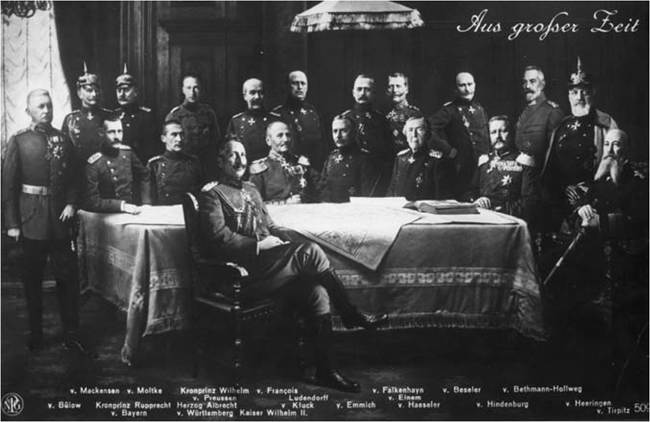
Plate 1.1 Kaiser Wilhelm II and his chief military, naval and political advisers, 1910. (Photo: General Photographic Agency/Getty Images)
Tirpitz's ‘risk fleet' strategy: to acquire an empire, Germany had to compel Britain to conciliate or give way. Imperialism through naval coercion failed spectacularly. Germany's gains in south-west Africa and the Pacific were small and economically burdensome. The German leadership had defined the goals of Weltpolitik only vaguely and pursued them in an erratic way. Historians put this down to the volatile personality of Wilhelm II and the ineptitude of his ministers. In reality, Germany simply could not make real advances abroad without plunging the whole European states system into conflict — in other words, not without jeopardizing German security.
Certainly, once war had broken out in Europe for reasons other than Weltpolitik, the pent-up aspirations for world power would come to the surface in German war aims — but only after the European states system had collapsed. If Berlin had really been bent on world power at all costs, then 1905 — when Russia was reeling from humiliation in Asia and Germany had military superiority over France — was the year to act. This course of action, proposed by Schlieffen in May that year, was rejected by Wilhelm II. To be sure, there are good reasons for focusing on Berlin, but this can be misleading. Weltpolitik was an expression of a much wider trend: ‘to remain a great nation or to become one,' as one French statesmen put it, ‘you must colonize.' France, Britain and Russia had been the winners of nineteenthcentury expansion; Germany and Italy were latecomers scrambling to catch up. Indeed, the only link between imperialist rivalries and the coming of war can be found in the way in which the Europeans greeted the decline of the Ottoman Empire as an opportunity to be exploited rather than as a threat to Balkan, and therefore European, stability. More broadly, the significance of European imperialism before 1914 lies in the way in which the neo-Darwinian impulses which drove the scramble for colonial expansion poisoned the European states system with the same struggle-or-die logic of excessive competition and inevitable war.
The same line can be taken with the view that German foreign policy was determined by domestic politics. This school sees Weltpolitik as manipulation. It was a cause around which Wilhelm II and his advisers hoped to rally the middle and industrial working classes behind the autocracy. Confronted by steadily rising socialism — the Social Democratic Party had won a landslide victory in the 1912 elections — German conservatives sought war in 1914 to stave off domestic political change. Once again, there is some substance here. In 1898, Chancellor Bulow justified Weltpolitik in these terms: ‘We must unswervingly wrestle the souls of our workers; [we] must try to regain the sympathies of the Social Democrat workers for the state and the monarchy.' Nonetheless, while domestic politics may help to explain Weltpolitik, historians now agree that domestic factors did not play a crucial role in 1914. Moreover, comparative history shows that the German situation was not unique. On the eve of war, all the Powers had to cope with internal pressures and relate them to external circumstances. Austria-Hungary is the most telling case: aggressive action against Serbia, it was thought, would arrest the nationalist forces pulling the empire apart. In Russia, military defeat at the hands of the Japanese in 1904—05 had resulted in revolution and concessions to the Duma (parliament). Nicholas II and his advisers were therefore apprehensive, fearing that another humiliation abroad, especially in the Balkans, might shatter the tsarist regime, while a great victory in support of the South Slavs might strengthen it. France and Britain, the two liberal parliamentary Powers, also were not immune to political turmoil and industrial unrest. In 1914, the British prime minister, H.H. Asquith, feared civil war in Ireland over Home Rule more than a European conflict. Generally speaking, across Europe, the Powers had to contend with the social and political challenges arising from modernization. The most that can be concluded from this is that internal factors played a background role in 1914.
More on the topic The long-term causes of the First World War:
- Planning for Long-Term Needs
- LONG TERM
- Long-Term Entrapment
- Long-Term Entrapment
- Long-Term Infiltration
- Long-Term Rehabilitation Follow-up
- Mass extinctions and adaptive radiations have shaped long-term patterns of evolution
- Chapter 17 LONG-TERM ECONOMIC GROWTH AND THE HISTORY OF TECHNOLOGY
- Long-term ecosystem development affects nutrient cycling and constraints on primary production
- CONCEPT 6.4 Long-term patterns of evolution are shaped by large- scale processes such as speciation, mass extinction, and adaptive radiation.
- Chapter 2 Multi-scale Agent-Based Simulation of Long-Term Dispersal Processes: Towards a Sophisticated Simulation Model of Hominin Dispersal
- From European war to World War
- Interpersonal Violence up to the First World War
- The Coming of World War II
- The Coming of World War II