The Mongol Empire under the Successors of Chinggis Khan
Despite Chinggis Khan's aspiration to end tribalism, this turned out to be beyond even his strength. At the very first kurultai after his death, during the year of the Rat, the most important decisions were made by his brothers and sons.
With the passage of time, even the leader's retinue (keshik), which always and everywhere is formed based on the soldiers' personal loyalty to their commander, turned into a family affair. At the kurultai Chinggis Khan's third son, Ogedei (r. 1229-1241), was proclaimed khagan (Great Khan or Khan of Khans) of the Mongol Empire.The choice of heir was made by Chinggis Khan while he was alive. He discussed with his closest companions in arms and relatives who should be the future leader. His firstborn son Jochi was not entirely a legitimate figure due to his questionable parentage. His second son Chagatai was found to be too impulsive, and this gave them cause for concern. The fourth son, Tolui, was the otchigin, tender of the hearth of the family and in time obligated to take over his deceased parents' household and domestic property. Therefore, the candidacy of the third son, Ogedei, proved to be the most acceptable for everyone. Ogedei was calm, even-tempered, generous in nature, and fun-loving.
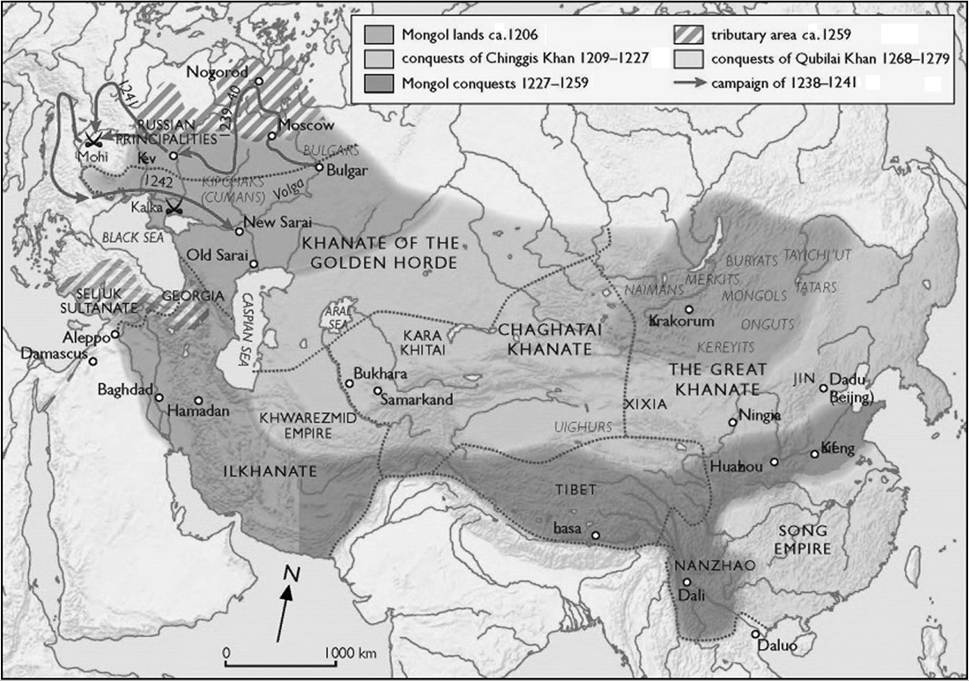
However, Ogedei's most significant virtue turned out to be his capacity to not disturb the natural course of events as they unfolded. He drank wine, hunted, and amused himself with his many wives, and meanwhile the Mongol warriors captured new cities and annexed new countries. During his reign, the empire stretched from the Volga to the Amur River. The general chronology of the most important military campaigns under Ogedei is as follows. The conquest of Northern China proceeded in a piecemeal fashion. In 1233 Mongol tumens (“ten thousands”) reached Manchuria and conquered the Jurchen state of Eastern Xia, and in the following year the Jin dynasty fell once and for all.
In the years 1231-1232, a campaign was launched against the Korean Peninsula and ended in the subjugation of the Goryeo dynasty. In the decades of the 1230s and 1240s, several successful campaigns were completed on the territory of present-day Iran. In 1234 war resumed in China, this time against the Song dynasty. Three years later, the Song had agreed to pay an annual tribute of 200,000 pieces of silver and 200,000 bolts of silk. Mongke renewed military action in 1251, but it was not until 1279 under Kublai Khan that all of China was finally conquered.In the year 1235, a kurultai took place that determined the fate of many nations of the Old World. A decision was made by the Mongol leaders to continue their conquests in Europe and Asia. Volga Bulgaria was taken in 1236. In the winter of the next year, the Mongol army invaded the territory of Rus’. One after another, Ryazan, Vladimir, Suzdal, and Rostov were taken by storm and burned down. The Mongols’ losses were not insignificant, and they spent a couple of years regathering their strength for new campaigns. But then, Chernigov was captured in 1239, and in the fall of 1240 Kiev was besieged and taken by storm. In January 1241 the Mongols invaded Poland and Hungary. Their appearance struck fear into the hearts of the population of European states, and the only thing that saved them was the death of the Mongol khagan Ogedei. The high-ranking khans returned home in order to discuss who would become the empire’s new ruler.
The Mongols’ policy of active expansion was necessitated by the fact that the stability of their empire directly depended on the ability of the khans to secure external sources for obtaining surplus products. Even in his youth, Chinggis Khan was known as a generous leader. His children and grandchildren surpassed their great patriarch in their generosity. Juvaini writes that Ogedei outshone all previous steppe khans in his largess. Everything taken in military campaigns he lavishly distributed to his companions in arms, without demanding that the loot be registered in a special inventory beforehand.[1367] The following words about acquisitiveness are attributed to Ogedei: “ Those who strove after these things were devoid of their share of intellect, for no difference can be imagined between buried treasure and dust, both being of equal advantage.
Since it will be impossible to return from that other world, we shall lay down our treasure in the corners of men’s hearth, and whatever is ready and present or may come to hand we shall give it all to our subject and to petitioners so that we may store up a good name.”[1368]Güyüg (r. 1246-1248), the son of Ogedei, desired that his reputation for generosity be even greater than his father’s. Ultimately, Güyüg rapidly depleted the khagan treasury by supporting those who helped bring him to power and by trying to curry favor with the rest. He also spent huge sums of money on the purchase of expensive goods from Central Asian companies, leaving behind debts of 500,000 silver pieces. There is even a story that at one point Güyüg entered the treasury and
saw mountainous piles of goods. When the khagan was informed that the transport of these riches from place to place was quite burdensome, he came to a truly Solomonic decision—he ordered that all the goods be distributed to the soldiers and the rest of the populace.
For this reason, Chinggis Khan's successors periodically faced situations when their treasury was empty. In one such instance, the army returned to Central Asia from a campaign and discovered that the storehouses were utterly depleted—no grain, no silk. The supporters ofthe militaristic party proposed to Ogedei that the entire population of Northern China be wiped out and their agricultural fields turned into pasturelands. The genocide was averted through the efforts of Yelu Chucai, a Khitan counselor who first served the Jurchen emperor before fulfilling the same role for the Mongol khans. Yelu Chucai managed to convince the Mongol khagan that it would be much more advantageous to impose taxes on conquered peoples. It was at this time that Yelu Chucai pronounced his famous words: “Although you obtained the Celestial Empire on horseback, you should not govern it on horseback.” Seeing what results could be obtained by following this advice, Ogedei appointed Yelu Chucai as chairman of the secretariat (Chinese: Zhongshu Sheng).
He became the de facto chief counselor of the imperial government. The secretariat worked through the details of the most important decisions; prepared decrees for their dissemination; and issued paizas (tablets of authority), stamps, and other attributes of imperial power. However, until Kublai Khan's accession to the throne, this body did not have a precise organizational structure.Since there were not any specialized fiscal institutions, the Mongol rulers widely adopted the practice of farming out the collection of taxes. Various kinds of “entrepreneurs” regularly offered Ogedei their services in order to increase the treasury's intake of tax revenues. Diverse types of taxes and duties were proposed—a tax on salt, a tax on alcoholic drinks, a tax on the use of land and irrigation systems, and others. At first, Yelu Chucai succeeded in establishing a stable tax system. Besides the standard land taxes, various obligations and exactions were instituted. In particular, the obligation to supply food to Mongol messengers and officials, who crisscrossed the entire territory of the empire, was a heavy burden. The success of the system was largely due to the fact that Yelu Chucai actively recruited former Confucian bureaucrats into the government apparatus. He convinced Ogedei that they possessed considerable knowledge and administrative experience. In order to optimize tax collection, in the years 1233 and 1234 a census was performed on the territory of Northern China.
When Yelu Chucai proposed instituting taxes, he was concerned not only with filling the khan's treasury, but also about the restoration and renewal of the state's economy. Toward the end of Ogedei's life, the influence of the devout Confucian on him waned. In the winter spanning 1239 and 1240, the Muslim merchant Abd-ar- Rahman proposed that he take over the tax collection duties, promising to double the revenue flowing into the treasury. Despite Yelu Chucai's vehement opposition, Ogedei and his circle consented to this plan.
In 1236, under pressure from the nomad aristocracy, Ogedei handed over a significant part of the conquered territories of Northern China as appanages. Yelu Chucai also failed to prevent this— he only succeeded in ensuring that a special auditor was assigned to each of the Mongol leaders to provide oversight.By the order of Ogedei, officials (baskaks) were sent to conquered states, accompanied by scribes (bitikchis). The word baskak is of Turkish origin (the Turkish root bas means “to press”). This is a calque of the Mongolian term darughachi (the Mongolian daru means “to press”). Both words literally mean a “person who affixes a seal in the name of the khagan” Judging by the available evidence, a wide range of administrative, military, and judicial powers were held by a darughachi. In order to strengthen the empire's infrastructure, the yam postal system was created in 1235. Every “thousand” was required to select supervisors for the relay stations (yams). They were in charge of supplying fresh horses, food, and shelter to messengers and other government officials.
There came a time when it was necessary to move the headquarters from Eastern Mongolia to a new site. A decision was made to build a capital in the valley of Orkhon, which would receive the name Karakorum (Mongolian: Kharkhorin). From this location, it was much more convenient to control both China and the trade routes through Gansu, as well as embark on military campaigns against Dzungaria and Turkestan. An important consideration in the choice of the capital's location was the necessity to gather together craftsmen from conquered states in one place. In the course of the first decades of the Mongol Empire, an enormous mobilization of human resources took place. After the seizure of Khwarezm, 100,000 craftsmen were taken as prisoner to Mongolia. The next wave of forced deportation of master tradesmen occurred during the campaigns against the Jin dynasty, as a result ofwhich many skillful craftsmen and artisans were brought to Karakorum.
They decorated the interiors of palace rooms and manufactured prestigious housewares and various adornments.The capital became a vivid embodiment of the empire's mix of cultures and peoples. In one section aristocratic estates and the khagan's palace were situated, in another section the inhabitants were Jurchen and Chinese craftsmen, and in a third resided Muslim merchants. In the city there were at least four markets, as well as temples and shrines of various religions. Ogedei's palace, Wanangong (Palace of the Ten-Thousand-Year Peace), was completed in the year 1235. In front of the palace there was the famous Silver Tree, crafted by the Parisian artisan Guillaume Bouchier. Four silver lions stood in front of the tree and kumiss, the fermented horse-milk of the peoples of the steppe, flowed out of their jaws. Four pipes in the form of gilded snakes ran from the tree trunk and dispensed various alcoholic drinks. The branches and leaves were sculpted from silver. And at the very top of the tree there was an angel holding a trumpet.
Despite the presence of a capital city, Mongol khagans spent the majority of their free time migrating from place to place according to the seasons, that is, when they were not on military campaigns. Ogedei frequently traveled to the north of Karakorum, where he spent his leisure time practicing falconry near Doityn balgas. During the summer he sought refuge from the sun in the cool climes of the Khangai Mountains. With the arrival of the winter frosts, Ogedei traveled to the south closer to the Gobi Desert. In early spring, he would return to Karakorum in order to resolve governmental affairs. The total distance of his annual sojourn amounted to about 450 kilometers.
After Ogedei's death and the brief reign of his son Güyük (1246-1248), power shifted to the offspring of Chinggis Khan's youngest son, Tolui. His son Mongke (r. 1251-1259) was the next to be chosen khagan. His candidacy was strongly supported by the most powerful and oldest of Chinggis Khan's descendants, Batu. Mongke had to exert much effort to sort out the administrative muddle, and repealed many of the existing yarlyks (edicts). He appointed Bulghai as head of the chancellery, commanding him to write down his decrees and produce copies of them. Various scribes served under Bulghai who could write in Uyghur, Persian, Chinese, Tibetan, and Tangut scripts. By 1260 there were already about one hundred translators employed in the Zhongshü Sheng.
Mongke believed that Chinese bureaucrats could serve in the conquered regions of China, but did not see any need to use them in the central government apparatus of the steppe empire. Judging by the available evidence, it was indeed the case that the Mongol headquarters had no great need for Chinese officials. Prior to Kublai Khan's reign, there were no special bureaucratic institutions created in conquered Chinese and Jurchen territories. In this prior period, the Mongol Empire lacked the very strict hierarchical palace ceremonies that were characteristic of Chinese kingdoms.
As the Mongol Empire reached the limit of its expansion, the number of military campaigns began to decrease. The ruling elite started tincreasingly to focus on levying various taxes on conquered peoples. The increase in taxes led to a variety of forms of protest—from simple tax evasion all the way up to revolt. Mongke was forced to repeal most of the old duties, and put into place new, fixed taxes. A single annual tax was instituted that was proportional to the amount of one's property (the ratio between taxes on the rich and poor was approximately seven to one). Religious institutions, the elderly, and the disabled were exempt from taxation. In order to streamline tax levying and the collection of government revenue, in the year 1252 Mongke ordered that a census be conducted of all the conquered realms. Darughachis (baskaks) and scribes fanned out over the empire to pursue this goal. Mahmud Yalavach was put in charge of the census in China. Arghun Khan returned to Central Asia to perform analogous functions. Berke Khan was sent to Rus' to take a census there, but it was conducted only later, in the winter spanning 1257 and 1258.
The Mongols encouraged religious diversity. Chinggis Khan himself and his immediate descendants did not show a preference for any particular world religion— they held all existing religions in esteem. This was due to a multitude of factors: the Mongols' belief that they were given the Mandate of Heaven to conquer the world, the absence of a strategic interest in world religions, the personal motives of the Mongol rulers, the need to prevent alliances between political elites of different religious creeds, and the pragmatic desire to secure their rule in conquered states. In
520 NIKOLAY n. kradin
Map 18.1. The Empire of the Mongols as It Developed during the Thirteenth Century ce.
Source: Cunliffe, 2015, By Steppe, Desert, and Ocean: The Birth of Eurasia, p. 420. Copyright: Oxford University Press.
the majority of territories, clergy (Daoshis, Buddhists, and Orthodox priests) were not required to pay taxes. With the passage of time, the Mongols in the Middle East, Central Asia, and in the lands of the Golden Horde converted to Islam, the religion of warriors and merchants. The acceptance of Islam accelerated the processes of acculturation, first among the elite; later, cultural borrowings from the settled agricultural world penetrated into other groups across the steppe.
During the reign of Mongke, the Mongol Empire de facto reached its maximum size where it could still be conceived as one entity. As any empire continues to expand, it eventually reaches a threshold where information can no longer be effectively exchanged. Sooner or later, information from the center to the periphery (and vice versa) takes so long to arrive that the center can no longer react to problems as they arise. Already during the time of Ogedei, some months or more were required to travel from the westernmost lands of the Mongol Empire to the easternmost. When a khagan passed away, the integrity of the empire was threatened. A long period of regency would begin, and power ended up in the hands of someone from the deceased khagan s close relatives. The period of regency would continue until a kurultai could be gathered to elect a new ruler of the steppe empire. The Mongol state was so big that it would take many months, or even years, before it was possible to gather a quorum of relatives that was sufficiently large to give such a decision legitimacy. On the other hand, the Mongol state was vast enough that rulers of regional appanages quite often did not manifest any interest in ascending to the throne in Karakorum.
More on the topic The Mongol Empire under the Successors of Chinggis Khan:
- PART IV THE MONGOL MOMENT
- The Unification of Eurasia
- Over a period of many centuries, Chinggis Khan and his exploits have attracted widespread attention.
- The Mongols and. the Transformation of Rus' Political Life
- Bang Peter F., Bayly C.A., Scheidel Walter (eds.). The Oxford World History of Empire. Volume Two: The History of Empires. Oxford University Press,2020. — 1352 p., 2020
- Foreign Relations
- Chapter 6 Pax Mongolica