PART IV THE MONGOL MOMENT
The Rise of Chinggis Khan and the Central Asian Steppe, Followed by Regional Reassertion
Peter Fibiger Bang
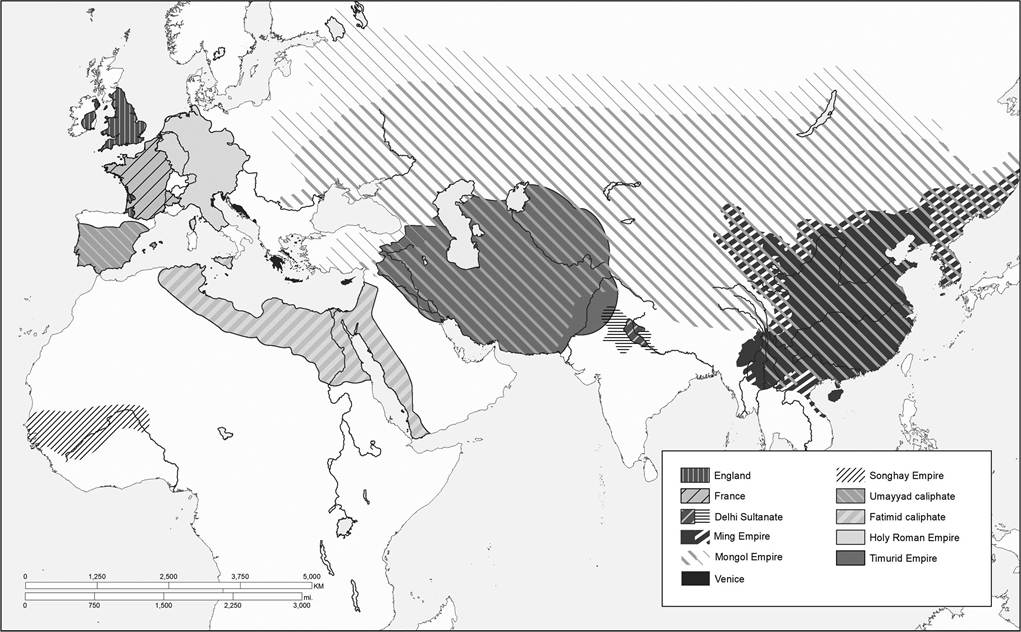
500 THE MONGOL MOMENT
Map IV.
The Mongol Moment: The Rise of Chinggis Khan and the Central Asian Steppe, Followed by Regional Reassertion. Copyright: Peter Fibiger Bang with Jonathan Weiland.
By 900, the two main ecumenic empires were a spent force, fragmenting into commonwealths of smaller polities as local elites had slowly hollowed out the power of the imperial courts. Across the great landmass of Afro-Eurasia, however, warrior and state-building elites continued to vie with one another to claim succession to the grand empires of the past and fill out their old symbolic shells. For a time, it looked as if imperial reinvigoration would come through the Song dynasty's (960-1279) successful reconquest of much of the old Tang Empire. On the horizon, however, a stronger force was assembling. Searching for a driver of world history, scholars have sometimes looked to the nomads of the Central Asian steppes. This view is arguably exaggerated; they were far from the most significant source of imperial conquest over the millennia.1 But this was their moment. A first wave came together with the establishment of several Turk and Mongol polities across Western Asia and the northern regions of China. Most important, perhaps, was the Jurchen Jin dynasty (1115-1234), which, by capturing the capital city of Kaifeng, managed to confine the Song to the south of China. That was only a taste of things to come, though.
Fluid and constantly changing political constellations had limited the capacity of the transmigrant and easily mobilized horse-riding nomadic warriors of Central Asia to assert their dominance over the sedentary populations of the sown.
At this point, firmer forms of political organization had begun to develop on the steppe. Most successful was Chinggis Khan (r. 1206-1227) who managed to forge the many tribes of the grasslands into a stalwart coalition of bow-wielding swift cavalry (Kradin, Chap. 18). The warrior society of Chinggis was intensely dependent on income from conquest to maintain its social structure. An unbeatable force had emerged, with an inbuilt need to go on. For a while, no one could resist as the armies of the Mongol Khaghan swept out to the four corners of the Earth from the heartlands of Eurasia. Old dynasties fell like chips in front of the armies of Chinggis and his successors. Baghdad was taken in 1258 and the Abbasid caliph executed. Lin'an,1 Though, see Scheidel in vol. 1, Chap. 2. today Hangzhou—the southern seat to which the Song emperors had relocated— surrendered in 1276 with much of the court. Kublai, the great Khan (r. 1260-1294) and grandson of Chinggis, seemed poised to establish a real world monarchy. Much in the style of the old Achaemenid king of kings, he made a point of embracing the many different cultural and religious traditions within a realm whose dimensions had never been matched before.
Yet even for a Great Khan, the extent of the realm was far greater than could be mastered. Since the time of the Achaemenids, on three occasions, seemingly irresistible conquerors had swept through the band of Afro-Eurasian sedentary peasant populations and state-making elites. The first was the campaign of Alexander the Great (334-323 bce), which had seen his Greco-Macedonian soldiers traverse the entire Achaemenid world from its westernmost fringes to its eastern extremities along the Indus River. A millennium later, roughly speaking, the armies of the Caliphate had matched and surpassed that feat by adding to the Persian Empire much of the Roman, all along the south Mediterranean coastline reaching up into Spain. Another half millennium on, the Mongols widened the amplitude of the conquering swing even further, from the south of China to the developing Russian principalities on the doorstep of Europe.
The staggering dimensions of the Mongol conquests reflected the fact that the areas capable of sustaining state-building elites had slowly but steadily continued to expand. Population estimates are extremely uncertain, but by the thirteenth century totals were probably approaching double that of classical antiquity. Even so, just as in the two previous parallel cases, the Mongol rulers also quickly had to face the prospect of fragmentation. No matter how fast the horses of the steppe, the logistical constraints and the obstacles of distance were too big, the varying centers of population still too far from each other, to keep the conquests together. The Mongol expansion resembled mostly the explosion of a supernova, with armies, like matter, shooting out from an epicenter in different directions, getting further and further away from each other before gradually slowing down. Eventually expansion ground to a halt, and as the conquered societies recovered from the shock, the new rulers were absorbed within the preexisting social order. The world of the Mongols broke up into a series of khanates and monarchies, which gravitated toward the macro-regions traditionally capable of sustaining a governing elite.The breakup of Mongol power may well have been hastened by the outbreak of another Afro-Eurasian pandemic of bubonic plague. During the middle decades of the fourteenth century, the harrowing Black Death decimated the populations of the sedentarized zones from east to west. It presumably also weakened the manpower reserves of the steppe rulers. Indeed, the intensification of contacts across the vast continent following in the wake of the Mongol armies may have enabled the disease to widen the reservoirs from where the pest could leap from its animal hosts onto human populations. Nevertheless, the earlier, so-called Justinianic plague of the sixth century had ravaged large swaths of Eurasia without the infrastructural support of the vast Mongol Empire; the Pax Mongolica may have been a catalyst, but not the necessary pre-condition; rather, this was the growth of urbanized, complex agrarian society.
At any rate, the Mongol moment was passing swiftly. Already in 1368, Zhu Yuanzhang—true to his name, which meant “weapon” in Mandarin—rose up, ousting the descendants of Kublai in China to found the Ming dynasty (Robinson, Chap. 19). Vigorously asserting its power, a set of fabled naval expeditions were soon to proclaim the might and unrivaled grandeur of the new dynasty across Southeast Asia and the Indian Ocean. The fleets were enormous, a colossal manifestation of power intended to arrive in distant harbors and awe rulers into submission. From faraway corners of the world, these navies, under the leadership of the Muslim eunuch admiral Zheng He, would bring back rare goods as tribute from foreign and exotic powers. Giraffes, gathered from East Africa, were paraded at court as wondrous omens of the blessed dispensation and universal reach of Ming rule. Once again, the emperors of a new dynasty would proclaim that a golden age had arrived under their just and virtuous gaze.[1358]
Soon, however, the expeditions were abandoned. The year 1433 marked their end. Historians have seen in this a fateful move, a retrenchment and turning the back on the world, unwittingly vacating the stage of history to European expansion and colonialism. Such an assessment is anachronistic. It was a long time before the rulers of “all under heaven” would feel the strains of European competition, let alone any credible threat. Meanwhile, they had more pressing concerns closer to home. Yongle, the very emperor to launch the fleets, moved his capital northward to Beijing, the better to control the Mongols of Inner Asia, the main threat to his monarchy. His armies were also hard at work trying to conquer Vietnam in the south. The fleets, on the other hand, were operating on such a costly scale that the effort would never pay off. In economic terms, they were a drain on resources, not essential to the empire. And from this perspective, the grandiose navies emerge as a form of imperial exuberance, a sign of the dynamism and strength of post-Mongol empire.
In the literature, the notion of post-nomadic empire has gained currency.[1359] As the power of the nomads waned after the Mongol moment, rulers again became sedentary.
But they managed to adopt or retain, in various ways, some of the military strengths of the steppe. Residing in Samarkand, Timur Leng (1336-1405) strove to revive the fortunes of Mongol and steppe power, but significantly, he did so as a Muslim ruler, combining the sedentary arts of the book with those of the sword and bow. Everywhere from Ankara to Delhi, his victorious armies inflicted terror as he sought to establish himself as paramount among the rulers of the Islamic world. Both Islam and Christianity were characterized by political fragmentation at the time (Tullberg, Chap. 21). Political division had left room in the Mediterranean for an opportunist merchant republic like Venice (Pezzolo, Chap. 22) to carve out a slim commercial empire of its own in the interstices of sedentary power - as seen so often in history (a phenomenon discussed by Chase-Dunn and Khutkyy, Chap. 3, Vol. 1). But there was no shortage of monarchs and dynasties pursuing imperialist projects in competition with their rivals. Overall, state-building clerics and warriors continued to expand the reach of the Christian and Islamic world orders, slowly consolidating their position.In the late eleventh century, Catholic popes had successfully launched the Crusader movement that for a brief period restored Christian control of Jerusalem. But, if success in the Holy Land was short-lived, the movement significantly found emulators elsewhere on the continent to launch crusades of their own to push forward the frontier of Christian rule.[1360] Equally, many Muslim rulers found legitimacy in being a gazi, a warrior for the faith. The towering minaret of Qutb Minar still remains as a grand testimony to the Delhi Sultanate and the powerful groups of Muslim warrior elites that by the end of the twelfth century had established themselves across North India (Kumar, Chap. 20). Meanwhile, Muslim statecraft was trickling down south through the Sahara, resulting in the rise of the widespread, but loose suzerainty of the Mali and Songhay empires in the West African Sahel (Hall, Chap.
23). One of their rulers, Mansa Musa, won legendary fame for the pilgrimage he undertook to the Muslim holy cities of Mecca and Medina. The rich offerings earned him a reputation for fabulous wealth in medieval chronicles and a sensational, wildly exaggerated image in some credulous modern histories.[1361] The real significance of his pilgrimage, however, is as yet another affirmation of the continuing force of the old imperial universalisms across the Afro-Eurasian world. In Europe, the so-called Holy Roman emperor and the pope wore each other out in struggles over the heritage of Rome and supreme leadership of Christianity.The prospect of universal empire continued to animate the world of kingship, its highest aspiration, not because it was realistic or absolutely achievable, but because the notion epitomized both the price put on military expansion and the quest for supremacy among one's rivals. When Timur, therefore, as one of the most successful conquerors of his generation, received an embassy from the court of the early Ming dynasty that addressed him as a mere tributary ruler, it was treated as an intolerable affront. A monarch who could countenance presenting himself to the world in cosmic vocabulary as “lord of the auspicious conjunction” was in no mind to accept an inferior position, even if it was in relation to the conveniently distant, if mighty Chinese emperor. The drama was choreographed according to the rules of the age- old grammar of rank and preeminence that we saw emerge among rulers of the third/second millennium BCE (Part I). Insult was returned in a game of tit-for-tat. The embassy was retained in Samarkand. Eventually Timur died in 1405 as he set out on campaign to bring the Ming emperor to yield and submit to Islam.[1362] However, if the two grandest imperial gestures of the early fifteenth century—the Chinese campaign of Timur and the tributary fleets of the Ming—both proved abortive, this was only in the short run. They were a herald of things to come. The world was about to be pulled more closely together while a spate of universal monarchies rose to preeminence across the world during the fifteenth and sixteenth centuries.
Bibliography and Guidance
The two massive tomes of Lieberman (2003-2009) may be the most successful attempt so far to structure a synthesis of Afro-Eurasian state- and empire- formation around the power of the Central Asian steppe, from the ninth century to the age of colonialism: the majority of sedentary populations lived in areas exposed to attacks from nomads and were subject to the imposition of vast empires; meanwhile an outer zone was protected from nomadic conquest and there fragmentation prevailed. Abu-Lughod (1989) presented the empire of the great khans as facilitating cultural and economic exchanges across its vast pan-Eurasian space, to form an alternative world system, which flourished before the coming of European commercial hegemony. The classic discussion by McNeill (1976), of how sedentary agricultural populations dynamically interacted with crowd diseases to form a slowly expanding body of societies, could have been included in any of the bibliographies for the part introductions of this volume, but is mentioned here for its suggestion that the intensification of contacts facilitated by the Mongol Empire also generated the conditions that made it possible for the Black Death pandemic to develop and spread. Di Cosmo, Frank, and Golden (2009) and Christian (1998), in combination, provide detail and a longue duree treatment of the polities of the nomadic steppe. Lattimore (1951) is a classic. In general, interpretations that see nomadic power as “shadowing” or rising on the frontier of sedentary societies seem to this author stronger than those that position the dynamics of the steppe as the decisive engine. Cunliffe (2015) for a moderate, Crossley (2019) for a bold and inspired version of “nomadic” world history.
Bibliography
Abu-Lughod, J. L. 1989. Before European Hegemony: The World System A.D. 1250-1350. Oxford.
Chan, H.-L. 1988. “The Chien-Wen, Yung-lo, Hung-hsi, and Hsuan-te Reigns, 1399-1435.” In F. W Mote and D. Twitchett, eds., The Cambridge History of China 7, 1: The Ming Dynasty 1368-1644,258-259. Cambridge.
Christian, D. 1998. A History of Russia, Central Asia and Mongolia, Vol. 1: Inner Eurasia from Prehistory to the Mongol Empire. Malden, MA.
Crossley, P. K. 2019. Hammer and Anvil: Nomad Rulers at the Forge of the Modern World. Lanham, MD.
Cunliffe, B. 2015. By Steppe, Desert, and Ocean: The Birth of Eurasia. Oxford.
Di Cosmo, N. 1999. “State-Formation and Periodization in Inner Asian History.” Journal of World History 10, no. 1: 1-40.
Di Cosmo, N., A. J. Frank, and P. B. Golden. 2009. The Cambridge History of Inner Asia. Cambridge.
Dreyer, E. L. 2007. Zheng He: China and the Oceans in the Early Ming Dynasty, 1405-1433. Edited by P. N. Stearns. New York.
Fletcher, J. F. 1968. “China and Central Asia, 1368-1884.” In J. K. Fairbank, ed., The Chinese World Order: Traditional Chinas Foreign Relations, 206-224. Cambridge, MA.
Gommans, J. 2007. “Warhorse and Post-Nomadic Empire in Asia, c. 1000-1800.” Journal of Global History 2:1-21.
Jensen, K. V. 2011. Kortstog ved Verdens Yderste Rand. Danmark og Portugal ca. 1000 til ca. 1250. Odense.
Lattimore, O. 1951. Inner Asian Frontiers of China, 2nd ed. Irvington-on-Hudson.
Liebermann, V 2003-2009. Strange Parallels: Southeast Asia in Global Context, c. 800-1830, 2. Vols. Cambridge.
McNeill, W H. 1976. Plagues and Peoples. New York.
Wink, A. 2011. “Postnomadic Empires: From the Mongols to the Mughals.” In P. F. Bang and C. A. Bayly, eds., Tributary Empires in Global History, 120-131. Basingstoke, UK.
More on the topic PART IV THE MONGOL MOMENT:
- Transformations of Post-Mongol East Asia
- Conclusion: A Theological Moment
- The unipolar moment: America at the apex
- The Mongol Empire under the Successors of Chinggis Khan
- The SuCpeime Moment
- The Comingof the Mongol
- 9 The Mongol Invasions
- Cromwell’s Imperial Moment
- Section Two: the Mongol “Threat”
- THE SUBPRIME MOMENT, 2001-2008
- 18 The Mongol Empire and the Unification of Eurasia
- Mongol States from Dawn until Dusk
- Let's imagine for a moment that you have the ability to look back in time and follow the change in a typical coral reef community in the Indian Ocean (FIGURE 17.3).
- The Interwar Moment: Violence versus Non-Violence
- In Part Two, we looked at the first part of Gaius' institutional scheme, the law of persons. It now remains to us to consider the law of things.
- Whilst the previous part considered some of the difficulties that have dogged documentary trade finance, Part II looks to the future. Given the technological advances that have occurred since the advent of the documentary letter of credit, the former is increasingly threatening to eclipse the latter.
- 12.109 In addition to permitted development rights granted by Part 6 (above), permitted development rights also apply in England under Part 3 (change of use) of the GDO for the conversion of agricultural buildings to some non-agricultural uses.142
- Classical Rome had a very liberal divorce policy (as did Greco-Roman Egypt; see Part III). By the first century B.C.E., women who were not married with manus [see Chapter 1, Part II.B.] had the right to divorce their husbands unilaterally, and eventually the same right was enjoyed by women married with manus.