The rise of political Islam
Islam provides a blueprint for social and religious interaction — the relations between individuals and those between the individual and God. Yet there is very little in the original Islamic sources, such as the Quran, about what form or structures states should take or what type of governance is preferable.
What Islamists therefore are positing as the foundation for an Islamic state is the implementation of the body of jurisprudence formulated by the early jurists, a body of work that was prescriptive at the time of writing and is being taken as descriptive today.Caliphate
The office of the successor to the Prophet Muhammad in his political and social functions. The Caliphate was abolished by the Turkish president Mustafa Kemal Atatürk, in 1924 after the dismemberment of the Ottoman Empire and the establishment of the Turkish Republic.
see Chapter 4
The modern concept of the Islamic state was developed by Muhammad Rashid Rida (1865—1935) in response to the dissolution of the Caliphate, the increasing influence of the Western colonial Powers on Muslim societies and the emerging Zionist movement. Two key factors need to be considered when looking at the notion of the Islamic state. The first is a historical one which situates the emergence of the Islamic state in the context of European physical and, more importantly, cultural encroachment. Rida's own circumstances were influenced by the British occupation of Egypt in 1882 and the need for Egyptians to formulate a response, in either nationalist or religious terms, not just to the occupation but also to the European ideas that were penetrating Egyptian society. An Islamic state encompasses both. The second factor is a conceptual one. The Western concept of the state, which developed from the Renaissance, the Enlightenment and the growth of capitalism, emphasizes individualism, liberty and law.
It sees the state as the guarantor of individual freedoms. In comparison, the Islamic concept of the state cannot be divorced from the group (jama’a), justice (‘adala) and leadership (qiyada or imama). The state thus becomes the guarantor of communal justice. Consequently it is not surprising that the driving force in Iran's Islamic revolution was the desire for socio-economic and political justice and that Islamist movements ever since have framed their political, military and social agendas in terms of justice, ranging from the eradication of corruption to liberating Palestine.The emerging political expressions of Islam in the late nineteenth and early twentieth centuries became known as Islamic modernism. It saw Islam as a blueprint for all aspects of life and as flexible and thus able to adapt itself. The label ‘modernists' derives from the fact that this school of thought, which is based on the works of Jamal al-Din al-Afghani (1839—97), Muhammad Abdu (1849— 1905) and Rida, emerged from the encounter with the West, and more specifically Western technological superiority and consequent Western colonial occupation of Muslim lands. This encounter raised the question of compatibility between Islam and modernity and how Muslims should respond to the West. They opted for internal reform — hence sometimes they are also referred to as Islamic reformists — designed to purify the Muslim community from all the elements that had weakened it and to embrace elements of modernity and technology in order to strengthen it.
see Chapter 4
pan-Arabism
Movement for Arab unity as manifested in the Fertile Crescent and Greater Syria schemes as well as attempted unification of Egypt, Syria and Libya.
From the beginning, modernist Islam was in competition with emerging secular nationalist ideologies and, in the first half of the twentieth century, nationalism was clearly the stronger force in the Muslim world. Indeed, it was the failure of secular nationalist ideologies to deliver what they promised that allowed political Islam to emerge as a viable alternative.
In the Arab world this process was triggered by the defeat of Egypt, Jordan and Syria in the 1967 June War with Israel. Until then the Arabs believed that by uniting against Israel under the banner of Arab nationalism they would be able to liberate Palestine. The 1967 June War drove home very clearly that pan-Arabism was an ideal which was not borne out by reality. Israel not only won the war but increased its own territory almost fourfold, swallowing the ‘rest of Palestine'. Criticism from Islamic ranks focused on the moral bankruptcy of pan-Arabism and the assertion that secularism itself and Arab nationalisms were mere imitations of alien ideologies. They advocated a return to indigenous values and claimed that the reason the Arabs had lost the war against Israel was because they had strayed from the righteous path of Islam. Islam would provide for justice and the liberation of Palestine.The bankruptcy of secular nationalism also applied to the domestic situation. Many of the newly independent Middle Eastern states such as Egypt, Syria, Algeria or Iraq had opted for a policy of Arab socialism, promising equality and prosperity to their populations. By the 1970s these socialist command economies, like their Eastern European counterparts, started to fail, living standards declined and in some cases food shortages brought people into the street in ‘bread riots'. The situation was further exacerbated in the 1980s and 1990s by the decline in oil wealth, the dramatic population increase and a soaring rate of unemployment. The inability of the state to deliver economically provided an opening for Islamists to push Islam as an alternative model of developmentalism based on the Islamic principles of equality and justice. Islamists also started to fill the gap in social, health and welfare institutions, particularly for the urban poor.
Since the 1970s, Muslim South-East Asia has also undergone a process of Islamic renewal as characterized by a dramatic rise in the building of new mosques, the proliferation of religious schools and educational programmes, an expansion of the market for Islamic publications, and the growth of Muslim cultural but also distinctly political organizations.
This Islamic resurgence took some inspiration from developments in the Middle East, most notably the 1979 Iranian Revolution. It also clearly shared in the disenchantment with secular nationalism and the search for an alternative response to modernity. At the same time, however, Islamic renewal in South-East Asia was highly region- and even statespecific, driven above all by the economic marginality of the Muslims in the corporatist states of Malaysia and Indonesia. Islam, since the 1965 expulsion of Singapore by Malaysia, became a means by which to redefine Malay identity and with it the New Economic Policy which favoured Muslim Malays over nonMuslim Chinese. Unlike in Malaysia, Islam did not become part of the discourse of the state in Indonesia. Islamization instead occurred at a popular level where it served as a way of challenging traditional hierarchies, but it did not arise as a challenge to the state until the fall of President Suharto in 1998. Yet, as in Malaysia, Islamism was driven by economic factors — the 1997 Asian financial crisis, widespread corruption, the failure of the state's development policies, and the descent of the majority of Indonesians into unemployment and poverty.Islamist movements: aims, strategies and political philosophies
The majority of twentieth-century Islamist movements share a number of grievances. Among their aversions are bankrupt Western-derived ideologies, corruption, authoritarianism, urbanization, rapid industrialization, Westernization, the unqualified American support for Israel, double standards in Western policy, social dislocation, the decline in public morality and the uncertainties created by globalization. Yet their emergence has been context specific. As a result, the aims and strategies of different organizations vary and their strategies, in particular, are more often than not a reflection of the limitations of the state rather than free choice. Broadly speaking, these movements can be located along a continuum from political Islamists at one extreme to militant Islamists at the other.
Political Islamists rely predominantly on political, social and educational means to achieve their aim of an Islamic state. They work from within the given state system and political structure to Islamize society and reform the state. They seek to achieve their aims in three important ways. First, they function as political parties, each with its own distinct political platform, and, like other political parties, field candidates and stand for elections. Second, Islamist movements also function as pressure groups, which lobby political parties, politicians and institutions to adopt more Islamic practices, to include Islamic law as a source in the state's legal system, and ultimately to adopt their model of an Islamic state. Third, they function as an alternative social welfare network by establishing community assistance projects including clinics, schools, day care centres, publishing houses and Islamic banks.The key difference between militant Islamists and political Islamists is that the militants do not believe in working within the existing system, which in their eyes is corrupt, ungodly and beyond redemption. They oppose the political strategy on the grounds that working from within effectively legitimizes failed regimes and are thus anti-systemic in nature. They not only see the use of force to overthrow such illegal governments as acceptable, but advocate it as just and holy — as jihad.
Jihad
Struggle in the way of God. A fundamental tenet of Islam consisting of the Greater jihad which is above all a personal struggle to be a better Muslim and the Lesser jihad which is physical fighting.
Historically, jihad was central to the expansion of the Arab Caliphate, especially during the Umayyad period. Yet contrary to much thinking in the West, physical warfare is only a minor part of the concept of jihad while at its core is ‘striving in the way of God', which is effectively an internal struggle for every Muslim to be a better person. What is interesting is how militant Islamists have appropriated this religious concept of jihad and have reinterpreted it to suit their own strategies.
see Map 19.1
salafi
Pertaining to the good ancestral example and tradition of the Prophet Muhammad, his companions and the first four Caliphs.
If one way of categorizing Islamist movements is by strategy, another way is in philosophical terms. This can be done by dividing them broadly into revolutionary Islamists and reformist Islamists or by looking at them more in terms of schools of thought. Revolutionary Islamists seek to Islamize society through state power in a top-down fashion, while reformist Islamists see Islamization as the result of social and political, bottom-up activities. With respect to specific schools of thought, three warrant closer inspection: salafis or neo-salafis, fundamentalists or neo-fundamentalists, and khawarij or seceders.
Salafi Islam is exclusive in terms of beliefs and doctrine. Salafis believe that Islam after the time of the Prophet Muhammad and the four righteous caliphs was corrupted. Consequently their movement strives to return to this purer period, and this puts them directly at odds with Islamic mysticism and pluralism. Their scripturalist and traditionalist orientation gave rise to the eighteenth- and nineteenth-century puritanical desert movements such as the Wahhabiya of Arabia, the Sanussiya of the Sahara and the Mahdiyya of present-day Sudan. Salafis are strict Sunnis opposed to any forms of popular Islam such as saint worship. Probably the most influential thinker for salafism is Ibn Taimiya (d. 1328) who emphasized the supremacy of shari’a over the unity of the community. He focused on ideological unity in order to compensate for the reality of political and social divisions. This interpretation is in juxtaposition to mainstream Sunni juristic theory in which unity of the community takes precedence above all, including pious and just government.
In the latter part of the twentieth century there has been a revival of salafi Islam, what some have labelled neo-salafism, including a branching out into new geographic areas. In addition to the Middle East, salafi movements are active in Central and South-East Asia. This spread of salafism can be directly linked to Saudi educational activities in Muslim countries, but also to the increasing insecurity in the face of globalization which makes a return to the moral clarities of the time of the Prophet Muhammad appealing.
Islamic fundamentalists share with the salafis the desire to return to the early sources of Islam. However, unlike the salafis, they do not focus on jurisprudence, but see Islam holistically as din (religion), dunya (way of life) and dawla (state). In the latter part of the twentieth century a number of more radical or militant splinter groups developed. These have become known as neo-fundamentalists. The latter are eclectic in their reading of Islamic sources and generally are action- oriented. Examples of neo-fundamentalists include Takfir wa al-Hijra, the group which was initially blamed for the assassination of Egyptian President Anwar Sadat in 1981.
The final category to be discussed here is that of khawarij or seceders. The original khawarij movement emerged when a group of soldiers seceded from the army of Ali because they disagreed with the issue of arbitration or consultation in the context of Ali's accession to the Caliphate. The philosophical basis of these seceders was that any decision, whether religious or political, had to be God's decision and that commission of a grave sin was grounds for excommunication. The khawarij thus became the first religio-political opposition movement against the state. The emergence of the nation-state in the twentieth century has given
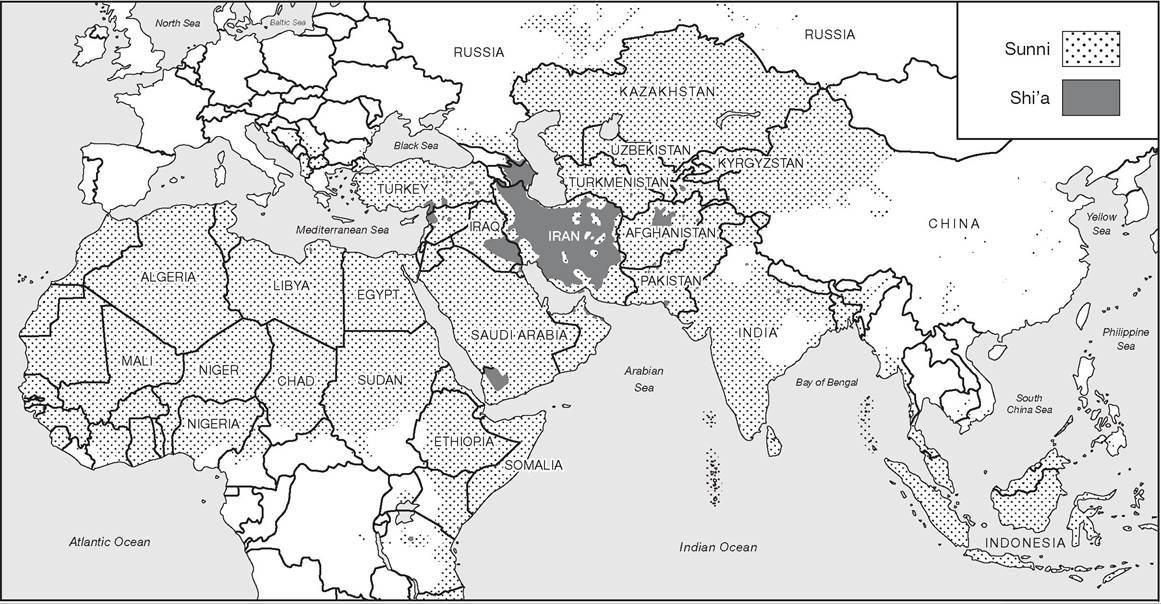
Map 19.1 The Muslim world
new momentum to anti-state opposition and with it a revival of the khawarij tradition. The first such challenge came from the Egyptian intellectual Sayyed Qutb to the regime of Gamal Abdel Nasser in the 1950s and 1960s. The philosophy espoused by Qutb was absolutist in the sense that in his world-view the choice was between ‘God's absolute rule' or al-hakimiyya I’illah and ‘total pagan ignorance' or jahiliyya. This was also reflected in his views on who did not belong to the community, which ranged from the exclusion of non-Muslims from political participation to the takfir (excommunication) of Nasser himself by labelling him an unbeliever. This, in turn, allowed Qutb's followers, who as Sunnis were not permitted to rise against a Muslim ruler no matter how unjust, to take up arms against Nasser. Qutb was ultimately imprisoned for his ‘rebellion' and executed in 1966. His notion of takfir, however, was taken up by a number of Islamist movements, not all of which are, strictly speaking, in the khawarij category.
A final point that needs to be made when looking at the various ways of categorizing Islamist movements is that the majority of movements do not clearly fall into one category or another. Many embrace select elements from different philosophies and most have adopted strategies which combine political and militant approaches, emphasizing one over the other merely as a way of adjusting to state responses.
Debating the state strategies and responses to the Islamist challenge
Hizb'allah (Arabic: Party
of God)
Lebanese Shi'a Islamist group which emerged in reaction to the 1982 Israeli invasion of Lebanon. Its primary aim until the Israeli withdrawal in May 2000 was the liberation of southern Lebanon.
State responses to the Islamist challenge can broadly be divided into two categories: co-optation and suppression. Co-optation means engagement by the government with the Islamists and their inclusion either through permitting them to stand for elections and to take up seats in the government or through partially adopting their discourse and agenda. The government of Jordan has pursued a strategy of co-optation since the mid-1980s, allowing the Muslim Brothers to organize, stand for elections and participate in the governance of the state as long as they do not resort to violence. Malaysia under Prime Minister Mahathir Mohamed has pursued a slightly different path. It has allowed for an official Islamic opposition in the form of the Partai Islam seMalaysia (PAS), while at the same time trying to undermine this opposition by adopting a more Islamic discourse for the state. The co-optation strategy is, of course, easier when the state faces political rather than militant Islamists but it has also been relatively successfully used to moderate militants. For example, Hizb'allah's aims have been moderated through its participation in Lebanon's electoral politics. Co-optation, however, has proved difficult with die-hard anti-systemic Islamists who are not interested in participation. Here states have often
opted for suppression.Suppression has also been the preferred choice of states which fear opening up their political system to any form of opposition, irrespective of whether or not it is Islamic, and of states whose overall domestic and foreign policy has been built upon coercion. For instance, in the late 1970s and early 1980s Syria's Ba'thist regime was challenged by the Muslim Brothers.The challenge was met by force and Syria descended into a spiral of violence until the Syrian army unleashed its full force on the Islamists in 1982 in their stronghold of Hama. The Islamists were brutally crushed, resulting in up to 20,000 dead. A more recent example is that of Algeria which had embarked upon a path of cautious political liberalization with its first democratic elections in 1991. When it was clear that the Islamic Salvation Front would capture more popular votes than the government party, the elections were cancelled half-way through and the army moved against the Islamists, resulting in a brutal civil war which lasted for much of the 1990s.
Ba'th (Arabic: Renaissance)
The name given to the panArab socialist party founded by Michel Aflaq and Salah Bitar in 1947. Its first congress was held in Damascus. It subsequently spread to Lebanon, Jordan and Iraq and eventually resulted in the establishment of two rival Ba'thist regimes, one in Syria since 1963 and one in Iraq 1968-2003.
Yet, just as Islamists do not necessarily fall into clear-cut categories, some states also shift back and forth between responses. For instance, Egypt has shifted between a policy of suppression under President Gamal Abdel Nasser, to 'encouraging'Islamists under President Anwar Sadat, and to both co-opting moderates and marginalizing extremists under President Hosni Mubarak. If the success of the state's response to the Islamist challenge is measured purely by whether a particular government or regime has been able to stay in power, both strategies appear to have worked. However, that would be oversimplifying the issues at hand. The majority of Islamists are playing a long game and believe that not only God but also time is ultimately on their side.Thus the state faces a dilemma in that neither suppression nor co-optation has proved effective in truly eliminating the challenge. The security approach of suppression has ignored the socio-economic dimensions and, in some cases, has even increased the popularity of Islamists by making them into martyrs. Co-optation has often been interpreted by the Islamists as weakness and has encouraged them to push harder.Similarly,the state's adoption of a more Islamic discourse has been seen as a partial victory.
More on the topic The rise of political Islam:
- CHAPTER NINETEEN The rise of political Islam, 1928-2000
- POLITICAL ISLAM, SECULARISM, AND MODERNITY
- The Slavs, the Empire, and the Rise of Islam
- Justice as a Political Principle in Islam
- Islam and Political Conflict in the World Today
- Sunni political theology and the problem of political ordering
- Europe has always had an interest in and fascination with the part of the world today called “the Middle East,” the lands to its south and east, which have since the seventh century been the heartlands of the Realm or House of Islam (Dar al-Islam).
- Political organization and ασφαλεια: Why does there need to be security for a political organization to exist?
- 5 The Rise of Kievan Rus’
- The Rise of Kievan Rus'
- Rule Through the Rise of Local Elites
- Violence inthe Rise to Power
- Islam and Nationalism
- The Rise of the Baptists
- The rise of the concept of structure
- 20 Early Islam
- 22 Islam in Iran
- Other Explanations of Islam’s Expansion
- The Rise and Fall of Quaker Regions
- The Spread of Islam