Scale effects[30]
5.1. Theory
Jones (1995) has pointed out that the simple model of the preceding sections whereby increased population leads to increased growth, by raising the size of the market for a successful entrepreneur and by raising the number of potential R&D workers, is not consistent with post-war evidence.
In the United States, for example, the number of scientists and engineers engaged in R&D has grown by a factor of five since the 1950s with no significant trend increase in productivity growth. This refutes the version of the basic model in which productivity growth is a function of skilled labor applied to R&D (Section 2.3). Likewise, the fact that productivity-adjusted R&D has grown substantially over the same period rejects the version of the model presented in Section 2 above in which productivity growth is a function of productivity-adjusted research.5.1.1. The Schumpeterian (fully endogenous) solution
Schumpeterian theory deals with this problem of the missing scale effect on productivity growth by incorporating Young’s (1998) insight that as an economy grows, proliferation of product varieties reduces the effectiveness of R&D aimed at quality improvement, by causing it to be spread more thinly over a larger number of different sectors.26 When modified this way the theory is consistent with the observed coexistence of stationary TFP growth and rising R&D input, because in a steady state the growth-enhancing effect of rising R&D input is just offset by the deleterious effect of product proliferation.
The simplest way to illustrate this modification is to suppose that the number of sectors m is proportional to the size of population L. For simplicity normalize so that m = L.27 Then the growth equation (10) becomes:

It follows directly from comparing (22) with (10) that all the comparative-statics propositions of Section 2.4 continue to hold except that now the growth rate is independent of population size.
5.1.2. The semi-endogenous solution
Jones (1999) argues that this resolution of the problem is less intuitively appealing than his alternative semi-endogenous theory, built on the idea of diminishing returns to the stock of knowledge in R&D. In this theory sustained growth in R&D input is necessary just to maintain a given rate of productivity growth. Semi-endogenous growth theory has a stark long-run prediction, namely that the long-run rate of productivity growth, and hence the long-run growth rate of per-capita income, depend on the rate of population growth, which ultimately limits the growth rate of R&D labor, to the exclusion of all economic determinants.
In Jones’s formulation:

26 Variants of this idea have been explored by van de Klundert and Smulders (1997), Peretto (1998), Dinopoulos and Thompson (1998) and Howitt (1999).
27 Thus, in contrast to Romer (1990) where horizontal innovations drive the growth process, here product proliferation eliminates scale effects and long-run growth is still ultimately driven by quality-improving innovations.
where the R&D input n is measured by the number R&D workers in G5 countries. Except for the assumption of diminishing returns (φ < 1) this is equivalent to the original formulation (5). In the special case where f takes a Cobb-Douglas form we have, in continuous time:

so that:

This semi-endogenous model is compatible with the observation of positive trend growth in R&D input, because as long as φ < 1 and the time path of gn is bounded, the differential equation (23) yields a bounded solution for productivity growth. In particular, if gn is constant, or approaches a constant, then
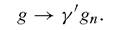
In the long run the growth rate of R&D labor cannot exceed the growth rate η of population, and in a balanced growth equilibrium it will equal η.
Likewise, the growth rate of productivity-adjusted R&D expenditure will equal η along a balanced growth path. Hence the radical implication that the long-run growth rate of an economy will equal γ'η, independently of what fraction of society’s resources are assigned to knowledge creation. Policies to stimulate R&D will have at most transitory effects on productivity growth and, by extension, on per-capita income growth.5.2. Evidence
These two competing approaches to reconciling R&D-based theory with the observed upward trend in R&D input offer a stark contrast. The Schumpeterian approach with product-proliferation effects retains all the characteristic comparative statics predictions of endogenous growth theory as outlined in Section 2.4, while Jones’s semi-endogenous theory denies all these predictions.
Fortunately the two competing approaches can also be tested using observed trends in productivity growth and R&D input. Specifically, the semi-endogenous model implies that the growth rate of productivity will track the growth rate of R&D input, whereas the Schumpeterian model implies that it will track the fraction of GDP spent on R&D.[31]
To derive this Schumpeterian implication note that, according to the growth equation (5), productivity growth depends on productivity-adjusted R&D per sector, n. Given the assumption m = L, if GDP per person grows asymptotically at the rate g then n will be proportional to the fraction of GDP spent on R&D.
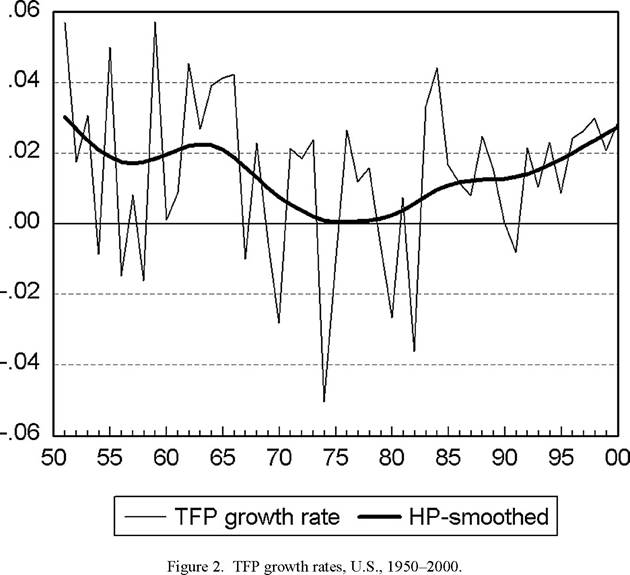
Figure 2 shows the growth rate of productivity in the United States from 1950 to 2000. There is no discernible trend. An Augmented Dickey-Fuller test rejects a unit root at the 1% significance level, confirming the stationarity of this series. Thus semi- endogenous theory implies that the growth rate of R&D input should also be trendless and stationary, whereas Schumpeterian theory implies that the R&D/GDP ratio should be trendless and stationary.
5.1.1. Results
Figure 3 shows that growth rates of the number of R&D workers in the G5 countries, N, and U.S. R&D expenditure, R, appear to have a substantial negative trend, having fallen roughly fourfold since the early 1950s. The impression of non-stationarity is supported by an Augmented Dickey-Fuller test, which fails to reject a unit root in gN at the 5% level.
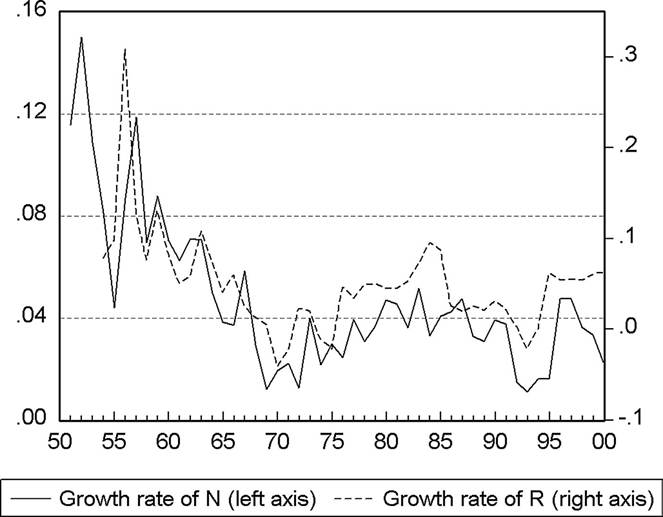
Figure 3. Growth rates of G5 R&D workers and U.S. R&D expenditures.
These findings are inconsistent with the implications of semi-endogenous growth theory.[32] Indeed they undermine the central proposition of semi-endogenous theory, because if productivity growth can be sustained for 50 years in the face of such a large fall in the growth rate of R&D labor then there is no reason to suppose that population growth limits productivity growth, except perhaps over a time scale of hundreds of years.
Figure 4 shows that the fraction of GDP spend on R&D in the U.S. looks more or less stable with perhaps a small upward trend.[33] It is notable that ever since 1957, R&D as a percentage of GDP has been fluctuating between 2.1% and 2.9%, with similar
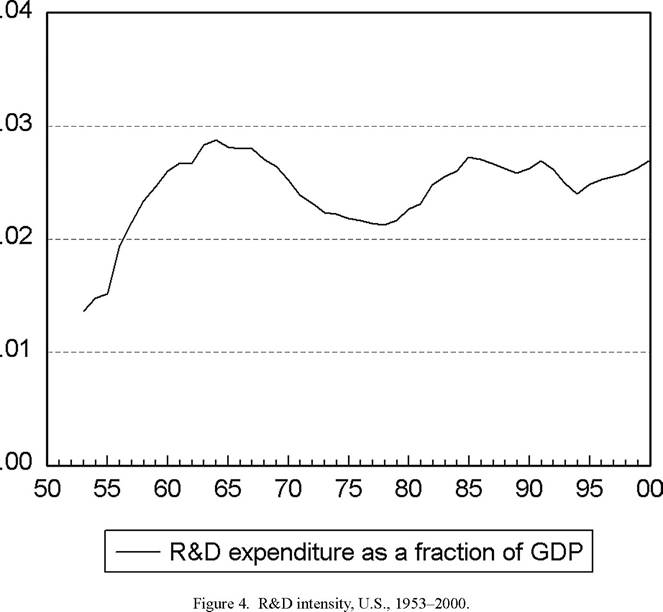
movements as in productivity growth: downward trend for 1964-1975 and upward trend for 1975-2000. The Stationarity of this series is confirmed by an Augmented DickeyFuller test, which rejects a unit root at the 1% level. This is in conformity with the version of Schumpeterian theory presented above, adjusted to take into account the effects of product proliferation.
5.2. Concludingremarks
The scale effect whereby increased population should lead to increased productivity growth clearly refutes a simple interpretation of the model in Section 2, in which L stands for the number of (skilled) individuals.
However, we have shown in this sectionof R&D. However, this literature has not allowed for the very long lags with which we think federal R&D has its effects. Moreover, throwing out federal R&D would at times amount to throwing out about 70% of the total.
that even if we stick to this interpretation of L, a simple variant of the Schumpeterian model can be developed, which carries all the same long-run growth implications except for the scale effect. The rival semi-endogenous theory of Jones (1995), which denies endogenous growth in the very long run, is inconsistent with the observation that productivity growth can be sustained through half a century of falling growth in R&D labor. The analogous implication of amended Schumpeterian theory, namely that productivity growth can be sustained as long as society allocates a constant fraction of its resources to research, is consistent with the evidence.
Two brief remarks conclude this section. First, there is no evidence pointing to the absence of a scale effect at the world level or in small closed economies. That the stock of educated labor should affect technological convergence and productivity growth worldwide was first pointed out by Nelson and Phelps (1966). Second, if we replace L by LeN, where eN denotes the quality of the labor force as measured for example by the average number of years in schooling (so that more educated countries have more efficiency units of labor), then even if one eliminates scale effects by taking L = m, there will still remain a “level effect” embodied in the eN term, whereby a higher average number of years of education N has a positive effect on growth. In the next section we show that increasing the fraction of highly educated workers and/or increasing the average number of years in schooling, have a positive impact on the rate of productivity growth, but the extent of which depends upon the country’s distance to the world technology frontier: in particular, the closer a country is to the frontier, the higher is the effect of an additional year of higher education on its rate of productivity growth.
6.
More on the topic Scale effects[30]:
- Conclusion
- Challenges for Scaling Agent-Based Modeling
- Pain
- Species richness increases with area and decreases with distance
- Urbanization and growth
- AVOIDING THE SNAKE PIT
- CONCLUSION
- VERTICAL RESTRAINTS IN INTERNET COMMERCE
- Abstract
- A Paradigm Shift: Urbanization and Intensification