7.7 The empirical meaning of differentiability
Derivates are, and cannot be, but ratios between homogeneous magnitudes. That is why it is necessary to represent satisfaction differences by means of intervals
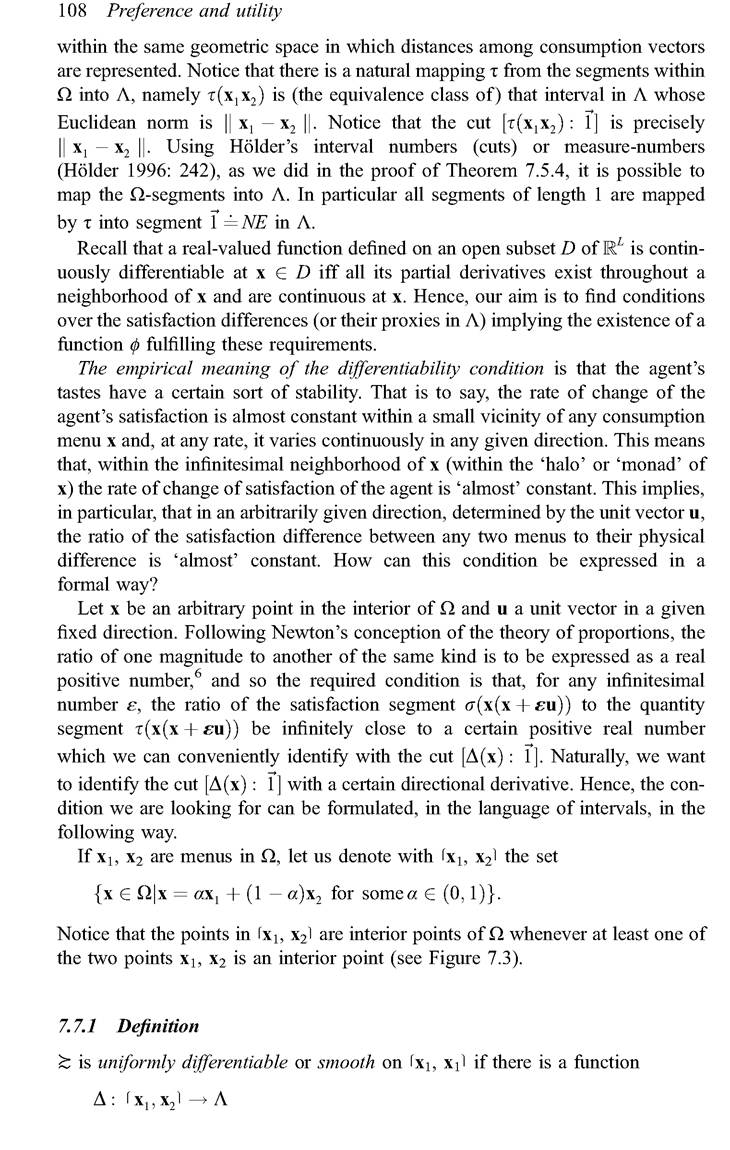
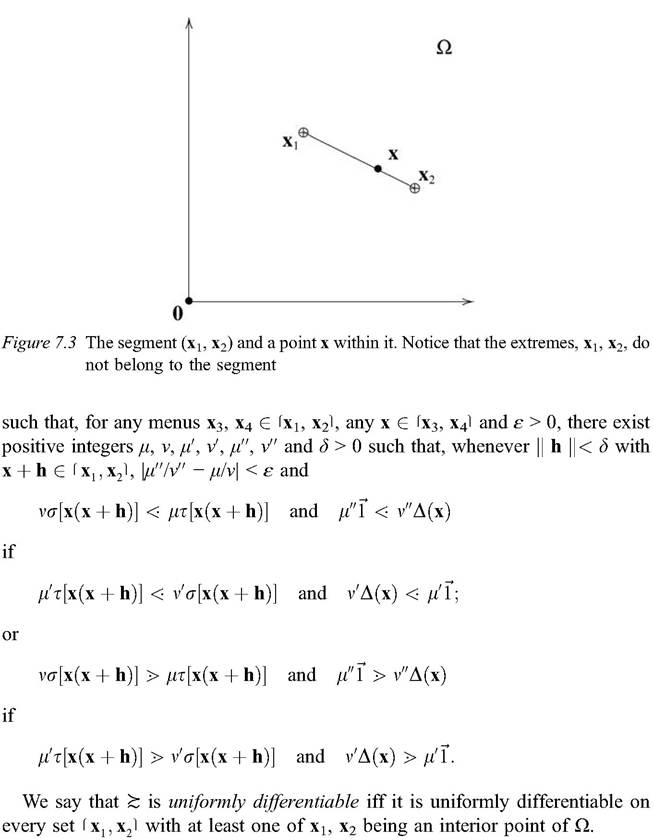
7.7.2 Theorem
If ≥ is uniformly differentiable, then there exists a utility function representing ≥ which is continuously differentiable in the interior of Ω.
PROOF: We will show, first, that there is a uniformly differentiable function φ on any open interval. Let f x1, x2l be any such interval, x3, x4 any menus in f x1, x2l with x3 ¼ x4, x any menu in f x3, x4l, and ε any positive number, as small as you wish.
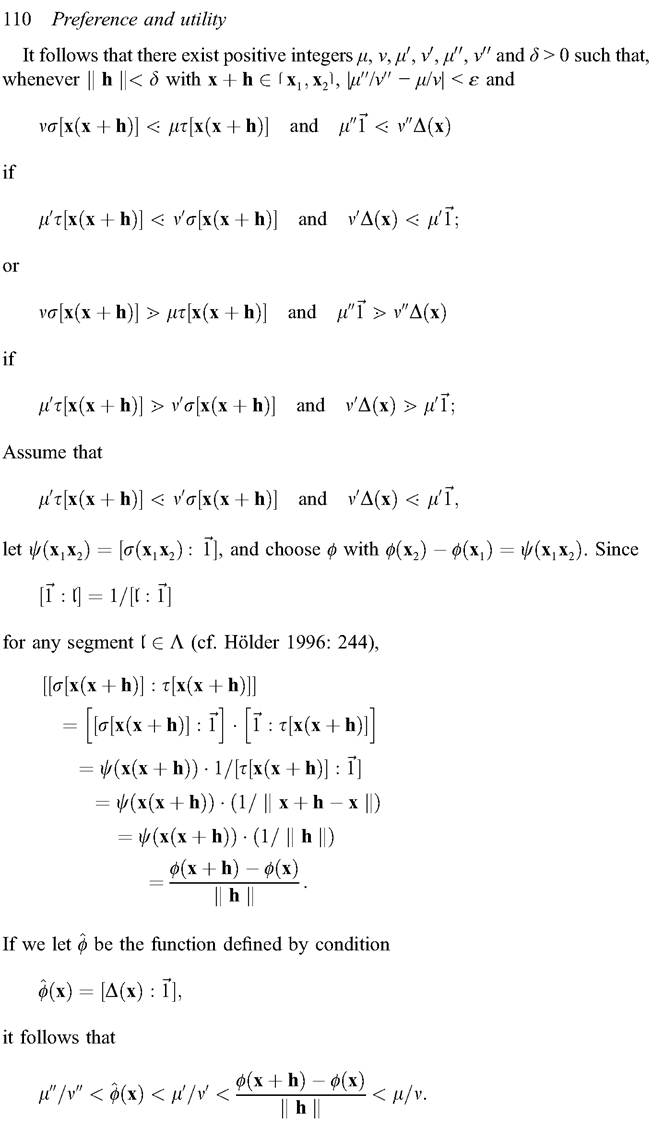
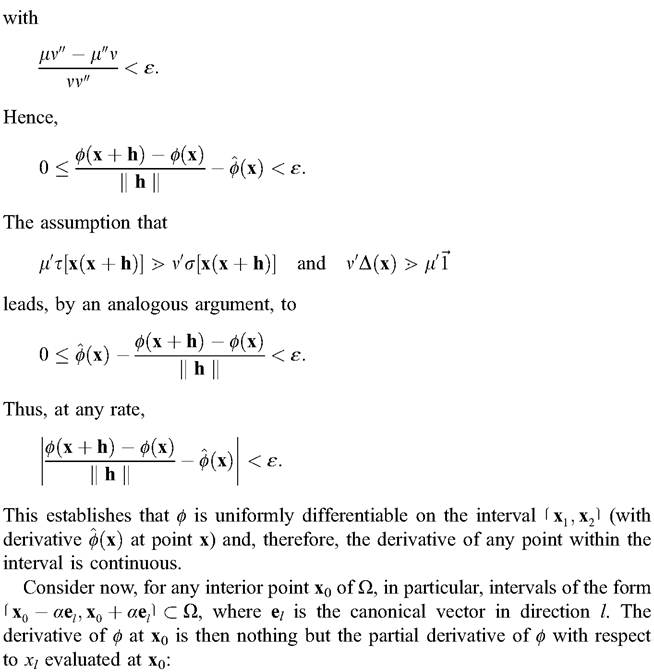

Since this derivative is continuous for every l (l = 1,..., L), we may conclude that φ is continuously differentiable at x0. As x0 was arbitrarily chosen, we may conclude that φ is continuously differentiable in the interior of Ω. ?
7.8 New foundations of preference theory
The previous argument shows that we can provide a new conceptual apparatus for preference theory by means of which all the usual properties of the preference relation, as well as the differentiability condition, can be expressed. Is it possible to find another conceptual apparatus that allows the expression of some differentiability condition? That is unlikely because differentiability requires the comparison of satisfaction distances with quantity distances within the same space.
At any rate, it is incumbent upon those who believe that it is feasible to do so to produce such an apparatus.By Theorem 7.5.9, a difference structure D is an algebraic-difference structure iff D admits a geometric representation. Hence, the new conceptual apparatus for preference theory can be briefly summarized as follows. I use the term ‘geometric-difference’ to avoid confusion.
7.8.1 Definition
D is a geometric-difference structure iff there exist Ω, R and σ such that

As pointed out in section 6 above, the preference relation ≥ can be defined in terms of σ and all the properties usually attributed to it can be expressed using the language of geometric intervals (see the examples there). The novelty - as I have just shown - is that the smoothness condition can also be so expressed. Thus, using the notion introduced in Definition 7.7.1 we can define the concept of a smooth preference structure.
7.8.2 Definition
A is a smooth preference structure iff there exist Ω and ≥ such that

By virtue of Theorem 7.7.2, there is a continuously differentiable utility function φ : Ω → R representing ≥. The relevance and usefulness of having such a function lies in that it allows the application of non-linear programming techniques in order to find the optimal points.
It would be desirable, because the empirical condition would be even more intuitive, to formulate entirely the smoothness condition in non-standard language, by means of the notion of an infinitesimal segment, as intimated in the informal discussion preceding the formal introduction of the condition. That is entirely feasible because Euclid’s Archimedian axiom is logically independent of the rest,7 but that would require a complete reformulation of Holder’s theory, as well as of the theory of algebraic-difference measurement.
Notes
1 See, for instance, Katzner (1970), Barten and Bohm (1981), and Mas-Colell, Whinston, and Green (1995).
2 Because the dimension of Ω is L, which is the same as that of Rl. This implies that the relative interior of Ω with respect to the linear space Rl is nonempty and so, for
Preference and utility 113 sufficiently small ε >0, the open ball Bε(x) centered at x is contained in Ω. For a discussion of the notion of relative interior that relates it to economic theory, see Koop- mans (1951), especially p. 45.
3 Precisely in the sense of Definition 3 in klst (1971: 151).
4 See Theorem 2 in klst (1971: 151); see p. 158 for a proof.
5 Von gleicher Richtung in the original.
6 Cf. Holder 1996: 241, §8.
7 Cf. Hilbert (1950: 21-2); Fleuriot (2001, ch. 4).
8
More on the topic 7.7 The empirical meaning of differentiability:
- 7.7 The empirical meaning of differentiability
- EMPIRICAL EVALUATION
- The fundamental Marxian theorem
- The Meaning of φιλοσοφεω: Cultivating the Philosophical Life
- Adolfo Garcia de la Sienra. A Structuralist Theory of Economics. New York, USA: Routledge,2019. — 235 p., 2019
- Meaning
- Meaning, Action and Explanation
- Some empirical caveats