Answers to Analyzing Data 1.1 Questions
1. Lakes with trout have lower densities of frogs than do lakes without trout, suggesting that the introduction of trout may have reduced frog density. However, while data from this study show that frog densities are correlated to the presence or absence of trout, they do not show that the trout caused frog densities to decline.
To test whether the introduction of trout caused frog densities to decline, the researchers would need to perform a controlled experiment.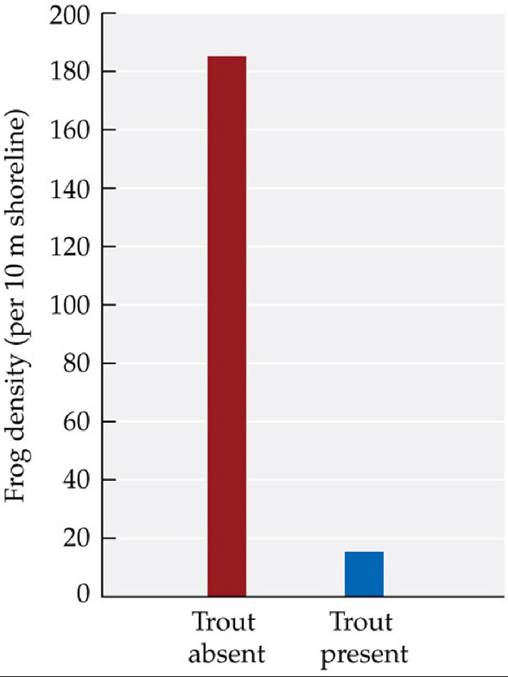
2. Results from control lakes that contain trout can be compared to results from trout-removal lakes: If the introduction of trout caused frog densities to decline, frog densities should increase in trout-removal lakes, whereas they should not change in the control lakes that still contain trout. Additionally, if the introduction of trout is the primary factor causing a decline in frog densities, frog densities also should not change very much in control lakes that never contained trout. Thus, if frog densities do not change very much in control lakes that never contained trout, such a result would strengthen the argument that changes in frog density observed in trout-removal lakes was due to the removal of trout, not to other unmeasured variables.
3.
a. For the 1-year period that ends just prior to when trout began to be removed from Lakes 1, 2, and 3, frog densities were close to zero per 10 m of shoreline in each of these lakes.
b. For the 1-year period that started one year after the removal of trout began, average frog densities were: 1.5 (Lake 1), 0.9 (Lake 2), and 0.9 (Lake 3) frogs per 10 m of shoreline. These data indicate that the removal of trout caused frog densities to increase within one year of beginning to remove trout from these lakes.
4.
a. The experimental results suggest that introduced trout caused frog densities to decline.
b. The experimental results suggest that frog populations can recover once trout are removed.
More on the topic Answers to Analyzing Data 1.1 Questions:
- Answers to Analyzing Data 8.1 Questions
- Answers to Analyzing Data 4.1 Questions
- Answers to Analyzing Data 7.1 Questions
- Answers to Analyzing Data 22.1 Questions
- Answers to Analyzing Data 24.1 Questions
- Answers to Analyzing Data 21.1 Questions
- Answers to Analyzing Data 13.1 Questions
- Reviewers
- Empirical Motivations
- INEQUALITY OF OPPORTUNITY: MEASUREMENT ISSUES AND EMPIRICAL RESULTS