Answers to Analyzing Data 7.1 Questions
1.
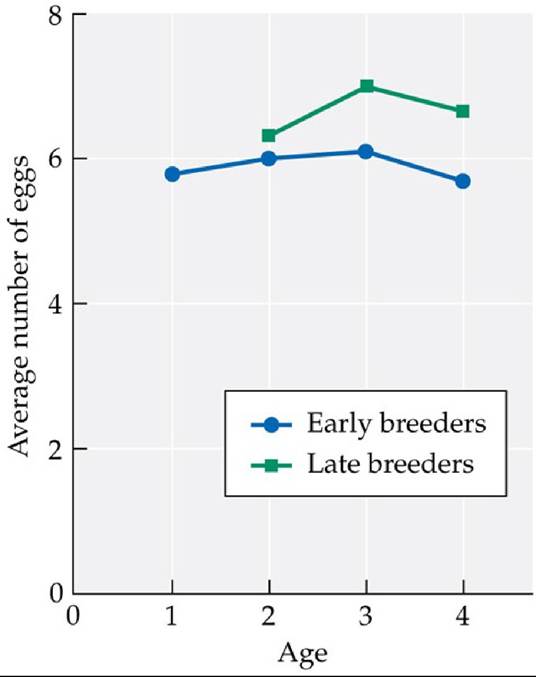
2. No. To see why, we can calculate how many eggs (on average) birds produced over the four years.
Birds that reproduced in their first year had laid an average total of 23.6 eggs by the end of the fourth year, whereas birds that delayed reproduction until their second year had laid only 19.9 eggs in the same amount of time.3. Yes. On a year-to-year basis, early breeders produced fewer eggs each year in years 2, 3, and 4 than did late breeders. This suggests that allocating resources to reproducing in their first year can reduce an individual's potential for reproducing in years 2-4.
4. Factors other than whether a bird reproduced in its first year may influence its reproductive success in years 2-4. An experimental approach to control for such factors would assign birds at random to the different treatments used in the experiment. There are several ways to test whether females experience a cost to reproduction that reduces their potential for future reproduction. For example, females could be assigned at random to one of the following three treatments: a control in which the number of eggs they laid was not altered; an experimental treatment in which extra eggs were added to their nest (increasing the female's costs of caring for eggs laid); and a second experimental treatment in which eggs were removed from the nest (reducing the female's costs).
More on the topic Answers to Analyzing Data 7.1 Questions:
- Answers to Analyzing Data 17.1 Questions
- Answers to Analyzing Data 6.1 Questions
- Answers to Analyzing Data 9.1 Questions
- Answers to Analyzing Data 5.1 Questions
- Answers to Analyzing Data 1.1 Questions
- Answers to Analyzing Data 2.1 Questions
- Answers to Analyzing Data 3.1 Questions
- Answers to Analyzing Data 4.1 Questions
- Answers to Analyzing Data 8.1 Questions
- Answers to Analyzing Data 10.1 Questions
- Answers to Analyzing Data 11.1 Questions