We sense energy in our environment in a variety of forms.
Light from the sun, a form of radiant energy, illuminates our world and warms our bodies. Objects that are cold or warm to our touch have different amounts of kinetic energy, which is associated with the motion of the molecules that make up the objects.
A grasshopper eating a leaf and a coyote eating a meadow vole both represent the transfer of chemical energy, which is stored in the food that is being consumed. Radiant energy and chemical energy are the forms organisms use to meet the demands of growth and maintenance, while kinetic energy, through its influence on the rate of chemical reactions and temperature, is important for controlling the rate of activity and metabolic energy demand of organisms. A cold endotherm needs to warm its body to the optimal temperature for physiological functioning. It does this by “burning” chemical energy from its food during cellular respiration. Ultimately, this food was derived from the radiant energy of sunlight, converted into chemical energy by plants. Most of the energy used to support industrial development, fuel our cars, and heat our homes originated ultimately with photosynthesis, which produced the organisms that became the fossil fuels we pump out of the ground.Autotrophs are organisms that assimilate energy from sunlight (photosynthetic organisms) or from inorganic chemical compounds in their environment (chemosynthetic archaea and bacteria).1 Autotrophs convert the energy of sunlight or inorganic compounds into chemical energy stored in the carboncarbon bonds of organic compounds, typically carbohydrates. Heterotrophs are organisms that obtain their energy by consuming energy-rich organic compounds made by other organisms—all of which ultimately originated with organic compounds synthesized by autotrophs. Heterotrophs include organisms that consume nonliving organic matter (detritivores); examples include earthworms and fungi in soil that feed on detritus derived mainly from dead plants, as well as bacteria in lakes that consume dissolved organic compounds.
Heterotrophs also include organisms that consume living organisms but do not necessarily kill them (parasites and herbivores), as well as consumers (predators) that capture and kill their food source (prey).On the surface, the distinction between autotrophs and heterotrophs would seem to be clear-cut: all plants are autotrophs, all animals and fungi are heterotrophs, and archaea and bacteria include both autotrophs and heterotrophs. Things are not always so simple, however. Some plants have lost their photosynthetic function and obtain their energy by parasitism. Such plants, known as holoparasites (holo, “entire, whole”), have no photosynthetic pigments and are heterotrophs. Dodder (genus Cuscuta, with approximately 150 different species), for example, is a common plant parasite found throughout the world (FIGURE 5.3A,B) and is considered a major pest of agricultural species. Dodder attaches to its host plant by growing in spirals around the stem and penetrates the phloem of the host, using modified roots called haustoria, to take up carbohydrates. Other plants, known as hemiparasites, are photosynthetic but obtain some of their energy, as well as nutrients and water, from host plants (FIGURE 5.3C).
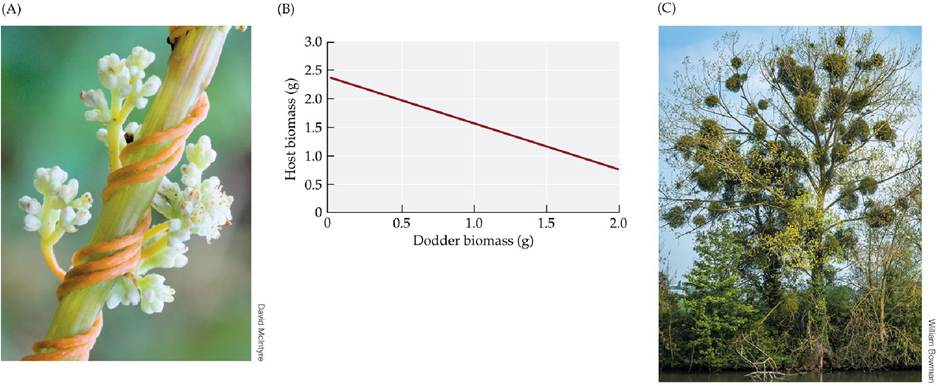
FIGURE 5.3 Plant Parasites (A) Dodder (Cuscuta sp.), a holoparasite that lacks chlorophyll, is shown here wrapped around the stem of a jewelweed plant. (B) Increasing amounts of European dodder (Cuscuta europaea) biomass result in decreasing growth of its host plant, stinging nettle (Urtica dioica). (C) Mistletoe, like the green mistletoe (Ileostylus micranthus) seen here, is a hemiparasite: despite having photosynthetic tissues of its own, mistletoe draws water, nutrients, and some of its energy from its host tree. (B after T. Koskela et al. 2002. Evolution 56: 899908.) View larger image
Conversely, animals can act as autotrophs, although this phenomenon is relatively rare.
Their photosynthetic capacity is acquired by consuming photosynthetic organisms or by living with them in a close relationship known as a symbiosis (see Concept 15.1). Some sea slugs, for example, have fully functional chloroplasts that supply them with carbohydrates through photosynthesis. These animals, in the order Ascoglossa, take intact chloroplasts from the algae they feed on into their digestive cells (FIGURE 5.4). The chloroplasts are maintained intact for up to several months, providing energy as well as camouflage to the sea slug.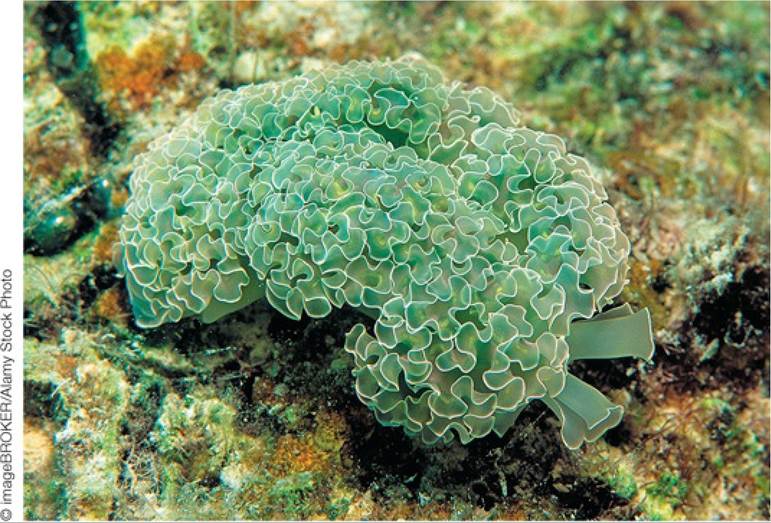
FIGURE 5.4 Green Sea Slug The green color of this lettuce sea slug (Elysia crispata) is associated with the chloroplasts it has taken into its digestive system. The chloroplasts can supply enough energy to the sea slug to maintain it for several months without food. View larger image
In the next two sections, we'll take a more detailed look at the mechanisms autotrophs use to capture energy and at some of the adaptations that make that process more efficient. We'll do the same more generally for heterotrophs in the final section of this chapter. Chapters 12 and 13 will provide more detailed considerations of energy capture by heterotrophs, and Chapter 16 will look at the energetic relationships among the species in a community.
1
- Organic chemical compounds have carbon-hydrogen bonds and are usually biologically synthesized. All other compounds are considered inorganic compounds.
More on the topic We sense energy in our environment in a variety of forms.:
- Reviewers
- B Hypotheses: Always Under Construction
- Why Focus on Managing Conflict?
- Chinese Religions on Gender and Identity
- Conclusion
- Avian Anatomy and Physiology
- The Red Word ofIvan Kulyk
- The Respiratory System
- Youth as a Conveyer of Discomforting Memories
- WHY COLONIALISM?