DYNAMICS
EOp invites a dynamic approach. If we apply an EOp policy today, what effect will it have on the distribution of types in the next generation? One hopes that sequential application of EOp policies would create a society in which most of the effect on inequality from circumstances has been eliminated.
A natural way to study this question is to analyze stationary states; that is, policies which have the property that the society they produce at date τ +1 is a replica of the society that existed at date τ.We know of only one paper on this topic, by Roemer and LJnveren (2012), which presents an extended example. In the society postulated, there are two economic classes, rich (R) and poor (P), whose pretax (inelasticallly produced) incomes are wR and wP,
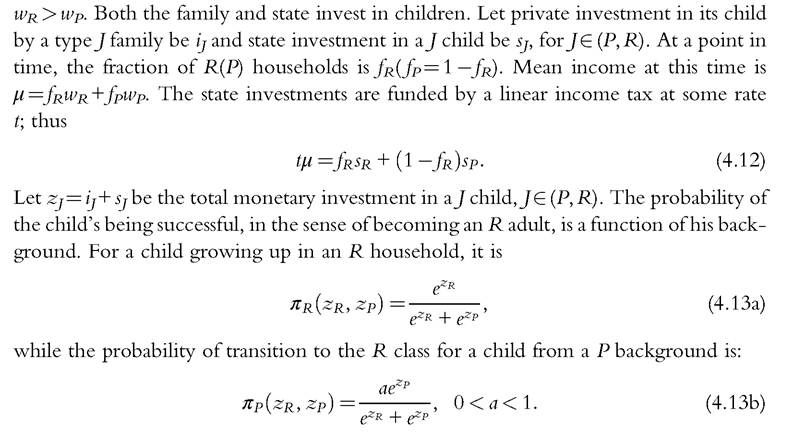
The fact that a < 1 models the idea that the cultural effects of growing up in a P household (and neighborhood) reduce the chances of becoming an R adult. The formulation of the transition probabilities is a reduced-form representation of a process of competition for the “good” jobs among young workers. 
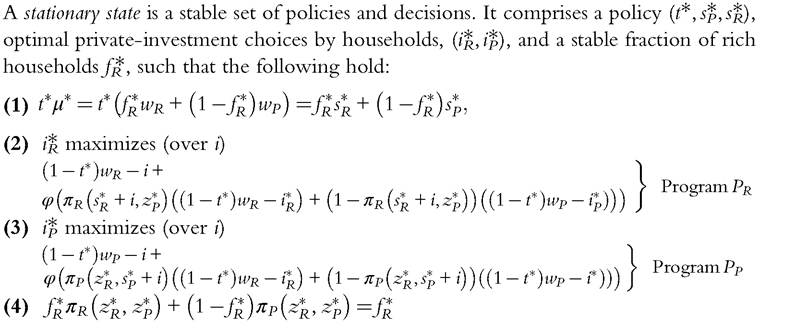
Condition (1) is the budget constraint, and condition (4) says that the fraction of R households is stable; condition (2) defines the optimal investment choice of an R parent, knowing that the next period will look exactly like the present period from the viewpoint of his child. Condition (3) defines the optimal investment choice of a P parent in the stationary state.
Write

An environment is summarized by the data (wR, wP, a, φ) with the intergenerational transmission functions (πr, πp).
For this environment, there will exist a set of stationary states. We are interested in the stationary state that is best from the equal-opportunity viewpoint. We define this as follows. In a stationary state, the expected standard of living of a J child is:
The equality-of-opportunity ethic maintains we should maximize the expected standard of living of the worse-off type of child. Thus, if ξ and ξ* denote two stationary states, then

Obviously, the ordering on stationary states defined by (4.15) induces an ordering on policies. We wish to compute the most desirable state policy according to the preference order (4.15).
Solving for the optimal stationary state is complicated, because the optimization program is nonconvex due to the incentive-compatibility constraints. The authors compute optimal policies for a randomly generated set of economies by analysis and simulation.
The striking result is that, in 76% of the economies randomly generated, the optimal stationary state from the EOp viewpoint is laissez-faire; that is, the state should neither tax nor invest in children. The reason is that if the state invests in poor children, rich families compensate by investing more in their children.
Admittedly, this is just an example. The authors then consider a second type of policy: investment in parents. Formally, this is modeled by devoting state investment to raise the coefficient a (see Equation (4.13b)), which reduces the handicap that poor children face due to their background. Now, in the simulations, in 80% of the cases, the state invests in parents (that is, in increasing a), but not in children.
These results are mindful of the work of Heckman (2011), who has been championing the importance of early childhood education. It appears that much of the disadvantage of being poor has already occurred by the age of three or four.
We suggest, based on these results, that investment in poor families may be more productive, in the long run, than investing directly in children.Finally, a more radical solution to the disappointing result that rich parents will often undermine, through private investments, the effort of the state to equalize opportunities for children through educational investment, is to ban private education. This is essentially what has been done in the Nordic countries, and it is perhaps no coincidence that these countries perform among the best in the world in terms of social mobility and equalization of opportunities.
A second approach to incentive issues in EOp is the work of Calsamiglia (2009), who points out that if there are several ministries attempting to equalize opportunities for different objectives, each taking a “local” approach, the consequence may be to not equalize opportunities globally. Her paper characterizes the types of local EOp policies that will induce global EOp.
Suppose that Paul and Richard have identical preferences and skills; both want to play professional basketball and to attend college. They face the same basketball resources in their two neighborhoods, but Richard’s (rich) neighborhood has better schools. So Richard is advantaged with respect to the probability of college admission due to a fortunate circumstance. Their probabilities of being admitted to college and a professional basketball team will depend on their efforts in school and in basketball, respectively, and on the resources in their neighborhoods.[145] Suppose initially that both pro-basketball and college recruiters adopt a “market” policy: they admit candidates based only on their scores on relevant tests, which are functions of effort and circumstances in the relevant arena. Facing these policies, Paul and Richard choose basketball and school effort (eB, eS) to maximize the total probability of admission to the basketball league and college, minus some convex cost in total effort.
Since school effort is relatively less effective for Paul, he devotes less effort to school than Richard and more effort to basketball. It turns out that Richard has a higher utility, although the two boys have identical preferences and skills.Now the basketball league and college alter their policies in an attempt to equalize opportunities. Suppose that the league’s policy is to admit players based only on their efforts pertaining to basketball. Then if Paul and Richard expend the same basketball effort, eB, they will enjoy the same probability of recruitment by the league, which is locally fair, because they have the same basketball circumstances. Suppose that the college admissions officer decides to give extra points on his college-admission score to Paul as compensation for Richard’s advantaged circumstances: he simply adds a lumpsum to Paul’s SAT score. This is also a local EOp policy. Given these two policies, Paul and Richard will not alter their efforts, because of the lump-sum nature of the compensation to Paul, and hence Paul and Richard will have the same probability of college admission (locally EOp), but Paul has a higher probability of getting into the basketball league, as he expended more basketball effort. Although the policies are each locally EOp, the global result is not opportunity equalizing.
The problem lies with the lump-sum nature of the EOp policy in the college sector. Calsamiglia proves that, under assumptions that the environment is sufficiently rich, the necessary and sufficient condition for local EOp policies to aggregate to a global policy that is opportunity-equalizing is that the marginal returns to effort must be identical for all candidates in each sector. Because Paul’s effort in school is less remunerative than Richard’s, due to his inferior school, the proper policy is to augment the returns per unit of school effort for Paul in terms of the desired outcome (probability of college admission).
Certainly, many affirmative action policies are of the wrong, lump-sum type. For example, universities often given extra points to students from disadvantaged backgrounds, in considering admissions. The empirical implications of Calsamiglia’s result have yet to be examined.
4.8.
More on the topic DYNAMICS:
- Incomplete contracts and market dynamics
- Cattle Movement Networks in Uganda
- The Cognitive (R)evolution: The End?
- Contents
- Molecular Epidemiology of Bovine Tuberculosis in Uganda
- Agrawal M.. Textbook of Pediatrics. 3rd ed. — CBS Publishers,2025. — 973 p., 2025
- Contents
- Brunei
- BACKGROUND AND DEFINITIONS
- Fligstein Neil. The Banks Did It: An Anatomy of the Financial Crisis. Harvard University Press,2021. — 334 p., 2021