Proposed solutions
Is the rent-seeking trap inescapable? By far the most important problem with respect to ensuring the self-enforcing character of a constitutional contract is that it must successfully constrain the power of the state itself.
Substantive restraints versus procedural rules
Generally speaking, substantive constraints on government have been dismissed as ineffective precisely because of the wide latitude they allow for reinterpretation. Gwartney and Wagner (1988a, pp. 44-9) make a strong case for procedural rules designed to uphold decentralization of governmental powers and to prevent the formation of legislative coalitions. Procedural rules will provide more effective mechanisms for self-enforcement than will substantive restraints on government. In their view, the weakness of substantive restraints derives from the politicization of the Supreme Court and the ease with which legislatures can find alternative ways to implement any given policy. They propose procedural rules requiring larger legislative majorities for legislative action at higher levels of government, thereby diffusing the power of the state to regional and local governments.
Judicial independence
Does independence of the judiciary serve the long-term public good? The traditional view of the purposes of judicial independence has been attacked as naive by law and economics and public choice scholars. Unlike many legal contracts, it is argued, there is no third-party enforcer, external to the contract, who can ensure that defectors are caught and forced to comply with the terms of the agreement. Although many countries have a nominally independent Supreme Court whose purpose is to enforce the constitution, the Supreme Court can only do this imperfectly in most cases, because the judges themselves are not totally immune from political pressures by groups wishing to subvert the original intent of the constitution.
Thus, given the unreliability of third-party enforcement, and given the strong individual incentives to defect from social cooperation, the constitutional contract should somehow be self-enforcing if it is to be maintained.The interest group theory first advanced by Landes and Posner (1975) makes the independent judiciary an integral part of the system of rent seeking engineered by Congress. However, the debate goes on. A very detailed criticism of the Landes-Posner theory is contained in Boudreaux and Pritchard (1994), who argue that the theory is seriously deficient and conclude that the United States federal judiciary is truly independent of Congress and the president, and that this independence was designed by the US Constitution’s framers as a means of furthering sound government.
A rule of law in politics
According to Buchanan (1993b) the direction of constitutional reform is obvious. If, somehow, the potential for differential treatment is reduced, so will be the inducement to rent-seeking behaviour. The off-diagonal solutions should simply be made impossible to achieve by the introduction of some rule or norm that prevents participants from acting or being acted upon differently, one from the other. If the off-diagonal attractors are eliminated, then the players operate with the reduced matrix shown in Figure 13.2. Thus the constitutional reform measure modifies the original prisoner’s dilemma game into a reduced setting in which each player, as a member of a political coalition, knows that any choice of an action or strategy must involve the same treatment of all players or constituencies (ibid., p. 3).
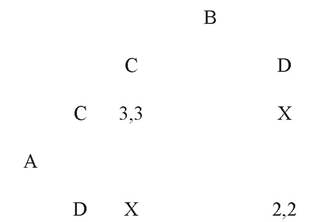
Figure 13.2 Modified prisoner’s dilemma
If and to the extent that differential treatment is replaced by equal treatment, or by the principle of generality in politics - analogous to that present in an idealized version of the rule of law - mutual exploitation will be avoided and politicians who seek to serve the ‘public interest’ will survive and prosper (ibid., p.
6). Thus it seems at least conceivable that rational persons, at the stage of entering into the agreement, may recognize the ‘rentseeking trap’ and engage in concerted effort to escape.However, in the hypothetical matrix construction above, the interaction was in fact assumed to occur in a state of nature, with each person holding equal prospects for membership in the majority and minority coalitions. This means that membership was assumed to be symmetrical among all participants. But this assumption may turn out to be too heroic with respect to real- world settings.
The prospects may differ among persons and groups of persons so as to create divergences in interests which may become a source of disagreement. Thus the question remains whether it is possible to modify the constitutional choice setting so as to reconcile such possible divergences. It appears that, at least from the perspective of potentially-conflicting interests among constituencies, the general problem of constitutional efficiency and survivability does not resolve itself naturally.
Veil of uncertainty and/or ignorance versus the availability of exit options Is it possible to specify the conditons under which constitutional agreement may be facilitated in real, non-hypothetical choice situations? Is it possible to modify the constitutional choice setting so as to reconcile divergences in interests? In this respect, two lines of reasoning have been pursued in the contractarian and neo-contractarian literature. The first line of argument focuses attention on the need for a ‘veil of uncertainty and/or ignorance’ as a precondition for an efficient constitution.
Buchanan and Tullock (1962) had to present a convincing positive argument that unanimous consent at the constitutional level was possible at all. How can agreement on rules among persons with potentially conflicting constitutional interests be achieved? The authors’ characteristic way of approaching this issue consists of emphasizing the uncertainty confronting all individuals taking part in constitutional deliberations.
The existence of ‘a veil of uncertainty’ induces individual participants in a constitutional process to prefer rules that do not systematically favour any particular subset of citizens.The proposed remedy involves the introduction of some means of ensuring people’s inability reliably to foresee their future particularized interests, as these may be affected by different rules, thereby inducing people to make constitutional choices on some assessment of the general working properties of alternative rules, and divorced from particularized interests. Thus agreement is facilitated by whatever increases people’s uncertainty about the particular effects that alternative rules can be expected to have on them. In fact the assumption of a ‘veil of uncertainty’ was also hidden in Buchanan (1993b), discussed above.
Buchanan’s approach has affinities with John Rawls’s (1971) construction, which utilizes the veil of ignorance along with the fairness criterion to derive principles of justice that emerge from a conceptual agreement at a stage prior to the selection of a political constitution. Thus in Rawls’s construction, the prospect of agreement is secured by defining certain ‘ideal’ conditions under which constitutional choices are hypothetically made. The choosers are assumed to be placed behind a ‘veil of ignorance’ which makes it impossible for them to know anything specific about how they will be personally affected by alternative rules. Ignorant about their prospective specific interests in particular outcomes, they are induced to judge rules ‘impartially’. Potential conflict in constitutional interests is not eliminated, but the veil of ignorance transforms potential interpersonal conflicts into intrapersonal ones (Vanberg, 1994, p. 170).
However, the constitutionalist notion of a veil of uncertainty or ignorance, though useful as an analytical benchmark, is not very practical. It is not clear how genuine uncertainty or ignorance could be achieved in real-world constitution formation.
Therefore, it has been argued that the availability of exit options can ensure a competitive setting for participants in constitutional deliberations and can even substitute for a veil of uncertainty. This condition for efficiency can be given operational substance in processes of real-world constitution formation (Lowenberg and Yu, 1992).In order to produce an efficient social contract or constitution, deliberations must be carried out in a competitive ‘constitutional environment’. This condition will be satisfied if an exit option exists for each contracting party. This conclusion is quite consistent with the Wicksell-Buchanan-Vanberg contractarian consensus test. Only in a competitive setting does unanimous agreement acquire operational substance (normative content).
Vanberg (1994) clearly recognizes that the true problem with the agreement criterion is not that it is too demanding but, rather, that it has too little normative content. A criterion needs to be specified which allows one to distinguish between constraints that are judged to make the respective individual choices involuntary, and those that do not. Vanberg’s analysis reaches the conclusion that a consistent normative-individualist approach needs to rely on a combined and simultaneous application of a purely procedural, rule-oriented, as well as a substantive, avoidance/exit cost criterion. The avoidance/exit cost perspective arguably provides a more operational specification of the contractarian norm than the notion of a hypothetical contract to which Buchanan (1975, 1977) as well as Rawls (1971) appeal.
The notion of exit has thus been invoked to give more operational substance to the concept of voluntary agreement. It is derived from Albert Hirschman’s (1970) classic distinction between exit and voice. Exit (and entry) is an important means by which individuals are able to express their preferences, and is precisely the method through which preferences are revealed in competitive markets for private goods.
An exit option introduces an element of market-like competition into the contracting process, which limits the ability of any party to wield power over another party. It is not even necessary that this exit option be exercised, since merely the threat of its use should be enough to restrain rent appropriation. The scope for opportunism is effectively constrained by competition, actual or potential.Furthermore, it is argued that exit options can help to solve the constitutional maintenance problem by establishing a competitive environment for post-constitutional political and market exchange (Lowenberg and Yu, 1992).
Federalism, once again
The strengthening of regional and local government relative to national government has been advocated by many scholars as an effective way to restrain the growth of legislative redistribution. The existence of separate jurisdictions with some protected powers within a constitutional federation inhibits coercive behaviour by the government. Such an arrangement facilitates migration at low cost between federal subregions and thereby enhances competition between these subregions. The resulting mobility forces competitive governmental units to supply public goods in preferred quantities and to ‘price’ them broadly in line with relative marginal evaluations.
The foregoing is related to the Tiebout effect (Tiebout, 1956), which says that individuals will sort themselves across communities in accordance with their preferences for the packages of taxes and public goods provided in each community. The ability of the owners of property rights to move to competing jurisdictions protects them from potential rent appropriation by a coercive government. Therefore, it is argued, a federalist constitution can effectively constrain the power of the state. In a federal system, citizens seeking political relief can vote with their feet.
The preceding paragraphs suggest that post-contractual exit opportunities might be characterized in terms of Tiebout competition between different political groupings. If the constitution permits mobility and political plurality, it will help establish and maintain a competitive political post-constitutional environment.7
Notes
1. A classic overview of public choice theory is contained in Mueller (1989).
2. Thus Backhaus (1995) contains an analysis of constitutional guarantees of basic rights and procedures, illustrated by three constitutions, the American Constitution of 1789 as amended in 1792, the German Basic Law of 1949 and the Dutch Basic Law of 1983. In addition, reference can be made to several case studies. Holcombe (1991) analyses the role of constitutional rules as constraints on government using three US constitutions: the Articles of Confederation (1781), the Constitution of the United States and the Confederate Constitution. Geoffrey Brennan and Jose Casas Pardo (1991) examine the Spanish constitution (1978). Sobel (1994) analyses the evolution of two international constitutions: the League of Nations Covenant and the United Nations Charter.
3. See, for example, Hefeker (1995); for some general reflections, see Eichengreen (1994).
4. The problem of time inconsistency has perhaps most notably been investigated in the context of central bank monetary policy; see in this connection the contributions of Barro and Gordon (1983a and 1983b). For a survey of subsequent elaborations and variations upon the same theme, see, for example, Walsh (2001, ch. 8, pp. 321-84).
5. In The Power to Tax, Brennan and Buchanan argue that the existence of potentially huge rent-seeking costs constitutes one of the important arguments for predicting that all rational individuals, behind a veil of ignorance, would seek to constrain exploitation by revenuemaximizing government to the maximum possible extent. The only way of doing so is to minimize the rents that accrue from ‘governing’ - that is, by constraining Leviathan so that its surplus is minimal. Government ‘surplus’, or the income that accrues to government for discretionary use, is defined as S = R - G, that is, the excess of revenue collections over spending on specified uses. Since G = aR, S = (1 - α)R, where a is the proportion of total revenues to be spent on specified public goods and services (Brennan and Buchanan, 1980 [2000], ch. 2).
6. For what may now well become a standard general and formal treatment of the principalagent model, see Laffont and Martimort (2002).
7. On the significance of the substitutability between intergovernmental competition for fiscal resources and explicit constitutional constraints on governmental taxing power, once the possibility of federalization is introduced, see Brennan and Buchanan, 1980 [2000], ch. 9. These authors’ emphasis is on federal assignment as a means of ensuring that individuals have available options as among the separate taxing-spending jurisdictions, and on the effect that the potential exercise of these options has on the total fiscal exploitation in the system. Total government intrusion into the economy should be smaller, ceteris paribus, the greater the extent to which taxes and expenditures are decentralized, the more homogeneous are the separate units, the smaller the jurisdictions, and the lower the net locational rents. (ibid., p. 216).
References
Alchian, A. A. (1950), ‘Uncertainty, evolution and economic theory’, Journal of Political Economy, 58 (3), 211-21, reprinted in A.A. Alchian, Economic Forces at Work, Indianapolis: Liberty Press, 1977, pp. 15-35.
Anderson, T.L. and P.J. Hill (1986), ‘Constraining the transfer society: constitutional and moral dimensions’, Cato Journal, 6, 317-41.
Backhaus, J.G. (1995), ‘An economic analysis of constitutional law’, research memorandum, University of Limburg, Maastricht.
Barro, R.J. and D.B. Gordon (1983a), ‘A positive theory of monetary policy in a natural rate model’, Journal of Political Economy, 91 (4), 589-610.
Barro, R.J. and D.B. Gordon (1983b), ‘Rules, discretion and reputation in a model of monetary policy’, Journal of Monetary Economics, 12, 101-21.
Boudreaux, D.J. and A.C. Pritchard (1994), ‘Reassessing the role of the independent judiciary in enforcing interest-group bargains’, Constitutional Political Economy, 5 (1), 1-21.
Brennan, G. and J.M. Buchanan (1980 [2000]), The Power to Tax — Analytical Foundations of a Fiscal Constitution, Indianapolis: Liberty Fund.
Brennan, G. and J. Casas Pardo (1991), ‘A reading of the Spanish constitution (1978)’, Constitutional Political Economy, 2 (1), 53-79.
Buchanan, J.M. (1975), The Limits of Liberty, Chicago: University of Chicago Press.
Buchanan, J.M. (1977), Freedom in Constitutional Contract, College Station, TX and London: Texas A&M University Press.
Buchanan, J.M. (1987), ‘Justification of the compound republic: the calculus in retrospect’, Cato Journal, 7 (2), pp. 305-12, reprinted in Gwartney and Wagner (eds) (1988b), pp. 131-7.
Buchanan, J.M. (1990), ‘The domain of constitutional economics’, Constitutional Political Economy, 1 (1), 1-18.
Buchanan, J.M. (1993a), ‘Public choice after socialism’, Public Choice, 77, 67-74.
Buchanan, J.M., (1993b), ‘How can constitutions be designed so that politicians who seek to serve “public interest” can survive?’, Constitutional Political Economy, 4 (1), 1-6.
Buchanan, J.M. and D.R. Lee (1991), ‘Cartels, coalitions and constitutional politics’, Constitutional Political Economy, 2 (2), 139-61.
Buchanan, J.M. and G. Tullock (1962), The Calculus of Consent: Logical Foundations of Constitutional Democracy, Ann Arbor, MI: University of Michigan Press.
Coleman, J. (1990), ‘Constitutional contractarianism’, Constitutional Political Economy, 1 (2), 135-48.
Eichengreen, B. (1994), International Monetary Arrangements for the 21st Century, Washington, DC: Brookings Institution.
Gwartney, J.D. and R.E. Wagner (1988a), ‘Public choice and constitutional order’, in Gwartney and Wagner (eds) (1988b), pp. 29-56.
Gwartney, J.D. and R.E. Wagner (eds) (1988b), Public Choice and Constitutional Economics, London: JAI Press.
Hefeker, C. (1995), ‘Monetary union or currency competition? Currency arrangements for monetary stability in East and West’, Constitutional Political Economy, 6 (1), 57-69.
Hirschman, A.O. (1970), Exit, Voice and Loyalty, Cambridge, MA: Harvard University Press.
Holcombe, R.G. (1991), ‘Constitutions as constraints: a case study of three American constitutions’, Constitutional Political Economy, 2 (3), 303-28.
Kliemt, H. and G. Brennan (1990), ‘Logo logic’, Constitutional Political Economy, 1 (1), 1257.
Laffont, J.-J. and D. Martimort (2002), The Theory of Incentives — The Principal-Agent Model, Princeton, NJ and Oxford: Princeton University Press.
Landes, W.M. and R.A. Posner (1975), ‘The independent judiciary from an interest group perspective’, Journal of Law and Economics, 18, 875-901.
Lowenberg, A.D. and B.T. Yu (1992), ‘Efficient constitution formation and maintenance: the role of “exit”’, Constitutional Political Economy, 3 (1), 51-72.
Merville, L.J. and D.K. Osborne (1990), ‘Constitutional democracy and the theory of agency’, Constitutional Political Economy, 1 (3), 21-47.
Mueller, D.C. (1989), Public Choice II, Cambridge: Cambridge University Press.
Rawls, John (1971), A Theory of Justice, Cambridge, MA: Belknap Press.
Schmidtz, D. (1991), The Limits of Government, Boulder, CO, San Francisco, CA and Oxford: Westview Press.
Sobel, R.S. (1994), ‘The League of Nations Covenant and the United Nations Charter: an analysis of two international constitutions’, Constitutional Political Economy, 5 (2), 173-92.
Tiebout, C.M. (1956), ‘A pure theory of local expenditures’, Journal of Political Economy, 64, 416-24; reprinted in T. Cowen (ed.), Public Goods and Market Failures, Chapter 9, London: Transaction, 1992, pp. 416-24.
Tullock, G. (1959), ‘Problems of majority voting’, Journal of Political Economy, 67, 571-9.
Tullock, G. (1967), ‘The welfare costs of tariffs, monopolies and theft’, Western Economic Journal, 5, 224-32.
Tullock, G. (1987), ‘The calculus: postscript after 25 years’, Cato Journal, 7 (2); reprinted in Gwartney and Wagner (eds), 1988b, pp. 139-47.
Vanberg, V.J. (1994), Rules and Choice in Economics, London: Routledge.
Wagner, R.E. (1988), ‘The calculus of consent: a Wicksellian retrospective’, Public Choice, 56, 153-66.
Walsh, C.E. (2001), Monetary Theory and Policy, Cambridge, MA: The MIT Press.
Wicksell, K. (1896), Finanztheoretische Untersuchungen [Investigations into the Theory of Finance], Jena: Gustav Fischer.
Wicksell, K. (1896 [1962]), ‘A new principle of just taxation’, reprinted in R.A. Musgrave and A.T. Peacock (1962), Classics in the Theory of Public Finance, London: Macmillan, pp. 72118.
Wiseman, J. (1990), ‘Principles of political economy: an outline proposal, illustrated by application to fiscal federalism’, Constitutional Political Economy, 1 (1), 101-24.
14
More on the topic Proposed solutions:
- Philosophy as Rational Understanding of the Lebenswelt
- Conclusion: Emerging Problems in Theory and Practice
- POPPER’S PROBLEMS OF DEMARCATION
- D Artificial Intelligence and the Hypothesis
- Modern Economics
- Republic of Chile: from sober deliberation to attempted revolution
- The Monetarist Counter-Revolution
- Technical War Work, March-December 1944
- Developments in the New Welfare Economics and the Economic Theories of Justice
- Dynamics and the Business Cycle