The general problem of efficient constitution formation and maintenance
The choice situation at the constitutional as well as the post-constitutional stage is ususally modelled as a classic prisoner’s dilemma (Figure 13.1), at least in so far as it involves potential conflict of interests between rational persons (Gwartney and Wagner, 1988a, p.
32; Buchanan, 1993b, p. 2). In ‘generalized prisoner’s dilemma situations’, that is, social constellations under which individuals, in separate and rational pursuit of their own interests, unintentionally but system-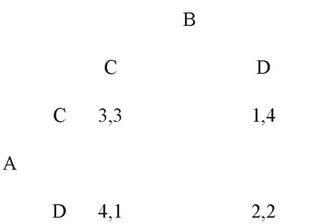
Figure 13.1 Classic prisoner’s dilemma
atically contribute to an overall outcome that is undesirable for all of them (or in any case less desirable than some alternative outcome that could be realized by concerted, organized action) there may exist a potential for mutual gains by collective action (collective organization).
Thus the constitution is essentially a contract intended to secure the mutual gains from social cooperation and to avoid the dominant defective strategy in the prisoner’s dilemma game which leads to a socially inefficient Nash equilibrium solution. Since the mutual gains from social cooperation constitute a public good, the maintenance of the constitutional contract gives rise to a problem that will not resolve itself naturally.
Even when it is supposed that agreement on appropriate rules can be achieved at the stage of constitutional contract formation, it should be recognized that individuals and interest groups inevitably will attempt to engage in post-contractual opportunism (the problem of constitutional maintenance). Thus the agreement, once achieved, must be enforceable. This opportunism takes several forms. First, each individual may have an incentive subsequently to defect from the cooperative agreement (the compliance or unilateral defection problem).
Whether or not it is rational for persons to comply with rules that they constitutionally may agree on is a matter of contingent, factual circumstances. It depends on whether or not the constraints that persons face after the agreement, that is post-constitutionally, make it rational for them to comply with previously agreed rules.A second form of post-contractual opportunism consists of rent seeking and special-interest plundering which ultimately reduce the value of post- contractual cooperation and undermine the constitution itself. Groups of individuals have an incentive to seek to capture the instruments of state power and to use them as vehicles to enrich themselves in ways that are not possible for private citizens. ‘Rent seeking’ is a term used by economists to describe actions taken by individuals and groups to alter public policy in order to gain personal advantage at the expense of others. The social costs entailed by this process are called ‘rent-seeking costs’ or, by some, ‘Tullock costs’, after Tullock (1967).5 Tullock showed not only that the inefficiency or social welfare cost of, say, a tariff consists of the Harberger triangle and can increase with the Tullock rectangle, but also that the pure transfer involved in the creation of tariffs or other privileges will lead market participants to expend resources in lobbying and political activities:
These expenditures, which may simply offset each other to some extent, are purely wasteful from the standpoint of society as a whole; they are spent not in increasing wealth, but in attempts to transfer or resist transfer of wealth. I can suggest no way of measuring these expenditures, but the potential returns are large, and it would be quite surprising if the investment was not also sizable. (ibid., p. 228)
The incentive to engage in rent-seeking activities is directly proportional to the ease with which the political process can be used for personal (or interest group) gain at the expense of others.
In other words, distributional politics is viable and tends to become dominant to the extent that differential treatment is constitutionally permissible (Buchanan, 1993b, p. 6).Tullock (1959) had shown that under any voting system which requires less than unanimous approval to implement policies, majority coalitions of interest groups will seek to obtain public provision of special interest projects. The dominant strategy for any organized interest group in a majoritarian polity is to lobby for policies which provide large benefits to its members and spread the costs among everyone else. This tendency exists even in liberal democracies. Through implicit vote trading, a coalition of interest groups, comprising a bare majority of voters, can get all or at least most of their favoured projects approved for public provision. Under certain conditions, the total costs of these projects can exceed their total benefits, while costspreading through the ‘fisc’ induces a rational ignorance of this process on the part of the disadvantaged majority. On the other hand, the asymmetric distribution of cooperative benefits leads subgroups of the collective to invest energy struggling for access to the government’s coercive power. But the effort may turn out to cost more than it is worth and the end result will be that the collective’s loss purchases the subgroup’s gain (Schmidtz, 1991, p. 91).
Buchanan and Lee (1991) demonstrate that the gains from politically generated restrictions on markets, even to organized producing interests, are more apparent than real. The analysis demonstrates that, under plausibly realistic assumptions concerning coalitions sizes, excess burdens, organizational costs and rent-seeking outlay, a genuine utility-maximizing calculus may dictate support for constitutional prohibition of all market restrictions, by all members of the polity, including those producer interests that might be considered to be the potentially identifiable beneficiaries of cartelization.
Principal-agent theory has been used to examine the rent-seeking problem (Anderson and Hill, 1986; Merville and Osborne, 1990).6 The principal, also the citizen, grants the agent (the government) the power of coercion. In exchange, the agent supplies the principal with public goods. Since the capitalized value of public assets is owned collectively, public good outputs of the government are like communal resources with widely diffused benefits. It soon becomes evident to vote-maximizing agents or legislators that they can maximize their political support by significantly reducing the provision of public goods to the population at large in favour of greater transfers to interest groups. These transfers are financed by general tax collections and provide concentrated benefits to designated groups. Such collusion between agents and special interest groups will invariably lead to a breaking of the constitutional contract.
Merville and Osborne (1990) use agency theory to demonstrate formally that, in majority-rule political systems, coalitions of minority factions will induce politicians to break the constitutional contract systematically in order to supply special-interest projects. Unlike contracts in private markets, political contracts are much more susceptible to this kind of opportunism.
More on the topic The general problem of efficient constitution formation and maintenance:
- Introduction
- Index
- A theoretical appraisal of EU integration
- Hale’s course, book and research
- The BRIC economies: Brazil, Russia, India and China
- Cossack Tatar Fighters