5 Buddhism
Jeffrey Brodd
California State University, Sacramento
Layne Little
University of California, Davis
Bradley Nystrom
California State University, Sacramento
Robert Platzner
California State University, Sacramento
Richard Shek
California State University, Sacramento
Erin Stiles
University of Nevada, Reno
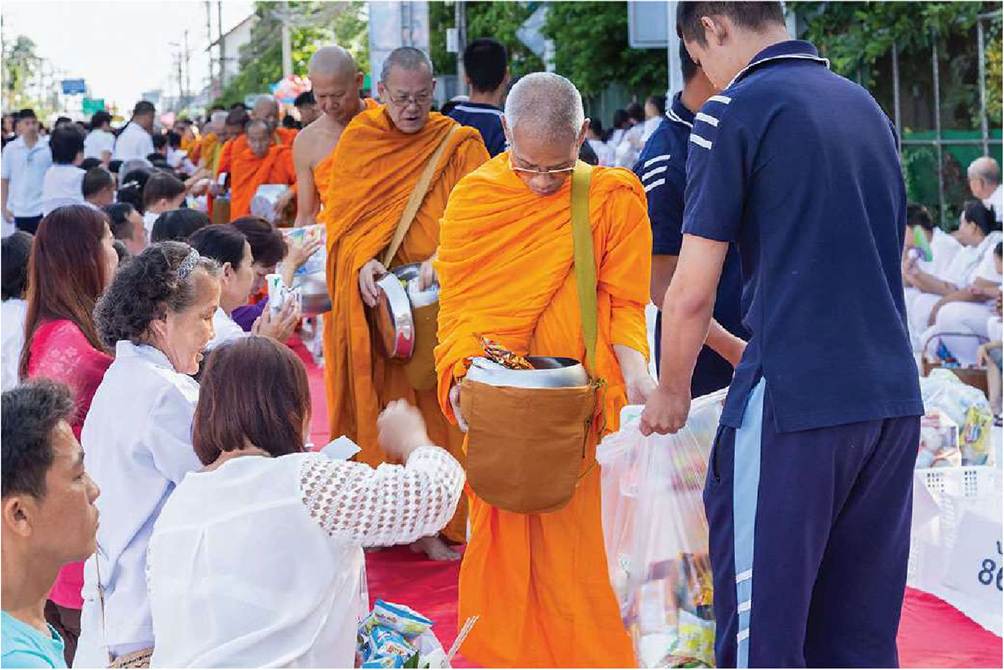
Buddhists offer alms to monks during a celebration of Vesak in Chiang Mai, Thailand.
TODAY IS VESAK Here in Chiang Mai, northern Thailand’s largest city, throngs of Thais and tourists crowd the streets and fill the city’s 300 Buddhist temples. This is a day to honor the Buddha, the Enlightened One, who learned great truths about the cause and cure for human suffering and taught them to the world. It is also a day for expressing gratitude to the order of Buddhist monks who have preserved the Dharma—the teachings of the Buddha—for twenty- five centuries. More than 1,500 monks will receive gifts of food and drink from thousands of laypeople during this celebration in Chiang Mai.
Vesak commemorates the birth, enlightenment, and death of the Buddha. According to tradition, all three occurred miraculously on the same day of the year, the full moon day of the lunar month of Visakha. On the Western calendar, this places Vesak sometime in May or, less frequently, in June.
Vesak is a time when Buddhists everywhere make a special effort to observe the ethical teachings of the Buddha. Many visit temples to hear sermons given by monks and leave offerings of flowers and candles. In Chiang Mai there is a special way of expressing devotion to the Buddha. At sunset on the day before Vesak, devotees light candles inside paper lanterns and set out on a nine-mile trek to the summit of a nearby mountain. Their destination is Wat Phrathart Doi Suthep, a famous temple that holds relics of the Buddha.
Once there, they circle three times around the temple’s Bhote chapel holding incense sticks and lotus buds. Then, at dawn, they make offerings for the support of the temple’s monks.According to an ancient story, as the Buddha lay dying, he told his disciples there was no reason to weep; his death would be in accordance with the impermanence of all things. They were welcome to honor him with offerings and devotions when he was gone, he said, but it would be more important to honor the Dharma and strive to follow its teachings. Like the Buddha’s disciples, those who understand the meaning of Vesak today honor the Enlightened One with simple expressions of devotion and their commitment to follow his teachings.
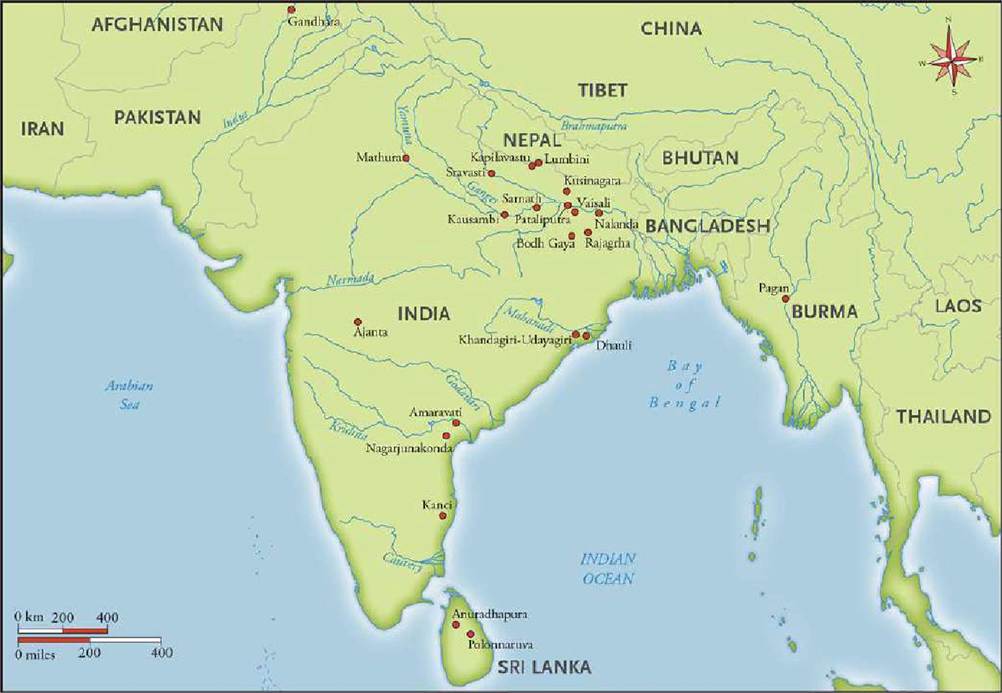
Significant sites of Early Buddhism.
Click here to learn more in an interactive map.
There are nearly 500 million Buddhists in the world today, about 7 percent of the global population.1 They belong to a vast number of Buddhist groups. These differ in important ways but all trace their origins back to the Buddha, our point of departure in this chapter. In this chapter we will examine the Buddha’s life and teachings, survey the history of Buddhism, and then take a look at important features of the Buddhist way of life.
TIMELINE
Buddhism
| c. 485-405 BCE | Life of the Buddha. |
| c. 405 bce | First Buddhist Council. |
| C. 305 BCE | Second Buddhist Council. |
| c. 272-231 BCE | Emperor Ashoka promotes Buddhism in India. |
| C. 250 BCE | Third Buddhist Council. |
| c. 247 BCE | Mahinda, a monk and son of Ashoka, brings Buddhism to Sri Lanka. |
| C. 25 BCE | First written text of Pali Canon produced in Sri Lanka. |
| c. 1-100 CE | Buddhism arrives in Central Asia and China. |
| 1-200 | Beginning of Mahayana Buddhism in India; composition of Lotus Sutra. |
| 300-400 | Buddhism arrives in Korea. |
| 300-500 | Beginning of Vajrayana Buddhism in India. |
| c.320-550 | Gupta Dynasty promotes Buddhism in India. |
| 400-450 | Bodhidharma, an Indian monk, brings Chan (Zen) Buddhism to China. |
| 552 | Buddhism arrives in Japan. |
| 600-800 | Buddhism arrives in Tibet. |
| c. 1100 | Construction of Angkor Wat in Cambodia. |
| c. 1200 | Muslim conquest brings virtual end to Buddhism in India. |
| c. 1800 | Western scholars begin to study Buddhism. |
| 1890-1921 | T. W. Rhys-Davids translates Buddhist texts into English. |
| 1893 | Buddhist leaders speak at World Parliament of Religions in Chicago. |
| 1959 | Tibet’s Dalai Lama flees to India. |
| 1970 | bgcolor=white>Development of Engaged Buddhism.
Click here to learn more in an interactive timeline.
Click here to compare other Chinese religions.
More on the topic 5 Buddhism:
- Vajrayana Buddhism: Tantric Buddhism in the Mahayana Tradition
- 41 Buddhism in China
- 44 Buddhism in Mongolia
- Buddhism Beyond India
- 42 Buddhism in Japan
- Buddhism in America
- Nicheren Buddhism and the New Religions
- Buddhism, Concord, and Conflict
- Mahayana Buddhism: The Great Vehicle
- The Early Introduction of Buddhism and Conflicts with the Native Religion
- Developments in Buddhism
- Buddhism as a Way of Life
- Buddhism in India
- Tibetan Buddhism or Lamaism