An Incoherent Contradiction
A history of the development of Religious Studies as a scientific enterprise in the modern university is an incoherent contradiction that reveals tensions between putative claims to academic status and the actual reality of continuing infiltrations of extrascientific agendas into the field.
Luther H. Martin and Donald Wiebe
A geological divide
‘ History of religions' is an academic label as ambiguous as any. The preposition ‘of', as Bruce Lincoln once remarked, ‘is not a neutral filler. Rather, it announces a proprietary claim and a relation of encompassment' (Lincoln 1996: 225). However, the relational nature of this non-impartial filler is not entirely clear. What does ‘of religions' really mean? Is history thought of as the main driver of religious phenomena (objective genitive)? Are ‘religions' supposed to provide the framework, the tools, the sense and the meaning of historical research (subjective genitive)? As anyone might guess, this is no linguistic trifle: the two meanings underlie two radically different approaches (see Table 1). Then again, a curious interlocutor - let us say, a prospective student - might feel prompted to ask, does the objective understanding of this not-so neutral label really differ from the study of religions as it is commonly practised in historiographical studies? Is the meaning implied by the subjective genitive all that different from theology? What's the point of having such a doppelganger of other disciplines? What are, then, if any, the main features of this weird academic discipline?
For all her doubts, our curious interlocutor might think that, after all, if such a discipline is part and parcel of the contemporary academic panorama, then it should also possess a precise disciplinary charter - which might look something like this. History of religions (HoR, henceforth) has been and still is usually conceived of as the study of religion (singular) and/or religions (plural) via comparative methods aimed at recovering and enhancing similarities (and, more rarely, differences) among religious beliefs and practices from the ancient past to the present day.
The discipline aims at gaining an insightful and precise classification of religious phenomena which, in turn, is supposed to enlighten the religious contents of human cultures from the first written documents to the newest religious movements, from the ethnographic accounts of bold nineteenth-century explorers to the religious vagaries of the Internet and theTable 1 History of what, exactly?
| Stress on | Method and theory | Adopted by | Theology | |
| Objective genitive | history | historical | Historicism | X |
| Subjective genitive | religion(s) | religious | P henomenology | ■/ |
spiritual, digital-age miscellanea available online. The available academic handbooks and the most important works from the past usually enlist a series of features deemed:
1. to strictly delimit and define the independence of the discipline from other apparently similar fields;
2. to point out the existence of a specific modus operandi;
3. to single out the major accomplishments and benefits deriving from the adoption of such m.o.
And yet, all of this is merely a facade. For all the relief and satisfaction that our curious interlocutor might experience, we should admit, for the sake of professional ethics, that the HoR has instead a rather convoluted history, and an even more complicated academic ID. When we look at the history of the discipline, we can notice that, quite astonishingly, a widespread, shared consensus among the researchers about the nature and scope of the HoR is difficult, if not impossible, to recognize. Indeed, the history of the discipline reveals that the grammatical divide between the objective and the subjective genitives runs like a geological fault across the field, with many shifts and cracks that stretch along the surface.
Therefore, in order to navigate this rugged and unstable landscape without getting lost, we could definitely use a map.Mapping the problematique
As Daniel L. Smail has aptly remarked, ‘metaphors do much of our thinking for us. Evoking whole fields of thought, they communicate complex ideas and images with extraordinary efficiency' (Smail 2008: 78). In our case, a metaphorical map can be exploited as a cognitive device by which a handy shortcut to highlight the main features that lie unseen is readily provided. The geological divide that characterizes metaphorically the disciplinary landscape is the result of historiographical tension and friction between the two forms of genitives implied in the label ‘history of religions'. As we will see in more detail shortly, during the twentieth century this tension climaxed in the objective genitive being adopted by historicism, while the subjective genitive had been mainly embraced by phenomenology (see Table 1). The various unsuccessful attempts to reconcile these two trends might be imagined as cracks that characterize the fault surface of our metaphorical map. Each one of those labyrinthine cracks implies a specific subset of points of view, ideas, issues and - most of all - problems.
By the juxtaposition of metaphor and reality, when we look at the fault zone depicted on our imaginary geological map, we can identify three main layers or discontinuities
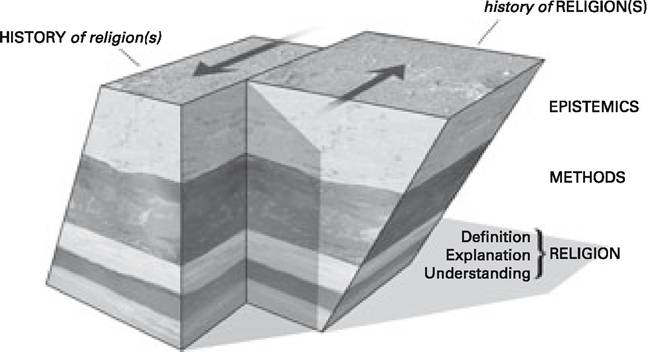
Figure 1 The disciplinary landscape: major issues in the history of religions visualized as a geological map
which represent what can be probably considered as the main issues of HoR qua discipline (see Figure 1):
1. As hinted at earlier, there has never been a disciplinary consensus on what the discipline should exactly be. In a recent volume, Swiss historian of religions Philippe Borgeaud has underscored that ‘history of religions is a branch of knowledge that has its own specificity, but it is a branch that presupposes a trans-disciplinary curiosity.
In fact, history of religions is dependent (among others) on history [...], philology [...], sociology, [...] ethnology and anthropology, [...], psychology' (Borgeaud 2013: 33-5). In one of the most remarkable accounts of the discipline from the first half of the 1960s, Mircea Eliade, possibly the most influential historian of religions of the past century, wrote that the ‘mission' of the HoR is indeed ‘to integrate the results of ethnology, psychology and sociology. Yet, in doing so, it will not renounce its own method of investigation or the viewpoint that specifically defines it' (Eliade 1964: xiii). To be fair, Eliade's statement may sound a bit confusing since it leaves our curious interlocutor wondering about what this specific ‘viewpoint' should be when so many different disciplines are involved. It is not just our interlocutor who happens to be confused, for the historians of religions themselves have had their fair share of hassles and headaches to figure out what this discipline should be about. In a remarkably comprehensive panorama of the whole history of the discipline published in 2010, Italian historian of religions Natale Spineto frankly admitted that HoR has an ‘uncertain epistemic foundation' and that, ‘indeed, the boundaries of the discipline are not very clear: depending on the disciplinary trend, it is possible to expand them to include substantially every field dedicated to the study of religion. Conversely, it is possible to narrow them to indicate a very restricted number of disciplinary schools of thought and perspectives' (Spineto 2010: 1256). This ‘epistemic patchwork' definition of HoR as a sort of Frankenstein discipline composed of many heterogeneous pieces, so to speak, is quite common and it is almost always highlighted as something necessary and useful for the wellbeing of the discipline.2. There has never been a shared disciplinary consensus on what the methods of the HoR should really be. Basically, there are as many methods as historians of religions.
‘History of religions', according to historian Ioan P. Culianu, ‘is almost never conceived of in the same way by two different scholars' (Culianu 1978: 18). Why is that? Basically, every major national school of HoR, more or less influenced by the presence of each pre-existing, locally predominant theological tradition, has developed independently a set of specific peculiarities and idiosyncratic features, so much so that the most important branches do not completely overlap in terms of methods and theories. For instance, according to one of the major encyclopaedic sources currently available on the HoR, German Religionswissenschaft is not quite the same as French histoire des religions, and the Italian storia delle religioni does not coincide exactly with the English history of religions (Casadio 2005a; cf. Wheeler-Barclay 2010: 247). Furthermore, there seems to be a lack of interest in resolving such issues. For instance, here is what Christian K. Wedemeyer wrote back in 2010: ‘For some, the study of religion today is precisely attractive because of its intellectual indeterminacy or, to give it a more respectable moniker, its “interdisciplinarity”' (Wedemeyer 2010: xxv). So, the fact that the historical study of religion is an autonomous branch of academia should be accepted at face value while abiding by the ‘intellectual indeterminacy' of its methods - which is something weird at best, reprehensible at worst, considering that such disciplinary identity is not the result of any epistemological reflection about cross-disciplinary integration (e.g. O'Rourke, Crowley and Gonnerman 2016). The result is something that, from an institutional point of view, might appear to fly in the face of any disciplinary acceptability.3. Finally, there has never been a disciplinary consensus on what religion is, must be, or should be. This final point might even be considered the root of all disciplinary evil, as it were, for it is the source of all confusion and problems. Most importantly, this is the reason why the HoR has served so many non-neutral, heterogeneous, and ideological purposes and aims, while losing epistemic momentum in endless discussions concerning definition, explanation and understanding (Penner and Yonan 1972).
In most of the major works of the past century, it is possible to find appreciative accounts of theological ideas; also, it is not uncommon to see the discipline hailed as the indispensable intellectual device by which the spiritual awakening of a new era could finally begin (von Stuckrad 2014: 113-77). In 1969, for instance, Eliade wrote that ‘by means of a competent hermeneutics [that is, the symbolic interpretation of religious contents from a religious perspective], history of religions ceases to be a museum of fossils, ruins, and obsolete mirabilia and becomes what it should have been from the beginning for any investigator: a series of “messages” waiting to be deciphered and understood' (Eliade 1984: 2). In this sense, comparison is used to postulate a universal belief in god(s) as the distinctive trait of humanity. Eliade also openly acknowledged HoR as a ‘saving discipline' with a remarkably religious tone (Eliade 1989a: 296, 2 March 1967). The method by which this salvation could be achieved is called ‘creative hermeneutics', triumphantly hailed as the ‘royal road of the history of religions' capable of leading its practitioners to the spiritual meaning behind and beyond historical events and, ultimately, to the renewal of human creativity (Eliade 1971: x). It goes without saying that those ‘messages' are supposed to help in unveiling a meta-theological, fideistic worldview (Juschka 2008), which inevitably blurs the boundary between academic, social, and scientific analysis and active advocacy for certain practices and beliefs. Indeed, a sympathetic perspective on such a controversial topic is not uncommon in the fields that study religion(s) (Stausberg 2014).As we will see in the next chapter, Eliade's idea highlights the kind of confusion between objective description and subjective redescription that is so typical of classical HoR. The consensus gentium, here intended as the agreement of peoples with regard to the ontological existence of a supernatural dimension, is exploited as the ultimate justification for the existence of the discipline. Which, as our curious and now a bit exhausted interlocutor might remark, is a bit like saying that, because people believed in sirens, there must be sirens somewhere and, therefore, something like a sirenological discipline - before having ascertained beyond any reasonable doubt the presence of sirens in the real world. There are sirens, indeed: the Sirenia, a group of marine mammals that includes manatees and dugongs, but I guess that this is not the mythological kind of sirens you might be thinking of. Moreover, as we will see in detail later on, this idea is fatally affected by the logical fallacy of the bandwagon effect (also known as argumentum ad populum), that is, ‘an argument that derives its force from the popularity of beliefs on which it is based' (Fellmeth and Horwitz 2009: 39; cf. Ambasciano 2015a). No matter how sincerely you might hope, believing in sirens, and sharing this belief with your family, friends, and colleagues, won't make them any more real than unicorns. If you replace sirens with things like ‘levitating shamans', there you have it: hermeneutical HoR in a nutshell (I have not made this up: there is indeed such a belief in the HoR; see Chapter 5).
Maps, compasses and bricks
All things considered, the preliminary survey of our imaginary geological map of the HoR reveals a fault zone at risk of earthquakes. The continuous friction between the rigid rocks which form the two sides of the fault has been building up a lot of stress within the very structure of the fault, which might be unexpectedly released as seismic activity. Under the umbrella term of HoR, ‘history' and ‘religion(s)' are in constant tension, with ‘religion(s)' exerting the most powerful and disruptive force (Lincoln 1996).
Now, if you are really living near an active fault, learning a bit of geological and scientific information will do you no harm and will surely empower your decisions, provided that the information you have is trustworthy. Here is what you should do.
First of all, a map without a compass is useless: learn to orientate yourself, sort out your sources and gather as much data as possible. Find out which are the most reliable and recent. Do your homework. It may turn out that, even though the fault is active, you can cope with it up to a certain extent. Depending on the seriousness of the situation, you might decide to build a better, earthquake-resistant, state-of-the-art designed house, or structurally reinforce the one in which you already live. You can opt for moving and relocating elsewhere, where institutional intervention has already invested in earthquake-resistant buildings or look for places where there is a lower seismic risk. Alternatively, should you be a stubborn denier of the import of such scientific research, you might also decide to ignore the Cassandras who cry wolf and keep on living where you live - at your own risk. As despicable as the latter choice might be, you might also feel drawn to active propaganda to deny that there is a serious geological risk, and that geologists are biased because of some inscrutable hidden agenda.
It is not difficult to see what these metaphors really imply: if HoR is the active fault, then knowledge comes from the history of the discipline (as well as from adjacent disciplines), the compass is the rational process of scientific enquiry, and the Cassandras are the updates from contemporary social and scientific research. Disciplinary denialism, finally, might be understood as the consequences of when ‘a well-entrenched belief system comes in conflict with scientific or historic reality, and the believers in this system decide to ignore or attack the facts that they do not want to accept' (Prothero 2013: 4). The problem is that HoR and the other disciplines that study religion(s) offer an overload of information usually characterized by a significant amount of noise. This complicated situation - and the possible way out - has been known to scholars since the very beginning of the discipline.
In 1912, psychologist James Leuba (1868-1946) concluded his volume entitled A Psychological Study of Religion, Its Origin, Function, and Future with an appendix that listed 48 interdisciplinary definitions of religions (actually, more than 50 because some entries included more than one definition) (Leuba 1912: 339-61). Leuba defined the rationale for his appendix as follows: ‘I trust that the perusal of these forty-eight definitions will not bewilder the reader, but that he will see in them a splendid illustration both of the versatility and the one-sidedness of the human mind in the description of a very complex yet unitary manifestation of life' (Leuba 1912: 339). More specifically, Leuba's intent was to offer what today we would call ‘supplementary data',
i. e. an additional corpus of data that served as the raw material upon which Leuba systematized four definitional super-categories. As reported in the second chapter of A Psychological Study of Religion, Leuba's arrangement of this array of disciplinary definitions consists of the following categories:
1. intellectual, a group encompassing definitions focused on metaphysics and natural theology;
2. emotional, including the ‘feeling of value' of the sacred;
3. relationary, with regard to ‘the consciousness of our practical relation to an invisible spiritual order';
4. biological, i.e. the ‘evolutionary and dynamic conception of mental life as opposed to the pre-Darwinian static conception' (resp., Leuba 1912: 29, 45, 38, 42).
Leuba decried the lack of definitional cogency and heuristic force of most definitions included in the first three categories (that is, the lack of convincing classification and explanatory advantage): ‘[a]lmost all of the definitions that have been reviewed attempt to say what religion is. According to them, it may be almost anything one pleases: a belief, a feeling, an idea, an attitude, a relation, even a faculty' (Leuba 1912: 42). The first three categories, Leuba continued, were ‘completely out of harmony' with the fourth class, the newest one, thought to provide the ‘most consequential change of point of view in contemporary psychology' (Leuba 1912: 42). Prefiguring Jeppe S. Jensen's interaction between e-religion ( external,i.e. social or individual behaviours) and i-religion (internal, i.e. mental mechanisms) (Jensen 2014: 1, 42), Leuba wrote that ‘in its objective aspect, active religion consists, then, of attitudes, practices, rites, ceremonies, institutions; in its subjective aspect, it consists of desires, emotions, and ideas, instigating and accompanying these objective manifestations' (Leuba 1912: 53; my emphasis). Finally, fully embracing a Darwinian perspective, Leuba concluded that ‘the reason for the existence of religion is not the objective truth of its conceptions, but its biological value. This value is to be estimated by its success in procuring not only the results expected by the worshipper, but also others, some of which are of great significance' - such as the pro-social and morally binding role of such beliefs as high gods (resp., Leuba 1912: 53 and 14; on Leuba's rationalist attitude, see Sharpe 1986: 104). As we will see in detail in the following chapters, Leuba's lucid recommendation was to remain a dead letter for decades.
Commenting on this list almost 80 years later, Jonathan Z. Smith - whose critical works had a groundbreaking impact on contemporary HoR and Religious Studies - has famously noted that religion is a
term created by scholars for their intellectual purposes and therefore it is theirs to define. It is a second-order, generic concept that plays the same role in establishing a disciplinary horizon that a concept such as ‘language' plays in linguistics and ‘culture' plays in anthropology. There can be no disciplined study of religion without such a horizon.
Smith 2004: 193-4
Smith did not mean that every definitional effort is equal to another one; like Leuba did before him, Smith considered epistemological evaluation and biology as paramount (Smith 2004: 19-25, 193). Unfortunately, Smith's comment has been used, and abused, to foster a social constructionism deprived of any link to human biology and cognition. Moreover, the lucid awareness or ‘self-consciousness of the researcher' hailed by Smith (Jensen 1993: 120) has been rarely cited as a universal glue for the discipline and, as a matter of fact, many of those interested in a self-conscious and epistemologically critical approach have migrated, as it were, to other, relatively new fields, i.e. Religious Studies (RS from now on)1 and Cognitive Science of Religion (CSR henceforth).
Indeed, critical proposals coming from a small minority of historians of religions, concerning a close re-examination of the most basic assumptions of the discipline from an epistemological perspective (Penner and Yonan 1972), paved the way for the very foundation of both RS and CSR. These two disciplines led the long-awaited conceptual deconstruction or reverse-engineering of the very tenets of classical HoR.
Notwithstanding their quite controversial relationship (see Arnal and McCutcheon 2013: 91-101), these disciplines at their core are much more similar than usually thought (cf. L. H. Martin 2014).2 They both have contributed to radically reconceptualize and reorganize the analytical toolbox in the wake of the recognition of the disunity of the concept of ‘religion’, which, as some CSR scholars claim, is composed of many building blocks, like a box full of Lego bricks, with each brick as a detachable unit having a different evolutionary provenance, function and structure (see Martin 2015: 127 for an ‘instructionless’ Lego set; cf. Taves 2009 and Barrett 2017). RS, in turn, has focused on the socio-political agendas which the very concepts of religion, as historically stratified and coercive tools to exert hegemonic control do convey and reinforce (e.g. Arnal and McCutcheon 2013: 27-30).
An updated current definition of what the concept of ‘religion’ is or, perhaps better, refers to, is provided by cognitive anthropologist Harvey Whitehouse:
arguably religion is not a single coherent entity but only a loose assemblage of patterns of thinking and behaviour that has been conceptualized very differently over time and across different language groups and cultural traditions. Recent research in the cognitive sciences suggests that many of the features commonly associated with the ‘religion’ label in Western scholarship and popular discourse are not the outcome of a single coherent cluster of causes but, rather, are the byproducts of disparate psychological systems that evolved to address very different kinds of problems.
Whitehouse 2013a: 363
Given their non-exclusive cognitive nature, each one of the components of the religious toolkit may be exploited for other non-religious purposes (e.g. ‘secular rituals’ such as national anthems, sports fanaticism, etc.), and actively co-opted as part of what Italian scholar Furio Jesi (1941-1980) called the mythological machine, i.e. the dynamic use of mythographical discourses to reproduce power structures and engender an institutional system of authority within an ‘imagined community’ (see Manera 2012; cf. Lincoln 2000, and Anderson 1991). What is panhuman is the ‘stickiness’ and reoccurrences of such mythological and societal structures. We will further explore these disciplines in the following chapters.
Sui generis crisis
The difference between the concept of religion as an instructionless, building-block, modular infrastructure and the tenets of classical HoR highlighted in the opening paragraphs could not be greater. Classical HoR was built around the concept that religion is a ‘thing’, that religion has a specific identity because it is an autonomous subject. Consequently, religion was thought to have an independent existence as a subject of enquiry. Therefore, religion could be compared across space and time and can be classified into smaller units. This is the so-called sui generis idea of ‘religion’, meaning that religion is conceptualized as belonging to a specific genus which, by virtue of its essential features, is ontologically not reducible to any other cultural, social, political or scientific taxonomic rank. This idea was not neutral or impartial; it had complex extra-epistemic reasons that, among other things, were the results of ideological and political strategies (Jensen and Geertz 1991). This is how RS scholar Russell T. McCutcheon has summarized the whole concept in a recent interview:
sui generis religion - i.e. unique, uncaused by something else, irreducible, one of a kind, pre-political, pre-social, the presumption that our object of study is a pristine experience that cannot quite be put into words; here ‘words' stands in for some kind of a contingent, historical, public thing that is somehow not fully capable of expressing the prior, interior, pre-political, unmediated experience.
McCutcheon 2014
Whenever this baffling circularity is openly endorsed as the main analytical tool for HoR, a constitutionally religious human being, or homo religiosus according to a fancy Latin label, provides nothing more and nothing less than a ‘model for a new natural theology', thus exiting a proper, non-confessional, empirical, epistemologically grounded research (Penner and Yonan 1972: 132). As some scholars have argued, this whole sui generis concept had been quite successful in supporting the modern establishment of HoR as an autonomous academic discipline in the United States and in Western academia during the Cold War, as the academically legitimized longa manus of anti-communist and pro-religious politics (e.g. McCutcheon 1997; Dolezalova, Martin and Papousek 2001; Arnal and McCutcheon 2013: 72-90).
As a result of this prevalent confessional aspect, it is unsurprising to note, as some historians of religions have highlighted themselves, that contemporary HoR is facing a profound epistemological and methodological crisis of identity (e.g. di Nola 1977a: 291-300; Sharpe 1988: 256; Lawson and McCauley 1993 in McCauley 2017: 53-73; Lincoln 2012; Martin and Wiebe 2016: 221-30). The way by which historians of religions arrive at their conclusions and the ideas that support those methods are increasingly under attack. While some historians of religions are really trying to update scientifically their own field, others are strenuously resisting any effort to update and improve their approaches.4 Resistance is strong, and some national schools are standing up against change more stubbornly than others, even when their pivotal tenets and central ideas seem to lack any sufficient support.
The arms race of natural theology
Probably, the most disturbing aspect to note at this point is that the future problems of the discipline were already present right from the start (cf. Wheeler-Barclay 2010). As the example of Leuba has shown, at the same time many exit strategies to escape from these issues have been devised over the course of the past centuries. This puzzle is the constant of the entire history of the history of religions and, in order to understand this situation, we have to contextualize the cognitive foundations of human reasoning within the scaffolding provided by the social history of science.
If ‘natural history is the careful observation of nature' which provided ‘the foundation for the discovery of evolution' (Travis 2009: 754), then the persistently confessional aspect of the sui generis approach of the HoR might be considered as something akin to natural theology, i.e. the identification of a creator, designer and (mostly) benevolent god thanks to intuitive reasoning and the observation of the living world (De Cruz and De Smedt 2015). In a sense, homo religiosus is but a folk-social and folk-psychological subset of a natural theology directed at proving the existence of such a god. Ironically, natural theology, in its efforts to accumulate a consistent encyclopaedia of natural knowledge, had been instrumental in the development of evolutionary theory. Even though the fine anatomical organization of such organs as the eye was incessantly hailed as proof of a creation by a caring, careful, designer god, the more natural theology strove to collect precise facts and elaborate complex classifications and explanations of the natural world, the wider the available knowledge that runs foul of any reductionist theological explanation became. Innumerable variations of optic organs apt to detect light and movement, from the more rudimentary to the most advanced, were being added as palaeontological research progressed. And, most of all, theodicy remained theologically challenging, to say the least (Ruse 2009; cf. Dawkins 1986).
Naturalist extraordinaire Charles R. Darwin (1809-1882), who in his youth had been enticed by the explanatory and confirmatory power of natural theology, grew sceptical until he renounced both natural religion and scriptural evidence in favour of an agnostic (and sometimes atheistic) scientific epistemology (Moore 1989; Pievani 2013a). In 1860, Darwin wrote explicitly in a letter to American botanist Asa Gray (1810-1888) that there was no rational way to cope with the problem of theodicy from within the perspective of natural theology:
but I own that I cannot see, as plainly as others do, & as I shd wish to do, evidence of design & beneficence on all sides of us. There seems to me too much misery in the world. I cannot persuade myself that a beneficent & omnipotent God would have designedly created the Ichneumonidce [a family of parasitoid wasps] with the express intention of their feeding within the living bodies of caterpillars, or that a cat should play with mice. Not believing this, I see no necessity in the belief that the eye was expressly designed.
Letter of Darwin to Asa Gray, 22 May 1860, Darwin Correspondence Project, DCP-LETT-2814
Likewise, as we shall explore in the third chapter, the Victorian intellectual arms race to explain the most astonishing details of the natural world as the results of a divine project, supported by what was considered as scriptural evidence, eventually led to the birth of evolutionary biology. The same process, characterized by the accumulation of evidence for justifying the existence of homo religiosus, led inevitably to a non- theological approach in the historical study of religion(s).
The analogy between natural theology and the history of the HoR ends here: while natural theology has been falsified as an untruthful epistemological enquiry and relegated to pseudoscientific neo-creationism (contra Roberts 2009), HoR is atypical in that, contrary to its predecessor (the Victorian science of religion which we will tackle
in the next chapter), it has been triumphantly accepted at the High Table of academia (Ginzburg 2010). In the process, HoR has also become a safe harbour for those natural theologians who work in the Humanities (Ambasciano 2014; Ambasciano 2015a; Ambasciano 2016a). This is, in a nutshell, the ‘incoherent contradiction' of the HoR (Martin and Wiebe 2016: 224). We will delve deeper into these topics in the following pages, and in the final chapter as well. Meanwhile, let me conclude by underscoring that a history of the HoR might be preliminarily framed as a mix of cyclical advance and regression in which counterintuitive, but trustworthy, scientific research vies for survival against cognitively intuitive, but fallacious, confessional approaches that are responsible for the ‘continuing infiltrations of extrascientific agendas into the field' (Martin and Wiebe 2016: 224). If we would want to simplify further this historiographical process, at the risk of losing the fine-grained texture of microscopic precision, we could say that every time a progressive, scientific movement concerned with natural approaches (i.e. scientific, psychologically and/or biologically based) gains momentum, a regressive reaction stops it, and so on, ad libitum, each time with unnatural responses (i.e. fideistic, theologically or spiritually based) replacing and neutralizing any previous scientific attempt. This apparently causes similar approaches and perspectives to recur repeatedly and recurrently. The HoR, if we want to return one last time to our metaphor, is a geological hotspot, an active fault zone where pro-science activists and anti-science denialists have fought almost incessantly about the nature, tempo and mode of geological risks themselves. And so far, thanks to the intuitive appeal of folk religion (McCauley 2011), anti-science denialists have had the upper hand, successfully repelling any pitch invasion from pro-science supporters. It is time for us to leave both our imaginary geological maps and our worn-out interlocutor and delve deeper into the unnatural history of HoR so that we can fully understand the legacy of the discipline.
12
More on the topic An Incoherent Contradiction:
- O’Connor and the ‘Second Contradiction'
- The social organism as the contradiction between society and personality
- Hume: No a priori proofs of matters of fact
- Contents
- The evolutional aspect of the social organism
- A Nooman of the Social Organism : monography / Volodymir Bekh ; ed. by Iryna Predborska. - Sumy : University book,2010. - 304 р., 2010
- Point of (k)no(w) return: The politics of the Eliadean HoR
- II slavery
- Chapter 24 From Meditation VI and from Objection ΓV and Reply Rene Descartes
- Consciousness
- SYMBOLIC ACTION: NATIONALIST OPPOSITION AND REGIME RESPONSE
- The Global, Cross-national Picture
- Education
- Humanitarian imperialists: empire, its abuses and its critics
- Law of Commerce, Commercial Law, Business Law
- What’s wrong with the torture memos?
- Conclusion
- Abstract
- Conclusion and recommendations
- Hallaq Wael B.. Law and Legal Theory in Classical and Medieval Islam. Routledge,2022. — 344 p., 2022