The Union of Hadiach
The original treaty was signed on 6 September 1658 near Hadiach by two commissioners of the king and commonwealth, and by Ivan Vyhovs'kyi, hetman of the Zaporozhian armies. The text was subsequently emended and ratified by the Polish-Lithuanian Diet in May 1659, although it continued to carry the original date.
The following excerpts are based on an unpublished translation by Andrew Pernal of the emended text.The Zaporozhian Army, being burdened by various oppression, took up its defense not out of its own free will, but out of necessity; since His Majesty [the king of Poland] has forgiven with His Fatherly Heart all that which took place during the turmoil and calls for unity, they [the Zaporozhians)... take part in this Commission and afterwards in common counsel to achieve a sincere agreement.
That the Old Greek [Orthodox! religion, the same one with which the Old Rus' joined the Crown of Poland, be retained by its own prerogatives and free exercise of church services, as far as the language of the Ruthenian nation extends.
To this Greek religion is granted the authority of freely erecting new churches, chapels, and monasteries as well as maintaining and repairing the old ones. With regard to the churches formerly founded for and properties [formerly donated to] the church of the Old Greek religion, these shall be retained by the Old Greeks, the Orthodox, and restored [to them]....
The [Orthodox] metropolitan of Kiev, the present one and his successors in the future, [together] with the four Orthodox bishops [from the Crown], [those] of Luts'k, L'viv, Przemysl, and Chelm, and the fifth from the Grand Duchy of Lithuania, [that] of Mstsislau, [and their successors in the future] shall sit in the Senate, according to their own order [of seniority], with such privileges and free vote as are enjoyed in the Senate by the Most Reverend Spiritual Lords of the Roman rite....
In the Palatinate of Kiev, senatorial dignities shall be conferred only upon nobles of the Greek rite; whereas, in the palatinates of Bratslav and Chernihiv, senatorial honors shall be conferred by alteration; thus, after the death of a senator of the Greek rite, he is succeeded by a senator of the Roman rite....
Also, in order that mutual affection may spread within the towns of the crown and the Grand Duchy of Lithuania, wherever churches of the Greek rite are to be found, the Roman [Catholic] burghers shall enjoy, equally with those of the Greek religion, common liberties and freedoms....
His Majesty and the estates of the crown grant permission for the building of an academy in Kiev, which is granted the same prerogatives and liberties as the academy of Cracow, only... that there be no professors, masters, [or] students of the Unitarian, Calvinist, [or] Lutheran sects. In order that [in the future] there be no occasion for altercation among the students. His Majesty shall command that all other schools which were [established] hitherto in Kiev be transferred elsewhere.
His Majesty, Our Gracious Lord, and the estates of the crown and the Grand Duchy of Lithuania also consent to [the establishment of] another academy, wherever a suitable place for it shall be found, which shall enjoy the same rights and liberties as the Kievan [academy].... Wherever this academy shall be set up, no other schools shall be founded there for all times.
Grammar schools, colleges, [other] schools, and printing houses, as many as will be necessary, shall be permitted to be established without difficulty....
Since the honorable Hetman and the Zaporozhian Army, [hitherto] separated from the commonwealth, are returning and renouncing all foreign protection.... security shall be provided [by an amnesty] to persons of all social positions, from the lowest to the highest [rank] and excluding no one;... in short, all those who served or are serving in any capacity under the honorable hetmans, both the former one and the one at present....
The entire commonwealth of the Polish, grand ducal Lithuanian, and Rus' nations, as well as the provinces belonging to them shall be restored as they existed before the war [of 1648]; that is, these three nations shall retain, as before the war, their own intact boundaries and liberties, and in accordance to the stipulation of the law, [their right to participate) in the councils, the courts, and the free elections of their lords, the kings of Poland and the grand dukes of Lithuania and Rus'. If, as a result of war with foreign states any agreement be reached that is detrimental to the boundaries or liberties of these nations, the above-named nations shall stand by their liberties as a commonwealth one and indivisible, without discord among themselves over the [differences between the two] faiths....
The Zaporozhian Army shall number ten thousand [men], or whatever [figure] the honorable Zaporozhian hetman shall enter in the register.
The mercenary army shall number thirty thousand [men], which just as the Zaporozhian [Army] shall remain under the command of this same Hetman. [The funds] appropriated for these troops shall come from the taxes voted at the Diet by the commonwealth [and levied] in the palatinates of Kiev, Bratslav, Chernihiv, and others.
The quarters for the Zaporozhian Army are assigned in the [same] palatinates and estates in which they were stationed before the war [of 1648]. All of the liberties granted to this Army by the charters of the most illustrious kings of Poland are confirmed: they [the Cossacks] shall retain their former liberties and practices....
No tenant of the estates of His Majesty or prefect, nor any hereditary or annuitant lord, nor their sub-prefects, officials, or any other servants shall collect, for whatever pretext, any taxes from Cossack farms, villages, towns, or homes. As [befits a] knightly people, [the Cossacks] shall be exempt from the heaviest and the lightest burdens [of taxation], including duties and tolls throughout the crown and the Grand Duchy of Lithuania.
Also, they shall be free [from the jurisdiction] of various courts of the prefects, tenants, lords, and [those of] their deputies, and be subject only to the jurisdiction of their own hetman of the Rus' armies. Moreover, the Cossacks shall be permitted to retain [such rights as the making of] all kinds of beverages, hunting on the land, fishing in the rivers, and other benefits according to [their] old customs....The honorable Hetman of the Rus' armies shall recommend to His Majesty as being worthy of [having conferred upon them] the coats of arms of nobility; all without difficulty shall be ennobled and accorded all the liberties [enjoyed] by the nobility [of the commonwealth].... one hundred [persons] shall be ennobled from each regiment.
No one shall lead any Polish, Lithuanian, or foreign armies [without the consent of the hetman) into the palatinates of Kiev, Bratslav, and Chernihiv. The mercenary troops, being under the command of the hetman of the Rus' armies, shall be supplied with provisions from the royal and church lands in the said palatinates, according to an ordinance [to be issued] by this same Rus' Hetman....
The three united nations shall endeavour, by all possible means, that there be free navigation on the Black Sea for the commonwealth.
Should His Tsarist Majesty [of Muscovy] refuse to return to the commonwealth the provinces [He occupied], and [should He] invade the commonwealth, then all the forces of the crown and the Grand Duchy of Lithuania, as well as the Rus' Zaporozhian armies under the command of their Hetman, shall unite and wage war [against the tsar].
Real estates, personal properties, crown lands, and sums of money confiscated from the nobles of the Rus' territories, even [from those] who served in the Zaporozhian Army and who at present are rejoining the fatherland, shall be returned [to them]....
[The hetman] shall not receive any legations from foreign states, and if any should arrive, he shall send them on to His Majesty.
To all property owners from both sides shall be afforded the possibility of safe return to and repossession of [their former holdings], including the [right of the secular] Roman-rite clergy to the bishoprics, parishes, canonries, rectories, and properties belonging to them that are located in the palatinates of Kiev, Bratslav. Chernihiv, and Podolia, as well as in the Grand Duchy of Lithuania, in Belarus, and Severia....
Since the hetman, the Zaporozhian Army, and the [hitherto] separated palatinates [from the commonwealth] are repudiating all protection of other foreign nations and are returning of their own free will as freemen to freemen, equals to equals, and honorable to honorable; therefore, for better security and for more certainty that this current agreement be adhered to, His Majesty and the commonwealth shall permit the Rus' natic treasurers, with the rank of senator.
their own chancellors, marshals, and
Ivan Vyhovs'kyi,
Hetman of the Zaporozhian armies, by his own hand, in the name of the entire army
Stanislaw Kazimierz Bieniewski, Castellan of Volhynia, Prefect of Bohuslav, Commissioner
Ludwik Kazimierz Jewlaszewski, Castellan of Smolensk, Commissioner
demands of the Cossack starshyna as well as to achieve peace among the region’s warring states.
Unfortunately for the plan’s proponents, the problem of the semi-independent Zaporozhian Cossacks was not resolved, since at best only a few of their elite might have been ennobled. Much more difficult to overcome was the heritage of animosity toward the Poles among broad segments of Ukraine’s population, who still remembered the wars of the Khmel'nyts'kyi period. Finally, the disenfranchised Zaporozhians distrusted Hetman Vyhovs'kyi and continued to look toward Muscovy, which in any case was not about to join the Hadiach confederation. Thus, the Union of Hadiach died a stillborn death.
Despite its failure, Hadiach warrants attention for two reasons. It was the last attempt to resolve the Ukrainian or Rus' problem as a whole within a Polish framework.
Moreover, it was used by later apologists for Poland as an example of the supposed tolerant nature of the Polish-Lithuanian Commonwealth. More important, Hadiach revealed how much less interested were the leading social strata in Ukraine in attaining independence for their homeland than in retaining or expanding their own social and political privileges within an existing state. If their own interests could not be furthered in Poland, then perhaps Muscovy might offer a better chance. In essence, the whole Period of Ruin in Ukrainian history can be viewed as a time when the Cossack starshyna continually shifted its allegiance from Poland to Muscovy and sometimes even to the Ottoman Empire in a desperate attempt to find a strong ally that would guarantee its leadership role within Ukrainian society. The starshyna was hampered in its efforts, however, by two forces: (1) the governments of Poland and Muscovy, each of which had its own preferences as to how ‘peripheral’ areas within its realm should be governed; and (2) the lower-echelon Cossacks from Zaporozhia and the peasants, who from the outset were opposed to the idea of replacing rule by a Polish or polonized Rus' aristocracy with rule by their ‘own,’ but a no less oppressive, Cossack aristocracy.Anarchy, ruin, and the division of Ukraine
During this era of continual civil war and foreign invasion, the Cossack starshyna had little effective control over events. The proposed Union of Hadiach, for instance, was viewed by Muscovy as a declaration of war, and in the spring of 1659 Tsar Aleksei sent an army of 100,000 troops to invade Ukraine. Although the Muscovites were defeated by a combined Polish-Tatar-Cossack force near Konotop (8 July 1659), Hetman Vyhov'kyi’s position was not improved. Revolts, especially on the Left Bank and in Zaporozhia, led by Cossacks who were discontent with the starshyna’s pro-Polish orientation resulted in the demise of Vyhovs'kyi in September 1659.
Following the Battle of Konotop in 1659, a new stalemate developed between Muscovy and Poland. What evolved was a situation whereby the Cossack state was divided between a Polish sphere of influence on the Right Bank and a Muscovite sphere of influence on the Left Bank (including Kiev and the region west of the city). Within each of these spheres, periods of cooperation were counterbalanced by periods of conflict involving various factions: the governments of Poland or Muscovy; the Cossack starshyna·, the lower-echelon Cossacks, led by the sich·, and the peasantry. There were efforts made by a few Cossack hetmans like Khmel'- nyts'kyi’s second son lurii Khmel'nyts'kyi (in office 1659-1663) and, especially, Petro Doroshenko (in office 1665-1676) to unify these diverse factions and to restore the prestige of the Cossack state that existed after the 1648 revolution, but none were successful.
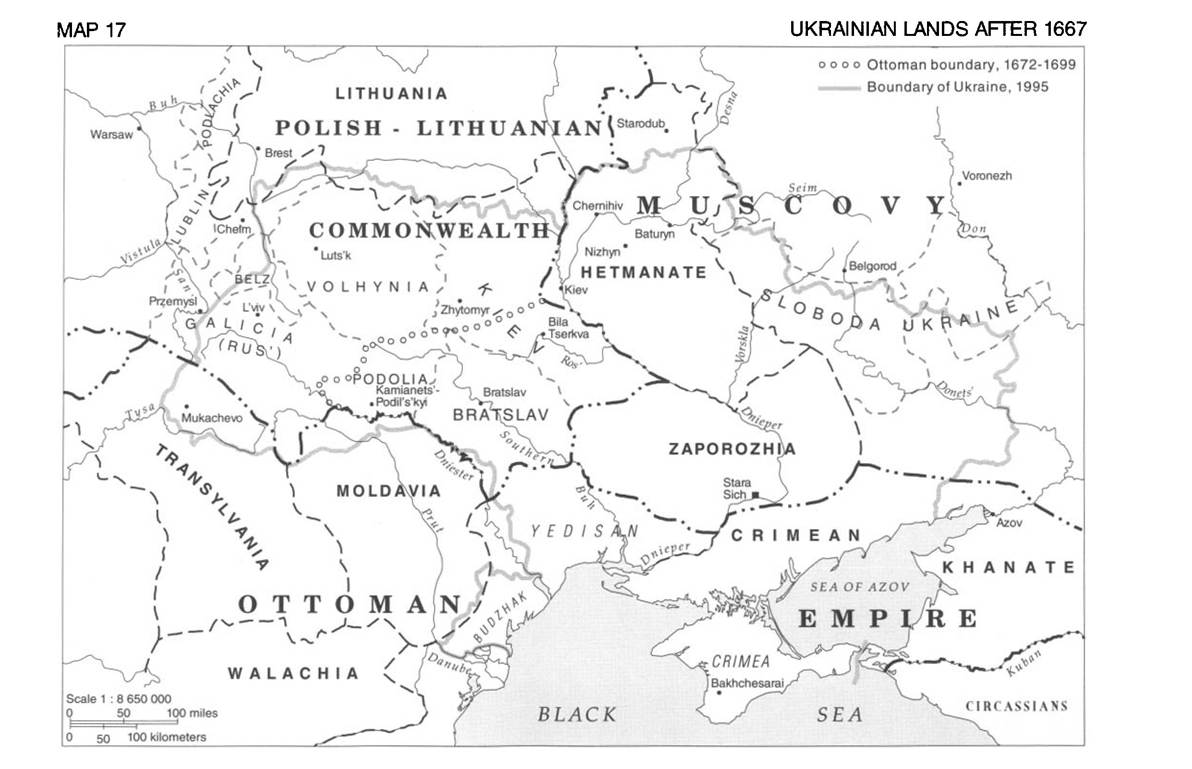
The possibility of an independent Ukrainian Cossack state became even more remote after Poland and Muscovy, exhausted by their inconclusive wars, decided to reach a modus vivendi. In 1667, both states signed the Treaty of Andrusovo, which was to last thirteen years and which delineated their de facto spheres of influence in Ukraine. In other words, Ukraine’s Right Bank went to Poland, its Left Bank to Muscovy. The city of Kiev was placed under Muscovite suzerainty for two years, although this initially temporary time period was extended. In the end, Ukraine’s capital would remain permanently within Muscovy. As for Zaporozhia, it was placed under the joint protection of Poland and Muscovy.
Within this new political constellation, Ukraine had two hetmans, one for the Polish Right Bank and one for the Muscovite Left Bank. The two hetmans often clashed with their own protectors - Poland and Muscovy - as well as with each other, especially when some dynamic leader tried to reunite both halves of Ukraine. The career of Hetman Petro Doroshenko epitomizes the confusion of the time. In 1665, he began as hetman in Poland’s Right Bank, but subsequently he turned against Poland, signed a treaty with the Ottoman Empire and the Crimea, and, in 1668, invaded Muscovy’s Left Bank. His pro-Turkish orientation - which revived a policy established two decades before by Bohdan Khmel'nyts'kyi - seemed to be the only policy that might bring some change in Ukraine’s status at a time when Muscovy and Poland preferred to remain at peace. Ukraine turned out to be the greatest loser, however, since an Ottoman army arrived and, with its Crimean allies, ravaged the Right Bank. Finally, after defeating Poland in 1672, the Ottomans annexed Podolia and placed the Bratslav and southern palatinates (on the Right Bank south of Zhytomyr) under their protection. Meanwhile, Doroshenko scrambled wildly, changing his allegiance several times among Poland, the Ottoman Empire, and, finally, Muscovy, where he was forced to settle (with honors) after his defeat and abdication from the hetmanate in 1676.
With the Ottomans in control of large parts of the Right Bank, Muscovy and Poland preferred to maintain peace with each other. In 1678, they renewed the Treaty of Andrusovo. Meanwhile, war continued, with Ottoman forces and local Cossacks on the Right Bank (Hetman lurii Khmel'nyts'kyi was made Prince of Ukraine, 1677-1681, by the Turks) pitted against a Muscovite army and local Cossacks on the Left Bank. In what seemed to be perpetual conflict, the peasants on the Right Bank, who had already begun to emigrate in large numbers while Doroshenko was still hetman, continued to flee eastward across the Dnieper River to the Left Bank and Sloboda Ukraine. Consequently, the Right Bank became largely deserted. Finally, in 1681 Muscovy and the Ottoman Empire signed a peace treaty (the Treaty of Bakhchesarai) whereby both parties agreed to a twenty-year armistice. Although the Ottomans continued to hold Podolia and Bratslav, they agreed that a buffer zone, or no-man’s-land without settlers, would be maintained in the heart of Ukrainian territory, that is, in eastern Bratslav and central and southern Kiev between the Southern Buh and Dnieper Rivers.
For its part, Poland could never acquiesce to Ottoman control of Podolia or any other part of what was considered the historical Polish patrimony. Moreover, Poland was now ruled by Jan Sobieski (reigned 1674-1696), famous for his successful defense of Vienna and crusade against the Ottoman Turks. Joined by Habsburg Austria, Venice, and the Papacy, Sobieski formed the so-called Holy Alliance against the Ottoman Empire. In order to continue his military ventures, he needed peace along Poland’s long eastern boundary. For this reason, in 1686 Poland agreed to abide by a new agreement with Muscovy. The pact became known as the ‘eternal peace’ and simply rendered more permanent the arrangement reached at Andrusovo in 1667. Poland renounced all claims to Left Bank Ukraine, as well as to Kiev, Starodub, and Smolensk, which had been retaken during the seventeenth century by Muscovy. Poland also acknowledged the supremacy of the tsar alone over the Cossacks in Zaporozhia, and it guaranteed all rights to the Orthodox Ukrainian population in its own sphere of influence on the Right Bank. Thus, by 1686 the two principal Christian states in eastern Europe, Poland and Muscovy, had agreed to a partitioning of Ukrainian territory more or less along the Dnieper River. The palatinates of Podolia, Bratslav, and southern Kiev were to remain in Ottoman Turkish hands until the end of the century, while the northern shores of the Black Sea continued as before under Crimean Tatar hegemony.
The Period of Ruin, which for Ukraine started in 1657 and ended three decades later with the signing of the so-called eternal peace in 1686, witnessed great changes in the political status of the country. The period began with Hetman Bohdan Khmel'nyts'kyi and his successors controlling most of Ukrainian territory. In their efforts to maintain autonomy, however, Khmel'nyts'kyi and his successors continually transferred their allegiance among Ukraine’s three powerful neighbors. The result, by 1686, was a Ukraine ravaged by civil war and foreign invasion, with little hope of independence or even full autonomy, and with its territory divided among Poland, Muscovy, and the Ottoman Empire.
More on the topic The Union of Hadiach:
- The Union of Hadiach
- The Union of Lublin (1569)
- Notes
- Index
- Selected Readings in English
- Michat Czajkowskfs Cossack Project During the Crimean War: An Analysis of Ideas
- Contents
- MAZEPA S CONTACTS WITH LESZCZYNSKI AND CHARLES XII
- Franciszek Duchinski and His Impact on Ukrainian Political Thought
- Index