Anorectal disease
Perianal discomfort is often caused by recurrent herpes simplex infection. The diagnosis should be confirmed by viral culture. Patient-initiated intermittent aciclovir can give adequate symptom control in some cases but many patients will require long-term maintenance therapy.
Resistance to both aciclovir and ganciclovir has been reported. Foscarnet is then the treatment of choice.Anal warts are common but rarely cause much in the way of symptoms and should be treated on merit given the absence of any effective antiviral therapy. Anal intraepithelial neoplasia has been described in association with human papillomavirus infection but reports of invasive malignancy are still infrequent.
Patients may present with a mucopurulent proctitis, possible causes of which include recently acquired or long-standing Neisseria gonorrhoeae or Chlamydia trachomatis infection.
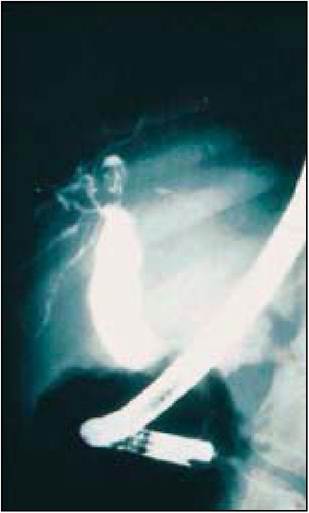
Figure 7.5 ERCP of AIDS sclerosing cholangitis with intrahepatic biliary tract distortion and dilatation of the common bile duct
Box 7.4 Differential diagnosis of liver disease
• Hepatitis or cholestasis
• M. avium-intracellulare complex
• Drug-induced
• Viral hepatitis
• Cytomegalovirus
• Mycobacterium tuberculosis
• Cryptococcus
• Microsporidia
• Lymphoma
• Kaposi's sarcoma
• Biliary disease
• Cryptosporidium
• Cytomegalovirus
• Microsporidia
• Lymphoma
• Kaposi's sarcoma
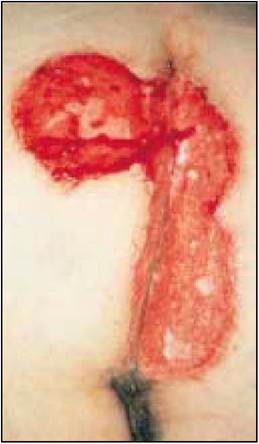
Figure 7.6 Aciclovir-resistant perianal herpes simplex infection
Neoplasia
Kaposi's sarcoma (KS) is commonly seen in the gastrointestinal tract and occurs in homosexual men more frequently than in patients from other risk groups. A new human herpes virus (HHV8) or Kaposi's sarcoma-associated herpes virus (KSHV) has been recently identified as a likely aetiological agent.
KS lesions in the gut have the range seen in the skin, from small telangiectatic lesions, not well shown on contrast studies and only seen at endoscopy, to larger nodular or polypoid lesions. Complications from gastrointestinal disease are unusual, but include ulceration, obstruction, haemorrhage, and diarrhoea.Lymphoma is much less common than KS however, although the incidence of KS has decreased along with the incidence of life-threatening opportunistic infections in association with the introduction of highly active antiretroviral therapy. The incidence of lymphoma has not been affected. HIV-associated lymphomas are usually high grade nonHodgkin's type, of B-cell origin. Extranodal involvement is typical and the gut is one of the commonest sites involved.
We thank Dr Wilfred Weinstein, UCLA Medical School, Los Angeles for providing the photograph of oesophageal candidiasis and Dr David Casemore, PHLS Glan Clwyd, North Wales for the electronmicrograph of cryptosporidium.
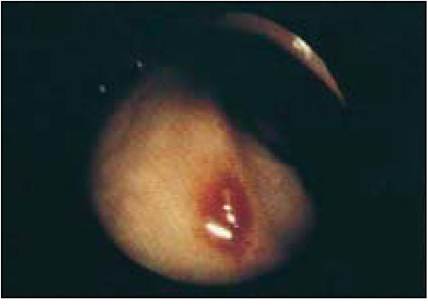
Figure 7.7 Discrete lesion of Kaposi's sarcoma in the rectum
8
More on the topic Anorectal disease:
- Anorectal physiology and function
- Inflammatory Bowel Disease
- Agrawal M.. Textbook of Pediatrics. 3rd ed. — CBS Publishers,2025. — 973 p., 2025
- Constipation and obstructive defecation
- CLINICAL EVALUATION OF GIT DISEASE
- ABDOMINAL MASS/LUMP
- Faecal incontinence
- CONGENITAL LUNG MALFORMATIONS
- Macrovascular Complications of Diabetes Mellitus
- Ectopic Hairs